The wrong floor in a healthcare or veterinary setting isn't just an eyesore — it's a liability. Here's how to choose one that actually holds up.
If you manage a medical clinic, veterinary practice, or animal wellness center, your floor takes a beating that most people never think about. Urine, blood, harsh disinfectants, constant foot traffic, and the occasional panicked animal — all before noon. And when the floor starts failing, it’s not just an aesthetic problem. It’s a compliance problem, a liability problem, and sometimes a patient safety problem.
Choosing the right flooring system for these environments is more nuanced than most contractors will tell you. Here are three things worth understanding before you make that call.
In a healthcare or animal wellness setting, grout lines are not a design choice — they’re a contamination point. Bacteria, urine, blood, and cleaning chemicals settle into tile grout and never fully come out, no matter how often the floor is cleaned. Over time, that buildup becomes a hygiene problem that no mop can fix.
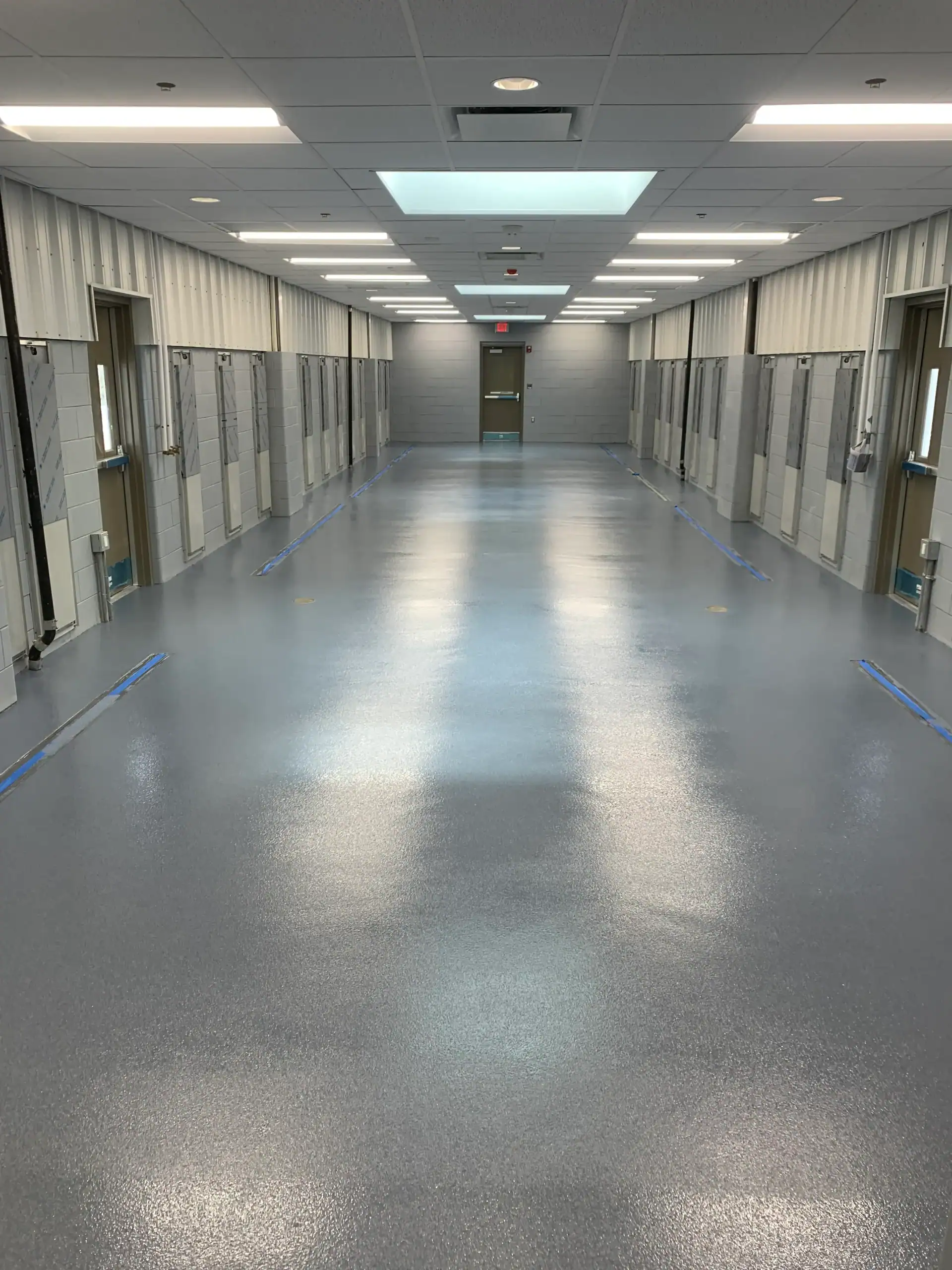
Seamless flooring systems — epoxy, cementitious urethane, or properly finished polished concrete — eliminate that problem entirely. The surface is monolithic, meaning there are no joints, seams, or crevices where pathogens can hide. That’s not marketing language. It’s the reason infection control guidelines consistently point to seamless surfaces as the standard of care in clinical environments.
It means the system was specified for the environment, not just installed in it. There’s a real difference between the epoxy you’d find at a big box store and an industrial-grade resinous system designed for a veterinary operating suite or a medical procedure room. The materials are different, the thickness is different, and the chemical resistance profile is entirely different.
A healthcare-grade epoxy system typically includes an antimicrobial additive that inhibits bacterial growth at the surface level, a chemical resistance profile that holds up to bleach, quaternary ammonium compounds, and the other heavy-duty disinfectants used in clinical settings, and a slip-resistance specification that meets real-world DCOF standards for wet areas — not just dry hallways.
One detail that often gets overlooked is the floor-to-wall junction. That corner where the floor meets the wall is one of the dirtiest spots in any clinical environment. A properly installed system brings the flooring material up the wall — typically four to six inches — creating what’s called an integral cove base. It seals that junction completely, so there’s nowhere for moisture, bacteria, or debris to accumulate. It’s a small detail that makes a significant difference during inspections and in day-to-day sanitation.
The compliance piece matters too. Healthcare facilities in Bohemia and across New York face scrutiny from the state Department of Health, and animal hospitals pursuing AAHA accreditation are held to strict facility standards. Flooring that meets ADA, OSHA, CDC, and FGI guidelines isn’t just good practice — it’s what keeps you on the right side of an inspection. Working with a contractor who can name those standards and explain how the system meets them is a meaningful differentiator from one who just shows up with a bucket of epoxy.
In the right zones, yes — and it’s underused. Polished concrete gets dismissed as an industrial look, but that’s a dated perception. When it’s properly ground, densified, and finished, polished concrete is seamless, non-porous, extremely durable, and easy to maintain. It doesn’t trap bacteria, it doesn’t harbor odors, and it holds up to daily cleaning without degrading.
Where it makes the most sense in a healthcare or animal wellness context is in lobbies, corridors, waiting areas, and administrative spaces — zones with heavy foot traffic but lower exposure to fluids and chemicals. In those areas, polished concrete can outperform vinyl tile on longevity, require less ongoing maintenance, and create a cleaner, more professional appearance than aging composite flooring.
The important distinction is that polished concrete is not a one-size-fits-all answer. Exam rooms, treatment areas, kennel runs, and surgical suites need a different system — typically a high-build epoxy or cementitious urethane with the antimicrobial and chemical resistance properties described above. The right approach is to think about the facility zone by zone, not as a single surface. A contractor who recommends the same product for every room regardless of what happens in that room isn’t giving you a specification — they’re giving you a sales pitch.
Concrete polishing also pairs well with facilities that have older slabs in decent structural condition. Rather than covering a serviceable concrete floor with material that will need replacing in five to seven years, grinding and polishing it creates a surface that can last decades with routine maintenance. For Bohemia and the surrounding commercial corridor, where many buildings were constructed in the 1970s through 1990s, that’s often a practical and cost-effective path forward.
Want live answers?
Connect with an Advanced Epoxy Flooring expert for fast, friendly support.
Most flooring failures in healthcare and veterinary facilities aren’t material failures. They’re installation failures. Specifically, they happen when surface preparation is rushed, when moisture isn’t tested before the system goes down, or when a contractor applies a product they don’t fully understand to an environment they’ve never worked in before.
The floor you end up with is only as good as the work that happens before the first coat is applied. That’s where the real difference between contractors shows up — not in the product name on the bucket.
Peeling epoxy is almost always a surface preparation failure. For epoxy to bond properly to concrete, the surface needs to be mechanically abraded — typically through diamond grinding — to create what’s called a concrete surface profile. This gives the epoxy something to grip. When that step is skipped or done inadequately, the bond is weak from day one, and the floor starts delaminating under the stress of real use.
The second most common cause of failure is moisture. Concrete slabs release moisture vapor over time, and if that vapor has nowhere to go, it builds pressure beneath the epoxy coating and eventually forces it off the surface. This is a particularly relevant issue for facilities in Bohemia and across Suffolk County, where Long Island’s coastal environment keeps humidity levels elevated year-round. Ground moisture and vapor transmission from older slabs are genuine challenges here — not theoretical ones.
The way to prevent it is straightforward but non-negotiable: we test for moisture before anything goes down. Moisture testing is a standard part of every installation we do, not an optional add-on. If the slab has a moisture issue, we address it first — whether that means a moisture mitigation barrier, a vapor-retarding primer, or additional prep work. Skipping that step to save time is how a three-year-old floor ends up looking like it’s fifteen.
For facilities in older commercial buildings — and there are plenty of them throughout Bohemia and the surrounding area — the concrete may also be uneven, cracked, or previously patched in ways that make direct epoxy application impractical. In those cases, a self-leveling underlayment is the right first step. These systems can be applied at varying thicknesses to create a smooth, flat base, and they’re walkable within a couple of hours. It adds a step, but it’s the difference between a floor that performs and one that doesn’t.
This is one of the first questions facility managers ask, and it’s the right one. Healthcare and veterinary facilities don’t have the luxury of shutting down for a week. Patients need to be seen, animals need to be cared for, and staff need somewhere to work.
The honest answer is that timeline depends on the system. Standard epoxy requires a multi-layer application — primer, base coat, topcoat — with cure time between each layer. The total process typically spans a few days, and the floor is ready for foot traffic within 24 to 72 hours after the final coat. For facilities that need a faster return to service, polyaspartic coatings are worth considering. They cure significantly faster than traditional epoxy and can handle foot traffic within hours of application.
For larger facilities, phased installation is usually the most practical approach. We work through the space in sections, keeping portions of the facility operational while the work moves through. It requires more coordination up front, but it’s far less disruptive than a full shutdown — and for most clinics and medical offices in Bohemia, that kind of scheduling flexibility is what makes a project actually workable.
One thing worth noting: a contractor who can’t give you a clear timeline or explain how they’ll manage disruption to your operations is a contractor who hasn’t done much work in active healthcare environments. This type of project requires planning, not just installation skill. The questions you ask before hiring someone are just as important as the product they’re putting down.
There’s no shortage of flooring contractors on Long Island. The difference is whether the one you hire understands what your facility actually demands — the compliance standards, the infection control requirements, the chemical exposure, the scheduling constraints, and the long-term cost of getting it wrong.
A floor that lasts 15 to 20 years in a demanding clinical environment looks very different from one that needs replacing in five. The gap between those outcomes usually comes down to who installed it and whether they knew what they were doing before they started.
We’ve been installing commercial and industrial flooring systems in Bohemia and across Long Island since 1990. If you’re planning a renovation, opening a new facility, or dealing with a floor that’s already showing signs of failure, we’re worth a conversation. We’ll tell you what system makes sense for your space — and what doesn’t.
Summary:
Article details:
Share: