Epoxy, urethane cement, polyaspartic — the options are real, and so are the differences. Here's how to choose the right system for your facility.

You’ve got a concrete floor that needs work. Maybe it’s cracking, dusting, or just not holding up to the traffic anymore. You search around, get a few quotes, and suddenly everyone is recommending something different — epoxy, polyaspartic, urethane cement, polymer coating. And somehow, each contractor is convinced their system is the only one worth using.
Here’s the truth: there’s no single “best” floor coating. The right system depends entirely on what your facility does, how it’s used, and what the concrete underneath is dealing with. If you manage a facility in Nassau County, this guide cuts through the noise so you can make an informed decision — and avoid paying for the wrong system twice.
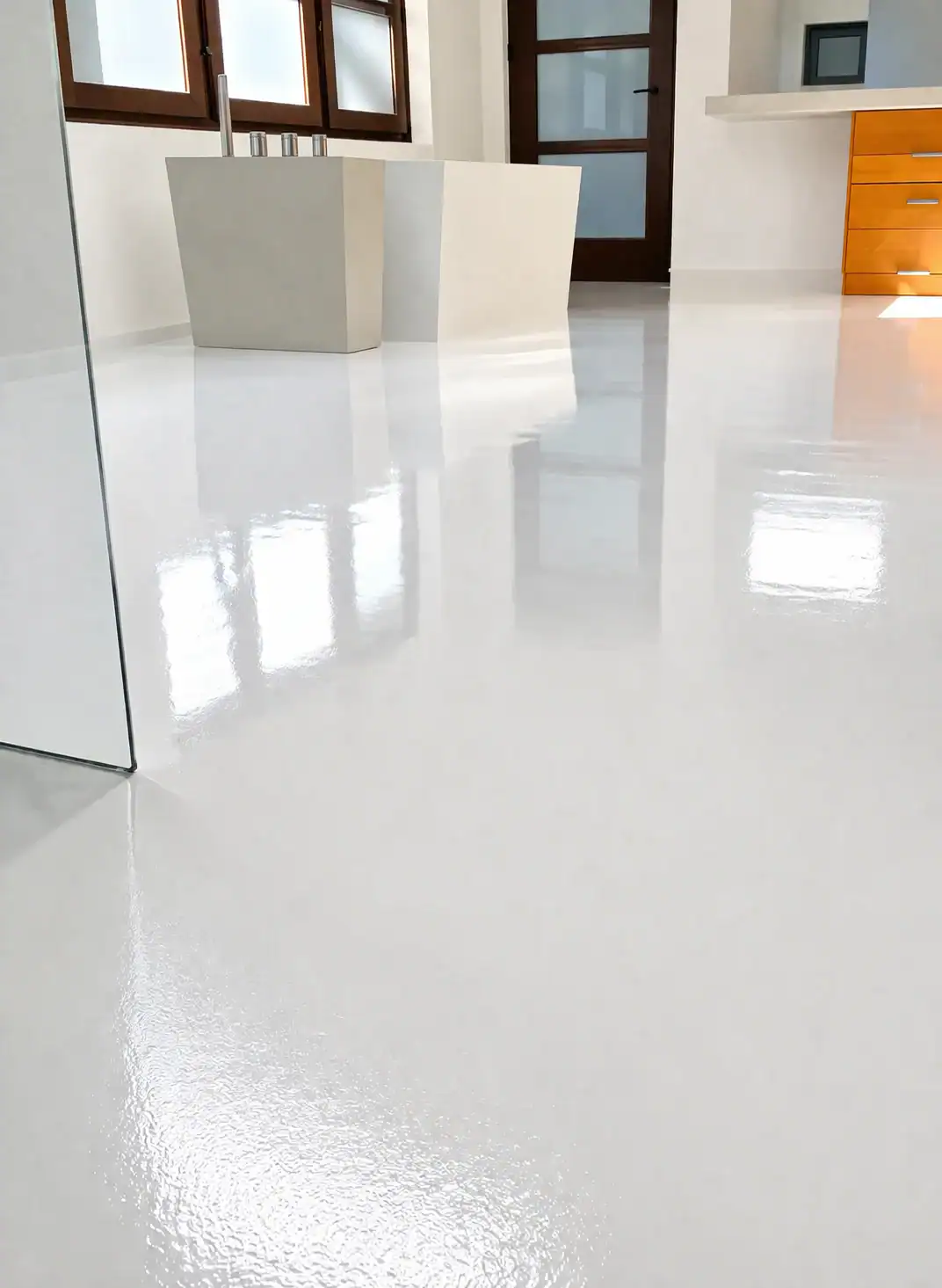
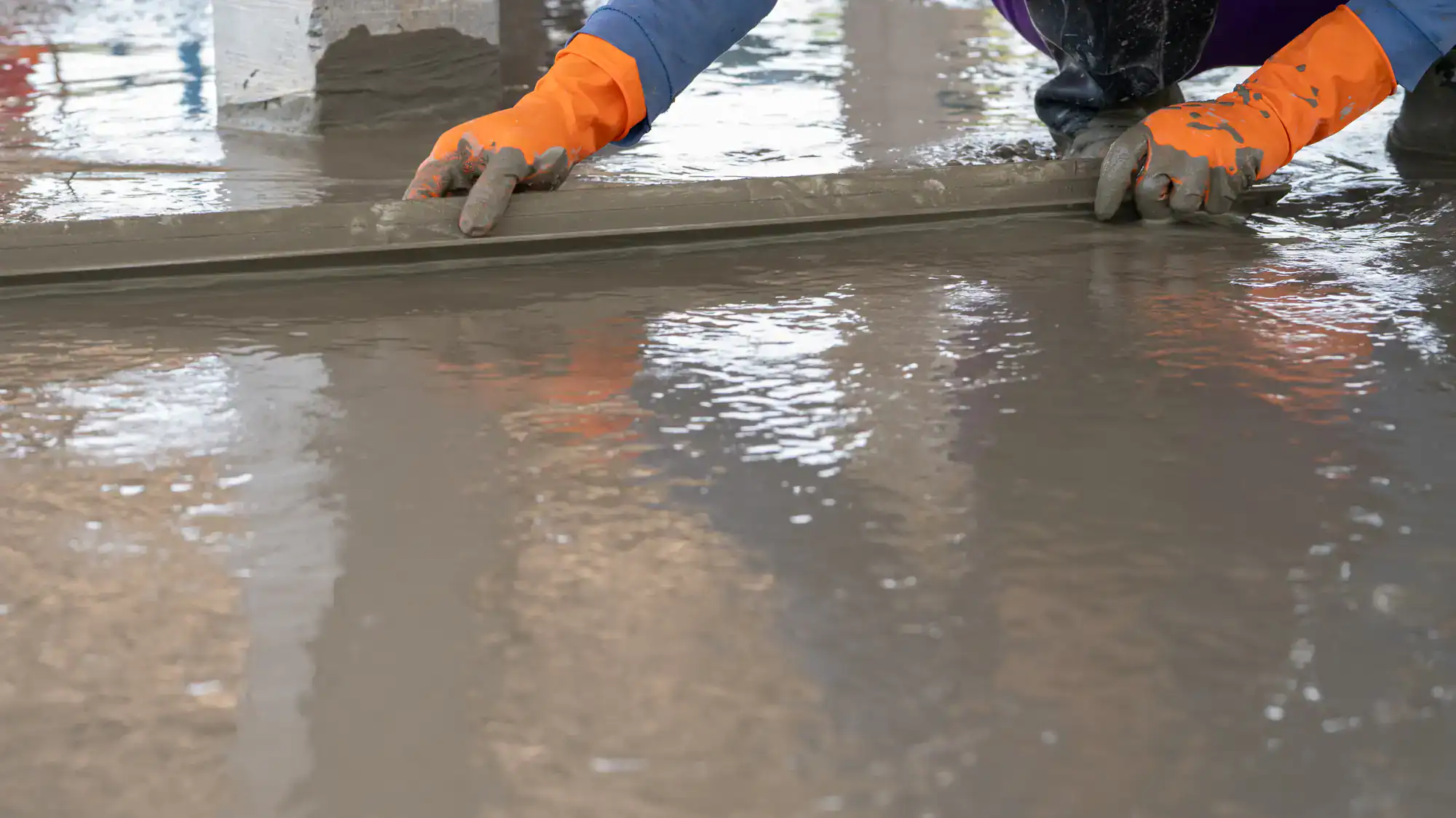
Commercial epoxy is a two-component resinous system — a resin and a hardener that chemically bond when mixed and applied to concrete. Once cured, it creates a dense, seamless surface that resists heavy traffic, chemicals, and moisture penetration in ways that paint, tile, or standard concrete sealers simply can’t match.
The key word is “commercial-grade.” There’s a meaningful difference between the 100% solids industrial epoxy systems we install in warehouses, healthcare facilities, and food service environments, and the diluted water-based products sold at big-box stores. Thickness, bond strength, and chemical resistance are all dramatically different. A properly installed commercial epoxy system can achieve bond strengths of 400–500 PSI — strong enough that the concrete itself fails before the coating does.
For high-traffic facilities across Nassau County — distribution centers near the I-495 corridor, automotive shops, retail spaces, school cafeterias — a well-specified commercial epoxy system installed over properly prepared concrete is one of the most durable flooring investments available.

Most people focus on the base coat when they think about epoxy flooring. But what goes on top is just as important — and often what determines how the floor holds up over time.
A polyaspartic top coat is a polyurethane-based finish coat applied over a cured epoxy base. It’s not a type of epoxy — it’s a chemically distinct product with some properties that standard epoxy doesn’t have. The two biggest ones are UV stability and cure speed. Standard epoxy yellows and dulls when exposed to sunlight or UV lighting. Polyaspartic doesn’t. For showroom floors, retail spaces, or any facility with significant natural light, that matters a lot more than it might seem on day one.
Cure speed is the other factor. A polyaspartic top coat can be walkable in as little as an hour, and ready for light vehicle traffic within a few hours. For a commercial facility that can’t afford extended downtime, that’s operationally significant. We’ve completed full commercial installations in Nassau County where the floor was ready for business within 24 to 48 hours of project start.
The combination of an epoxy base coat and a polyaspartic top coat is, in most cases, the strongest multi-layer system available for commercial environments. The epoxy base provides the thickness, bond strength, and chemical resistance. The polyaspartic top coat provides UV protection, scratch resistance, and fast return to service. Neither one alone does everything the combination does.
What this means practically: if a contractor is quoting you a polyaspartic-only system with no epoxy base, ask questions. Polyaspartic applied directly to concrete without a proper base coat is thinner and less forgiving of surface imperfections. It can work in certain applications, but in a heavy-duty commercial environment, the layered system almost always wins. We factory-train specifically for these multi-layer applications because the sequencing, timing, and product compatibility all have to be right.
Not all commercial epoxy systems are built the same. A standard commercial epoxy might be perfectly appropriate for a retail floor or office space. But a warehouse floor handling daily forklift traffic, a loading dock taking constant impact, or a manufacturing facility with chemical spills needs something specified for that load — what the industry calls a heavy-duty epoxy floor coating.
The difference shows up in a few ways. Film thickness is one — heavy-duty systems are applied in higher build coats, resulting in a thicker overall system that distributes impact load more effectively. Aggregate broadcast is another — broadcasting quartz or aluminum oxide into a wet epoxy coat creates a textured surface that improves both slip resistance and wear life. For facilities where OSHA slip resistance requirements apply, this isn’t optional.
There’s also the question of what the floor is being exposed to chemically. A standard epoxy formulation handles mild chemical exposure well. But if your facility uses aggressive cleaning agents, petroleum products, or industrial solvents on a regular basis, the epoxy formulation needs to be specifically rated for those exposures. This is exactly the kind of specification question that separates contractors who actually understand the science from those who install the same product in every building regardless of what happens inside it.
We’ve worked in Nassau County facilities ranging from automotive service bays in Hempstead to food distribution operations near the county’s industrial corridors. The floor specification we’d use for each of those is different — and it should be. Getting that wrong upfront is how you end up with a floor that looks fine at six months and starts failing at eighteen months. The goal is a system that’s still performing at year ten or fifteen, which is entirely achievable when the product is matched to the environment correctly.
Want live answers?
Connect with an Advanced Epoxy Flooring expert for fast, friendly support.
Urethane cement flooring — also called cementitious urethane — is the system that comes up whenever someone asks about commercial kitchens, food processing plants, or any environment with extreme temperature swings and frequent hot water washdowns. It’s not as widely known as epoxy, and there’s a reason for that: most contractors aren’t trained to install it.
Unlike standard epoxy, urethane cement is formulated to handle thermal shock — the rapid temperature cycling that happens when you steam-clean a floor or run hot washdown water across a surface that’s been sitting at ambient temperature. Standard epoxy becomes brittle under that kind of thermal stress and can crack or delaminate over time. Urethane cement flexes with it.
It’s also 2–3 times more abrasion-resistant than standard epoxy by industry testing standards, which matters in environments with constant foot traffic, rolling carts, and industrial cleaning equipment. For Nassau County food service operations — commercial kitchens, institutional dining facilities, school cafeterias — it’s often the right call, not epoxy.

Nassau County’s commercial kitchen operators deal with a specific set of regulatory and operational realities that make floor selection more consequential than it might be elsewhere. The Nassau County health department requires commercial kitchen floors to be smooth, non-absorbent, easily cleanable, and durable. That’s not a suggestion — it’s a code requirement that gets checked during inspections. A floor that’s cracking, pitting, or absorbing grease and moisture is a health code issue, not just a maintenance problem.
Urethane cement meets that standard directly. It’s seamless, which means no grout lines or joints where bacteria can accumulate. It’s non-porous, so spills, grease, and cleaning chemicals don’t penetrate the surface. And it handles the thermal cycling of commercial kitchen operations — steam, hot water, temperature swings between walk-in cooler proximity and cooking line heat — without the brittleness issues that standard epoxy can develop over time.
The installation process is more demanding than standard epoxy, which is part of why many contractors don’t offer it. Surface preparation still starts with diamond grinding, and moisture testing is still essential. But the mixing ratios, application thickness, and cure management for urethane cement require factory training and hands-on experience to get right. When it’s installed correctly, it’s one of the most durable floor systems available — with lifespans well beyond ten years in active commercial kitchen environments.
We’ve installed urethane cement systems in commercial kitchens throughout Nassau County, including facilities in Baldwin and along the county’s restaurant-dense corridors. The reason we push for the right system in the right environment — even when a standard epoxy quote would be simpler to write — is that the floor has to actually hold up. A kitchen floor that fails in three years costs far more in downtime and replacement than the price difference between systems ever would have.
“Polymer flooring” is a broad category, and it’s worth understanding what it actually means before you hear it in a sales conversation. Polymer is the chemistry class that epoxy, polyaspartic, polyurethane, and urethane cement all belong to — they’re all polymer-based systems. So when a contractor says they install “polymer flooring,” that could mean almost anything.
What most people mean when they use the term in a commercial context is a resinous, seamless floor coating system — as opposed to tile, vinyl, hardwood, or bare concrete. The category includes everything from thin decorative coatings to thick industrial mortar systems. The performance differences between the various polymer systems are significant, which is exactly why the conversation about which one is right for your facility matters so much.
In practical terms, the polymer flooring systems most relevant to Nassau County commercial and industrial facilities break down into a few categories. Standard commercial epoxy covers the broadest range of applications — warehouses, retail, schools, healthcare, automotive. Cementitious urethane handles the high-heat, high-washdown environments where standard epoxy struggles. Polyaspartic coatings provide UV stability and fast cure as either a standalone system for lower-demand applications or as a top coat over epoxy in more demanding ones. Polyurethane sealers and topcoats round out the category for applications where flexibility and chemical resistance are the priority.
The reason this matters is that Nassau County’s commercial building stock — much of it built in the mid-twentieth century — presents a range of concrete conditions that don’t all respond the same way to the same product. Older slabs in Hempstead or Massapequa often have decades of contamination history, more developed crack patterns, and moisture vapor conditions that newer construction doesn’t. The polymer system that works on a fresh slab in a new build-out isn’t necessarily the right call for a 1960s warehouse floor that’s been through fifty years of use. Diagnosing the concrete condition and matching the system to it is where the real expertise lives — and it’s something we’ve been doing on Long Island since 1990.
The short answer is: it depends on what your floor is actually dealing with. Commercial epoxy is the right call for most high-traffic facilities — it’s durable, chemical-resistant, and built to last. But if you’re running a commercial kitchen, a food processing operation, or anywhere with serious thermal cycling, urethane cement is the better system. And regardless of which base system you choose, a polyaspartic top coat is almost always worth it for UV stability and faster return to service.
What matters most is getting the specification right before any product touches your floor. Surface preparation, moisture testing, and honest system selection aren’t extras — they’re the difference between a floor that lasts fifteen years and one that needs replacing in three.
We’ve been working through exactly these decisions with Nassau County facility owners and managers for over 35 years. If you’re trying to figure out which system makes sense for your space, Advanced Epoxy Flooring is worth a conversation — no pressure, just a straight answer based on what your facility actually needs.
Summary:

Article details:
Share: