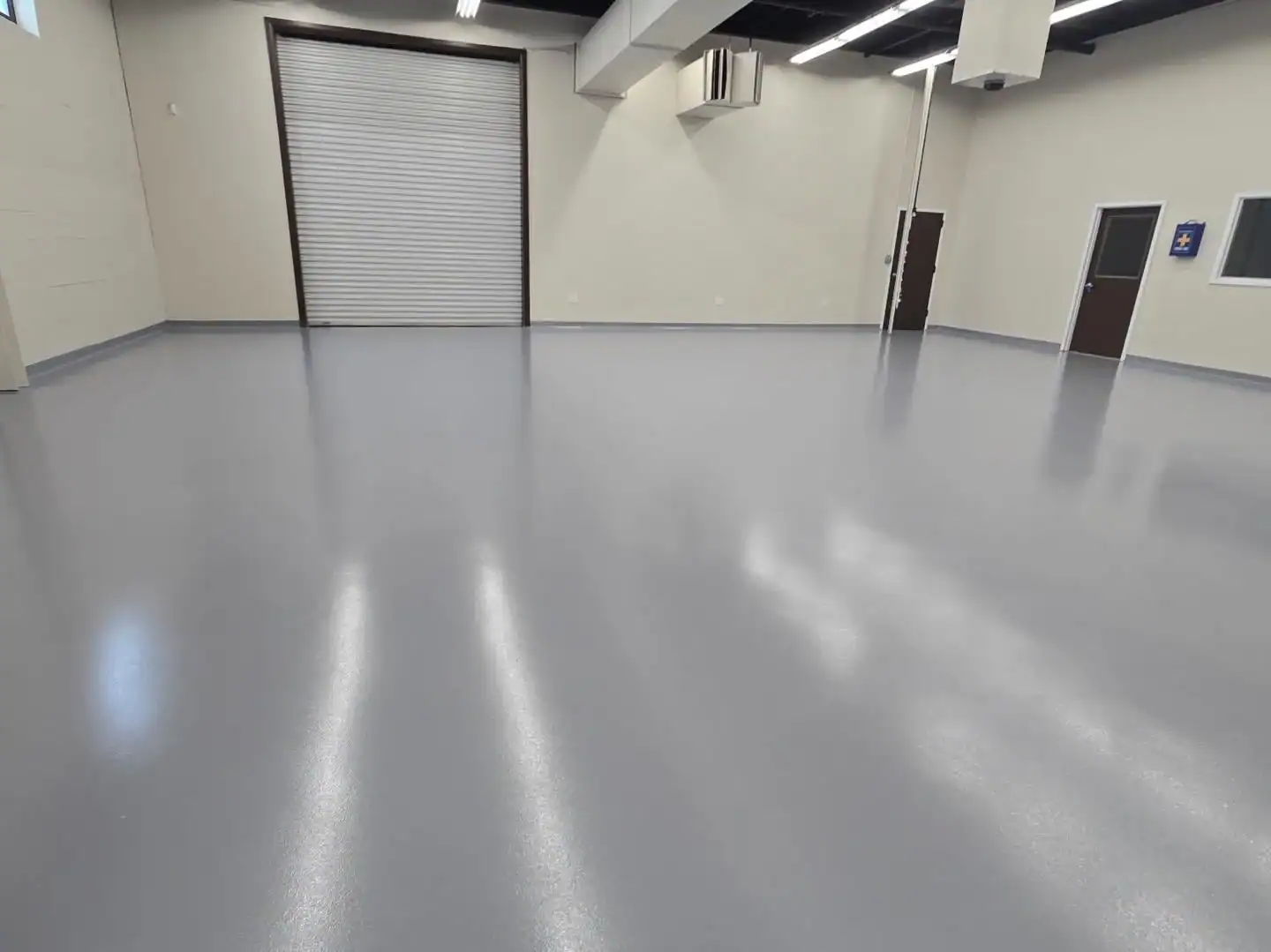
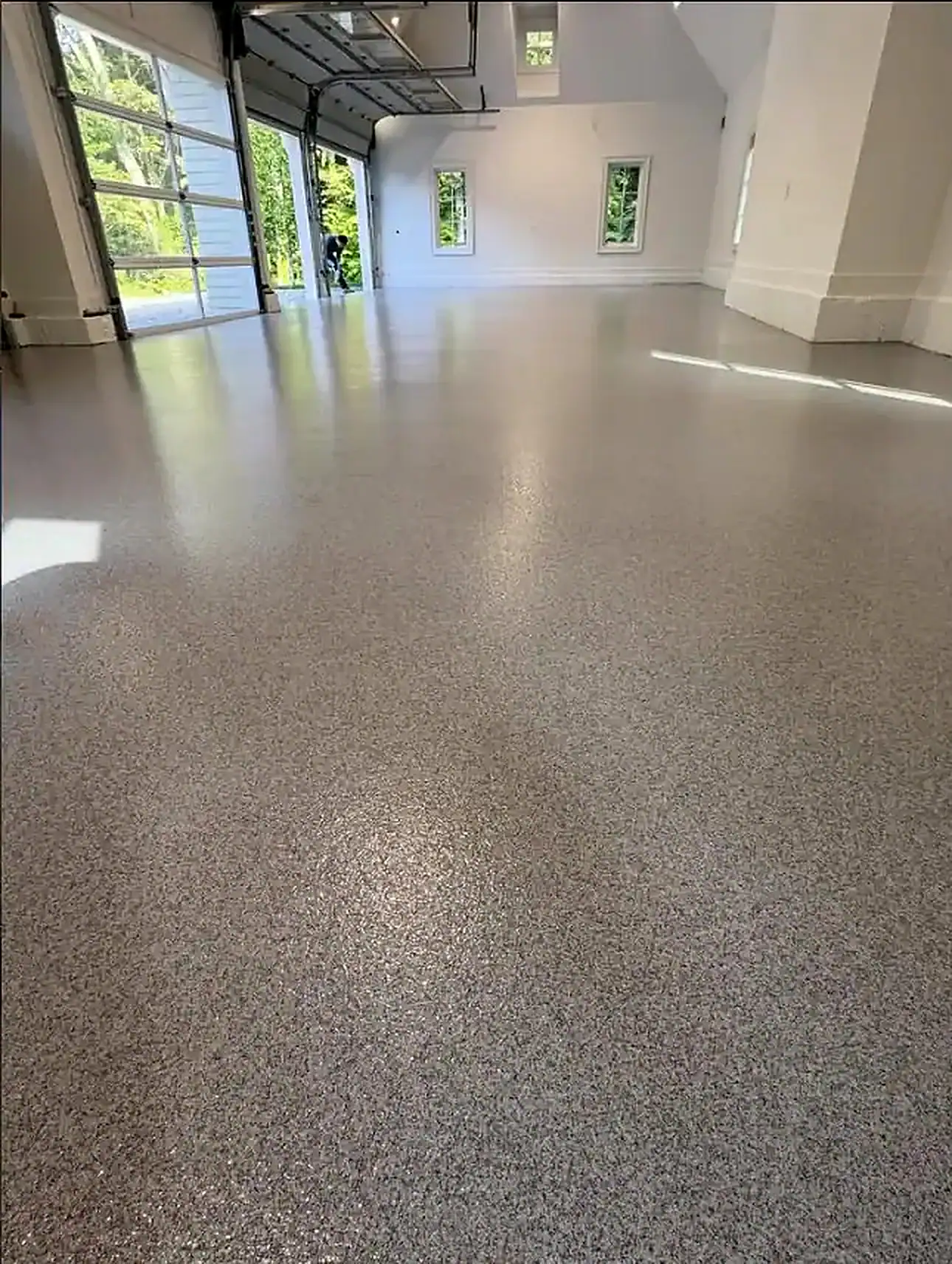
Before you choose between polished concrete and epoxy, there's one factor most contractors never mention — and it's the reason floors fail.
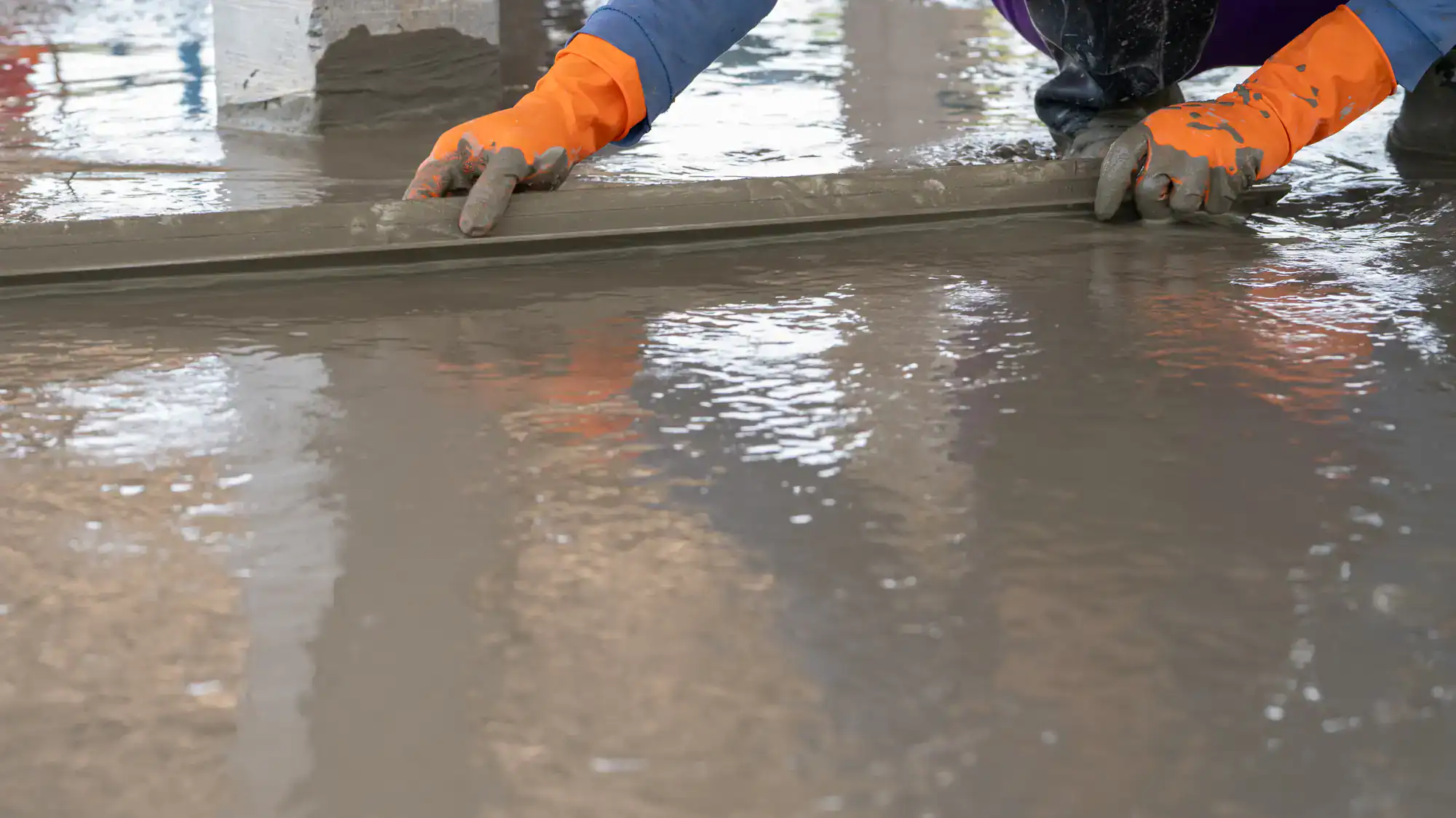
You’ve done the research. You know polished concrete looks sharp, epoxy is tough, and both are a serious upgrade from bare gray slab. What most guides won’t tell you — and what most contractors won’t bring up until after something goes wrong — is that moisture inside your concrete can make either option fail, regardless of how good the installation looks on day one.
This isn’t a scare tactic. It’s the reality of working with concrete in Nassau County, where the ground holds water, the air carries humidity off the Atlantic, and older slabs were poured without the vapor barriers we’d use today. Understanding the moisture factor before you choose a flooring system could save you the cost of doing the whole job twice.
Concrete looks solid, but it’s porous. Moisture vapor moves through it constantly — rising up from the soil, migrating through the slab, and eventually hitting whatever coating or surface treatment is sitting on top. When that coating is epoxy, which creates a sealed, non-porous barrier, any moisture trapped beneath it has nowhere to go. The pressure builds, the bond weakens, and eventually the floor blisters, bubbles, or peels away from the slab entirely.
Moisture-related problems account for roughly 38% of all flooring failures in the U.S., and it’s widely considered the single leading cause of floor covering system failure. The frustrating part is that a visually dry slab can still be pushing vapor upward at levels that will compromise an epoxy coating within months. You cannot see it, and you cannot assume.
Testing is the only way to know what you’re actually working with — and it should happen before any coating decision is made, not after.
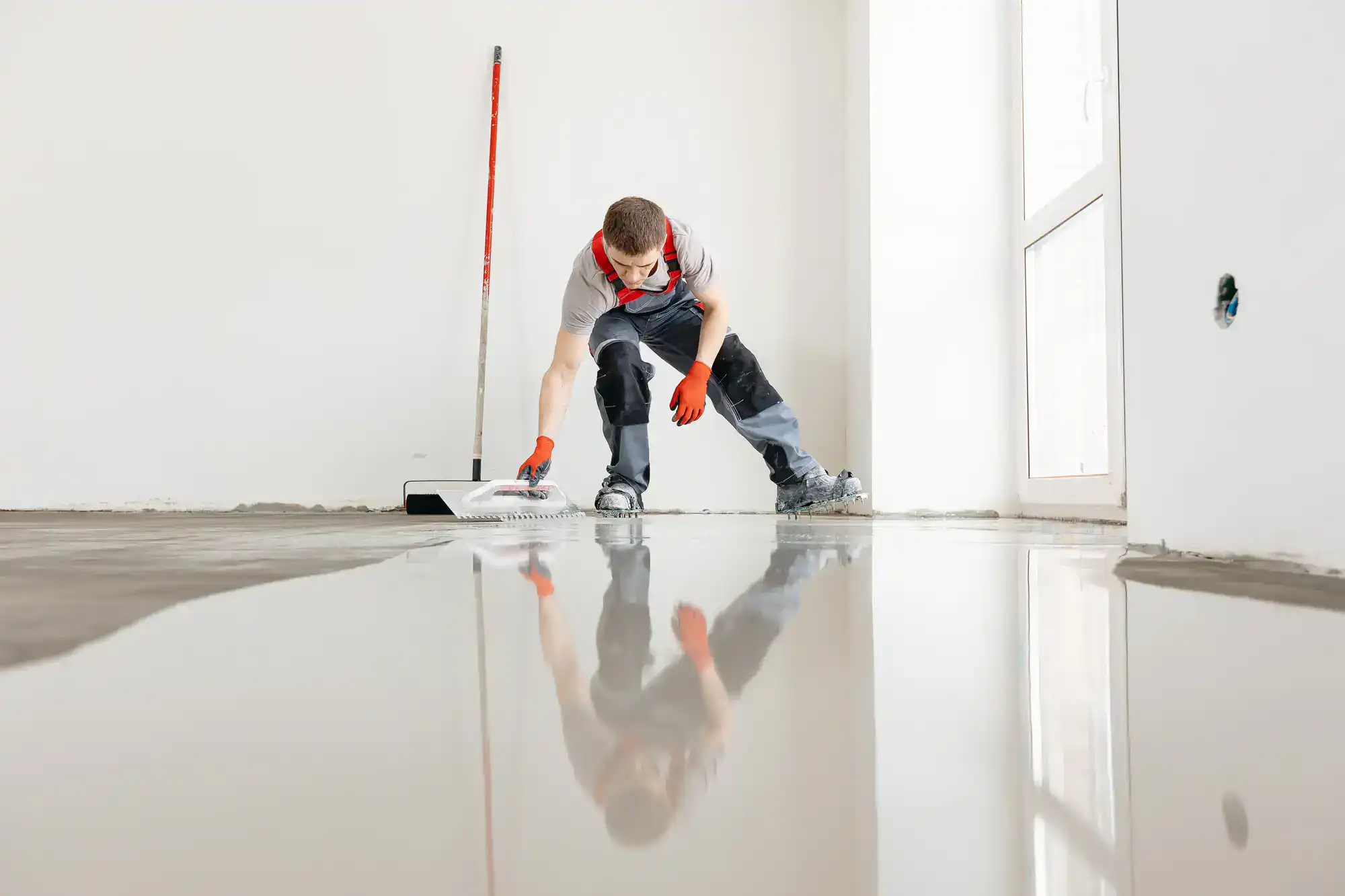
The calcium chloride moisture test — formally known as ASTM F1869 — is one of the two standard methods we use to assess concrete moisture before a flooring installation. The process involves grinding a small area of the slab down to bare concrete, placing a sealed plastic dome over a dish of anhydrous calcium chloride, and leaving it in place for 60 to 72 hours. When the dome is removed, the weight gain of the calcium chloride dish tells you how much moisture vapor moved through the surface during that window.
The result is expressed as pounds of moisture per 1,000 square feet per 24 hours. ASTM F710 sets the general threshold at 3 lbs or below for most flooring systems. Results above 5 lbs typically mean a moisture mitigation system is needed before any coating goes down — which adds roughly $1.50 to $3.00 per square foot to the project, but is far less expensive than a failed floor.
One important detail: the calcium chloride test requires specific ambient conditions to be valid. The space needs to be between 65°F and 75°F, with relative humidity between 40% and 60%, for at least 48 hours before and during the test. In Nassau County, summer humidity routinely runs 70 to 90 percent. Testing in those conditions without climate control produces unreliable results — which is why we always discuss site conditions before scheduling a moisture assessment.
The calcium chloride test measures vapor emission at the surface, which makes it useful but not complete on its own. It doesn’t tell you what’s happening deeper inside the slab, which brings us to the second method.
The in-situ relative humidity test — ASTM F2170 — goes deeper, literally. Small holes are drilled into the concrete at 40% of the slab’s total depth, probes are inserted, and they’re left to equilibrate for a minimum of 72 hours before a reading is taken. That 40% depth isn’t arbitrary. Research from the Technical University of Lund established that moisture at that depth represents the equilibrium level the surface will eventually reach once a floor covering is applied and the slab can no longer release vapor freely.
ASTM F2170 sets the general threshold at 75% relative humidity or below for most epoxy systems. Results above that threshold indicate a slab that is still actively releasing significant moisture — and applying a sealed coating over it is a gamble with predictable odds.
Most flooring manufacturers now recommend or require the in-situ RH test over the calcium chloride test alone, largely because it isn’t as sensitive to ambient temperature and humidity conditions in the building at the time of testing. For Nassau County, where those ambient conditions fluctuate significantly between seasons, that reliability matters.
Best practice is to run both tests simultaneously, along with a pH test of the concrete surface. Each one tells you something different. Together, they give you a complete picture of what the slab is doing — and what it’s going to do to whatever you put on top of it. We conduct all three as part of our standard pre-installation protocol, because a single test isn’t enough to make a confident call on a system that’s meant to last 10 to 20 years.
Want live answers?
Connect with an Advanced Epoxy Flooring expert for fast, friendly support.
Moisture testing is the diagnostic step. Surface preparation is where the installation either earns its longevity or quietly sets itself up to fail. Industry consensus puts surface prep at 70 to 80% of what determines whether an epoxy floor holds up over time — and the method used to prepare the surface is one of the clearest indicators of whether a contractor knows what they’re doing.
The professional standard is diamond grinding. It removes surface contaminants, opens the pores of the concrete to accept the coating, and creates a consistent surface profile that allows epoxy to bond at a mechanical level. Acid etching is cheaper and faster, but it produces inconsistent results, can leave chemical residue that interferes with adhesion, and is not appropriate for commercial or industrial applications. If a contractor proposes acid etching for anything beyond a light residential job, that’s worth asking about.
The average single-family home in Nassau County is approximately 73 years old. A lot of those homes were built during the postwar suburban expansion of the late 1940s through the 1960s, when vapor barriers under concrete slabs were either minimal or nonexistent. The ones that were installed have often degraded over the decades. What that means practically is that a large portion of Nassau County’s residential and commercial slabs are sitting on soil with no meaningful barrier between the ground moisture and the concrete above it.
Add to that Nassau County’s geography. The South Shore communities — Long Beach, Freeport, Oceanside, Massapequa, Merrick, Valley Stream, Wantagh, Baldwin — sit on barrier islands and low-lying coastal terrain with documented elevated water tables. Hydrostatic pressure in these areas pushes moisture upward through slabs regardless of surface conditions. A floor that looks and feels dry in a Freeport garage or an Oceanside commercial space may still be emitting moisture vapor at levels that will destroy an epoxy coating within a year.
The North Shore isn’t exempt either. Proximity to Long Island Sound means year-round marine humidity, and the freeze-thaw cycles that Nassau County experiences every winter create micro-fractures in concrete over time — small pathways that accelerate moisture vapor transmission as the slab ages. Road salt compounds the problem in garages and ground-level commercial spaces, where chloride ions penetrate the surface and affect both the concrete’s structural integrity and its pH balance, which matters for coating adhesion.
None of this means epoxy is the wrong choice for Nassau County properties. It means the preparation work has to match the conditions — and that skipping moisture testing here carries more risk than it would in a drier, inland market.
This is the question most people are really asking when they start comparing the two options, and the honest answer is that they handle moisture in fundamentally different ways — neither is universally better, but one may be significantly better for your specific slab.
Polished concrete is a mechanical process. Diamond tooling refines the surface through progressively finer grits, a chemical densifier is applied to harden and seal the concrete itself, and the result is a surface that has been transformed rather than coated. Because polished concrete doesn’t create a sealed barrier on top of the slab, moisture vapor can continue to move through it without building up pressure. The densifier actually reduces vapor transmission over time. For slabs with elevated moisture that can’t be fully mitigated, polished concrete is often the more forgiving long-term option.
Epoxy creates a sealed, non-porous surface — which is exactly what makes it so durable, chemical-resistant, and hygienic in commercial environments. But that same impermeability means any moisture vapor that reaches the underside of the coating has nowhere to go. When moisture levels exceed what the system is rated for, the coating delaminates. It’s not a product defect and it’s not an installation error in isolation — it’s a physics problem that proper testing and system selection are designed to prevent.
The right choice depends on what your slab is actually doing. A properly tested slab with acceptable moisture levels can support a long-lasting epoxy system — and in environments like commercial kitchens, healthcare facilities, automotive shops, and food service spaces, epoxy’s chemical resistance and seamless surface make it the stronger option. A slab with elevated moisture may need either a moisture mitigation layer beneath the epoxy, or a shift toward polished concrete if the application allows it. We’ve been working through exactly this kind of decision with Nassau and Suffolk County clients for 35 years, and the answer is rarely one-size-fits-all.
Concrete floor polishing and epoxy are both excellent systems when they’re matched to the right conditions. The problem isn’t the products — it’s the shortcuts that happen before they’re applied. Skipping moisture testing, using the wrong prep method, or choosing a system based on aesthetics alone rather than what the slab can actually support are the decisions that lead to floors that look great for six months and fail before the second winter.
Nassau County’s combination of older building stock, coastal water tables, marine humidity, and freeze-thaw cycles makes moisture assessment more important here than in most markets. That’s not a reason to hesitate — it’s a reason to ask the right questions before you commit to anything.
If you’re weighing your options for a garage, a commercial kitchen, a warehouse floor, or any other space in Nassau County, we’ve been doing this work on Long Island since 1990. Reach out and we’ll start with an honest conversation about what your slab actually needs.
Summary:
Article details:
Share: