
When the leveling is done right, the floor covering you chose actually performs the way it’s supposed to. Large-format tile sits flat without lippage. Luxury vinyl plank doesn’t flex, click, or separate at the seams. The renovation you invested in looks the way it was supposed to look and stays that way.
In Oceanside, that outcome requires more than just pouring a bag of self leveling compound and calling it done. Over 82% of the housing stock here was built before 1960, much of it on land that was marshland before it was developed. Decades of uneven ground settlement leave concrete slabs with dips, humps, and surface shifts that modern flooring simply can’t bridge on its own. The correction has to happen at the slab level first.
Moisture is the other factor that separates a floor that lasts from one that fails within a year. Oceanside sits at 10 feet of elevation with a groundwater table that’s close to the surface year-round not just after a storm. That means vapor is moving up through your slab constantly, and if no one tests for it before the leveling compound goes down, you’re building on a problem that hasn’t been solved. The right process accounts for that before anything else.
We’ve been doing this work on Long Island for over 30 years, with deep roots in Oceanside and across the South Shore. Danny Harmer, our president, has more than 40 years of hands-on installation experience and he still runs the operation the way it was built: no subcontracting the hard parts, no handing off prep to one crew and finish to another. When you hire us, one accountable team handles the job from moisture testing to final surface.
That matters in a place like Oceanside. The South Shore environment the tidal exposure, the coastal flooding history, the older building stock along corridors like Long Beach Road and Merrick Road creates conditions that a generalist crew won’t catch until something goes wrong. We’ve been working in Nassau County long enough to know what those conditions look like in the field, not just on paper.
Our crew is OSHA 40 certified, factory-trained in advanced resinous systems, and most have been with us for over a decade. We’ve installed floors across the country including the White House kitchen in 1996. The work in Oceanside gets the same standard.
The first thing that happens on any job in Oceanside is a real assessment of the slab. That means moisture testing ASTM F2170 relative humidity testing and moisture vapor emission rate measurement before any product is selected or applied. In a community built at this elevation, on this type of ground, skipping that step isn’t a shortcut. It’s a setup for failure. The compound has to be matched to what the slab is actually doing, not just what it looks like on the surface.
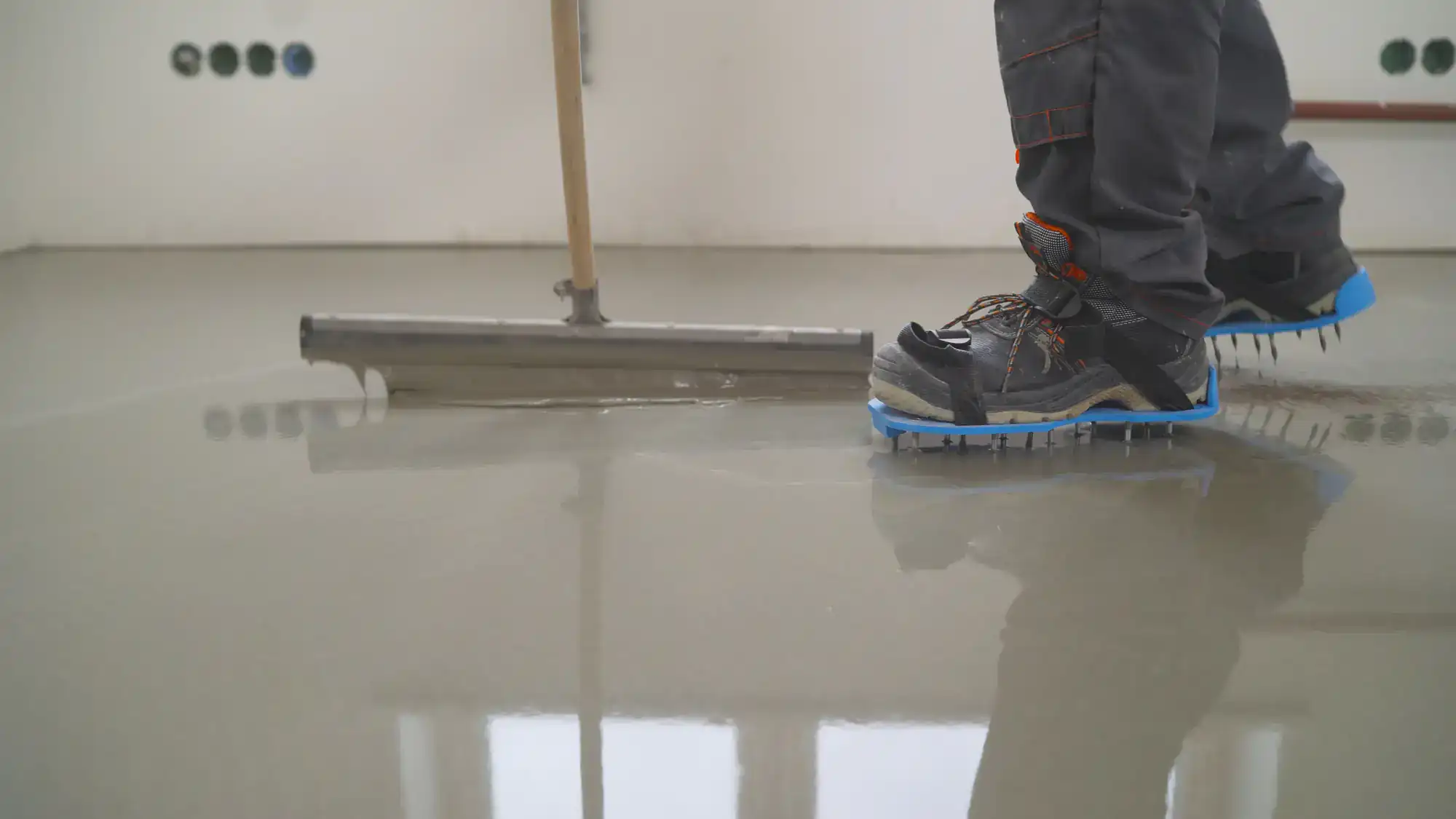
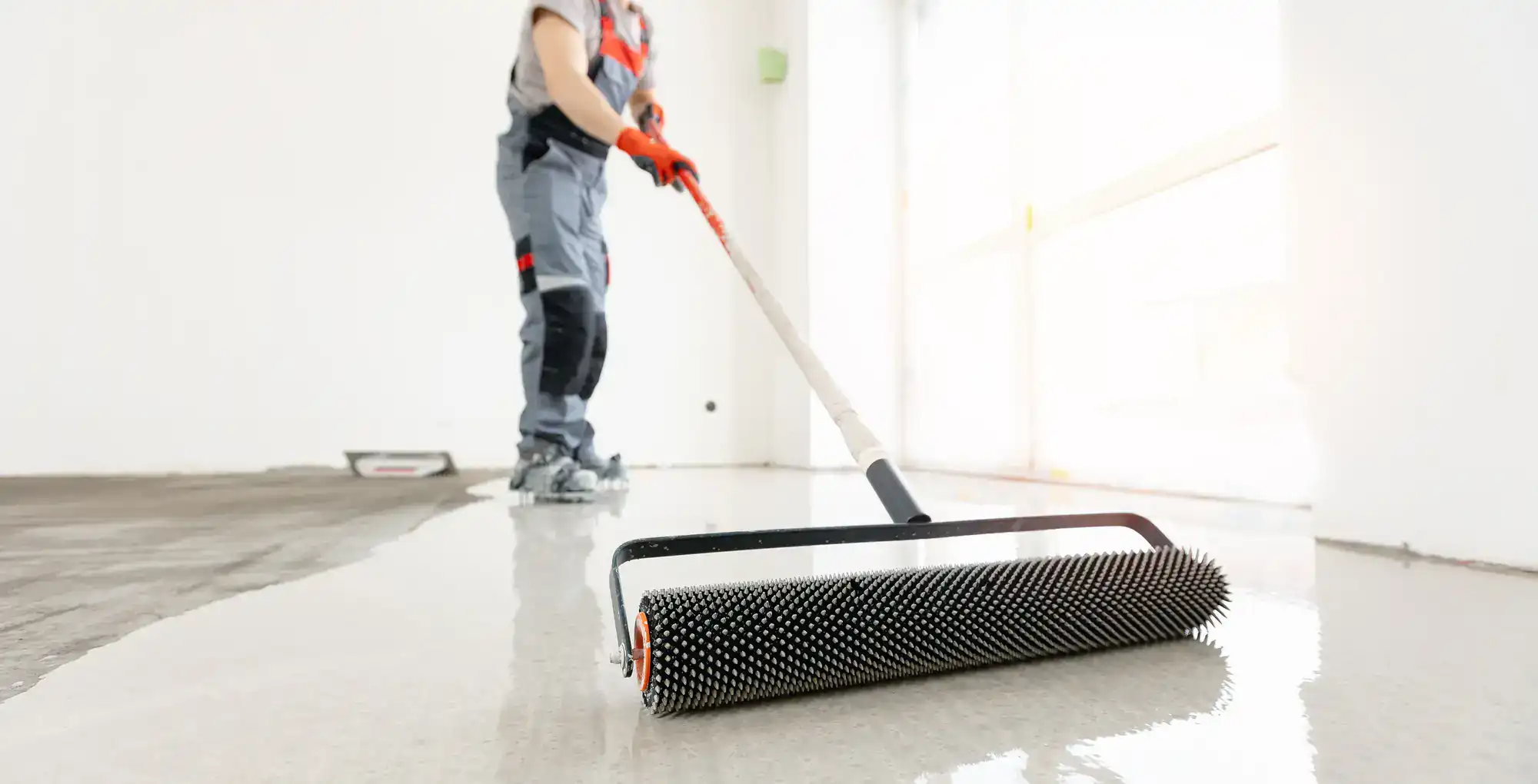
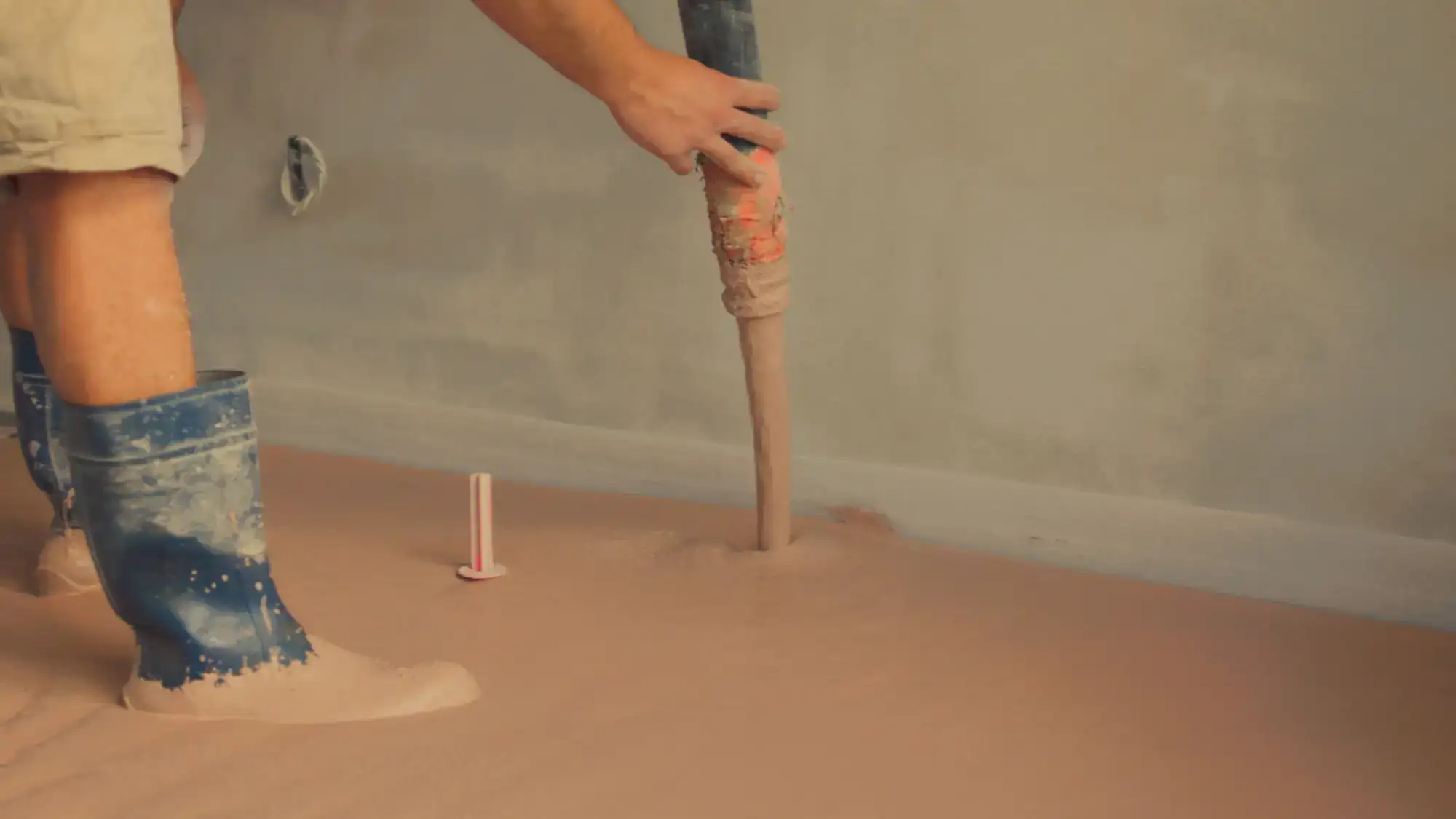
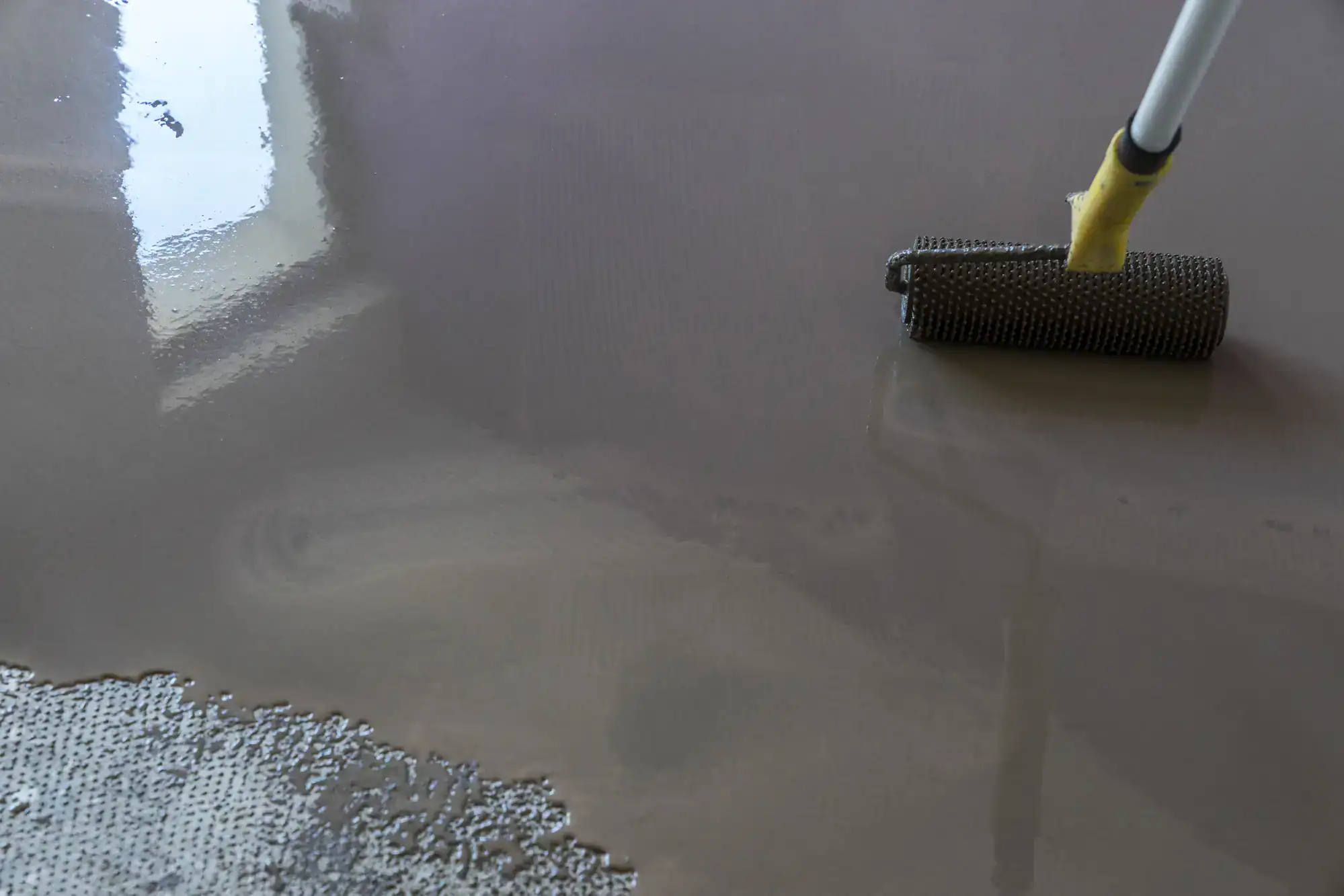
Once the slab condition is confirmed, surface preparation comes next. That means grinding, cleaning, and repairing any cracks or damaged areas so the leveling compound bonds correctly. We then pour and distribute the self leveling underlayment flowing it into low spots, correcting surface irregularities, and curing it to a flat, hard substrate. The system handles correction depths from a quarter inch up to two inches neat, and up to five inches with aggregate added, so whether the issue is minor surface variation or significant differential settlement, we address it in one mobilization.
From there, the floor is ready for foot traffic within four to six hours. For commercial clients along the Merrick Road corridor or near the Long Beach Road business strip, heavy traffic readiness comes within 24 to 48 hours. The timeline is real not a best-case estimate. And because we handle the final floor coating system as well, the entire project stays with one crew from start to finish.
Ready to get started?
The self leveling underlayment work we handle in Oceanside covers the full range retail spaces along Merrick Road, medical offices near Mount Sinai South Nassau, food service operations, light industrial facilities, and residential renovations in the post-war ranches and split-levels that make up the majority of the hamlet’s housing stock. Our service isn’t tiered by property type. The same diagnostic process, the same product standards, and the same crew accountability apply to every job.
What changes is what the slab requires. A 1950s Cape Cod on a canal street in south Oceanside has different moisture exposure than a commercial unit in a Merrick Road strip. A multi-unit building like The Villas at Oceanside has different flatness tolerances and timeline requirements than a single-family kitchen renovation. The assessment phase exists specifically to account for those differences so the product selected and the thickness poured are based on actual slab conditions, not a standard formula applied to every address.
The cementitious self leveling underlayment systems we use here are factory-specified for environments with chronic vapor transmission which is exactly what Nassau County’s South Shore delivers year-round. Fast curing concrete leveler options are available when commercial downtime is a constraint. And because the full scope prep, pour, and final coating stays with one contractor, there’s no gap between what was promised and what gets delivered.
Oceanside was largely developed by building over marshland and tidal wetlands, particularly as the hamlet expanded south through the mid-20th century. When structures are built on filled ground, the soil beneath them compresses unevenly over decades and the concrete slabs poured on top of that ground shift and settle along with it. The result is the dips, humps, and surface irregularities that show up in homes that are otherwise structurally sound.
This isn’t a defect in the original construction. It’s a predictable outcome of where and when the neighborhood was built. The homes along the canal streets and in the southern portions of Oceanside tend to show more pronounced settlement than those on higher, more stable ground to the north. If your floor feels uneven underfoot, or if you’re seeing cracked tile, lifting vinyl plank, or doors that no longer close cleanly, differential slab settlement is usually the first thing worth investigating.
Moisture is the most common reason self leveling underlayment fails and in Oceanside, it’s not a seasonal issue. The hamlet sits at 10 feet of elevation with a groundwater table that stays close to the surface throughout the year. That means moisture vapor is consistently moving upward through concrete slabs, even in homes that have never experienced visible flooding. If the vapor emission rate isn’t measured and confirmed to be within acceptable limits before the leveling compound is applied, the compound can delaminate, bubble, or fail to bond properly sometimes within months.
ASTM F2170 sets the standard: relative humidity below 80% and a moisture vapor emission rate below 5 lbs. per 1,000 square feet per 24 hours before installation proceeds. That testing is built into every Oceanside job we do not offered as an add-on. Oceanside’s documented history of coastal flooding events, including the impacts of Hurricane Sandy across southern Nassau County, means many slabs here have been exposed to significant water intrusion at some point. Testing before the pour is the only way to know what you’re actually working with.
The thickness depends entirely on what the slab assessment reveals. For minor surface irregularities the kind that show up in older homes when you roll a marble across the floor and watch it drift a pour in the quarter-inch to half-inch range is usually sufficient. For more significant differential settlement, where you can feel the slope underfoot or measure a visible drop across the room, the correction depth may need to reach an inch or two. In cases where the slab has major structural variation or where a significant height change needs to be built up, we can add aggregate to extend the system to five inches in a single pour.
What matters is that the thickness is determined by what the slab actually needs not by what’s fastest or cheapest to apply. A pour that’s too thin won’t correct the problem. A pour that’s too thick without the right aggregate support can create its own issues. The assessment phase exists to get that number right before anything is mixed.
Yes, but it requires more attention to conditions than a summer pour. Self leveling underlayment products need the ambient temperature and the slab surface temperature to be above 50°F and ideally closer to 65°F to flow, set, and cure correctly. In unheated commercial spaces, garages, or below-grade areas during a Nassau County winter, the slab itself can be significantly colder than the air temperature, which can cause the compound to stiffen before it has time to self-level properly.
Managing a cold-weather pour means confirming slab temperature before mixing, selecting a product formulated for lower-temperature environments, and in some cases, bringing the space up to temperature before and during the pour. This isn’t unusual work it’s just work that requires the right product knowledge and process discipline. The spring renovation window from March through June and the fall commercial turnover season from August through October tend to be the busiest and most straightforward times for this type of work on Long Island, but we handle winter jobs correctly when the conditions are managed properly from the start.
For most residential projects a homeowner leveling a slab before new tile or luxury vinyl plank goes down self leveling underlayment is an interior improvement that doesn’t require a building permit. Oceanside is an unincorporated hamlet within the Town of Hempstead, so permitting falls under Nassau County and Town of Hempstead jurisdiction rather than a separate village or city government.
For commercial projects, the answer depends on the scope of work. If the leveling is part of a larger renovation that involves changes to the structural slab, modifications that affect ADA-compliant floor elevations, or work that falls under a broader commercial buildout permit, Nassau County or Town of Hempstead permits may apply. If you’re not sure whether your project requires one, that’s a straightforward question to answer before work starts and it’s worth confirming rather than assuming. We can walk you through what typically applies to your type of project in this area.
When it’s installed correctly meaning the slab was properly prepared, moisture levels were confirmed within acceptable limits, and the right product was selected for the substrate conditions self leveling underlayment is essentially a permanent correction. It doesn’t wear out the way a floor covering does. The compound cures to a hard, dense surface that reaches full compressive strength at 28 days and is designed to outlast the flooring installed on top of it.
The cases where self leveling fails prematurely almost always trace back to one of a few things: moisture that wasn’t tested before the pour, a bonding surface that wasn’t properly ground and cleaned, or a product that wasn’t matched to the actual depth or load requirements of the application. In Oceanside specifically, moisture is the variable that gets skipped most often and it’s the one that causes the most expensive failures. A floor that was leveled correctly in a 1960s ranch on the South Shore should still be performing decades later, long after the tile or vinyl on top of it has been replaced once or twice.