
Most commercial kitchen floors in Oceanside don’t fail because of bad luck. They fail because the contractor who installed them didn’t test the slab for moisture first. In a community built on former swampland, sitting next to active tidal canals, with a water table that doesn’t forgive shortcuts skipping that step is a guarantee of delamination. The floor looks fine for six months, then it starts to peel. That’s not a product problem. That’s a process problem.
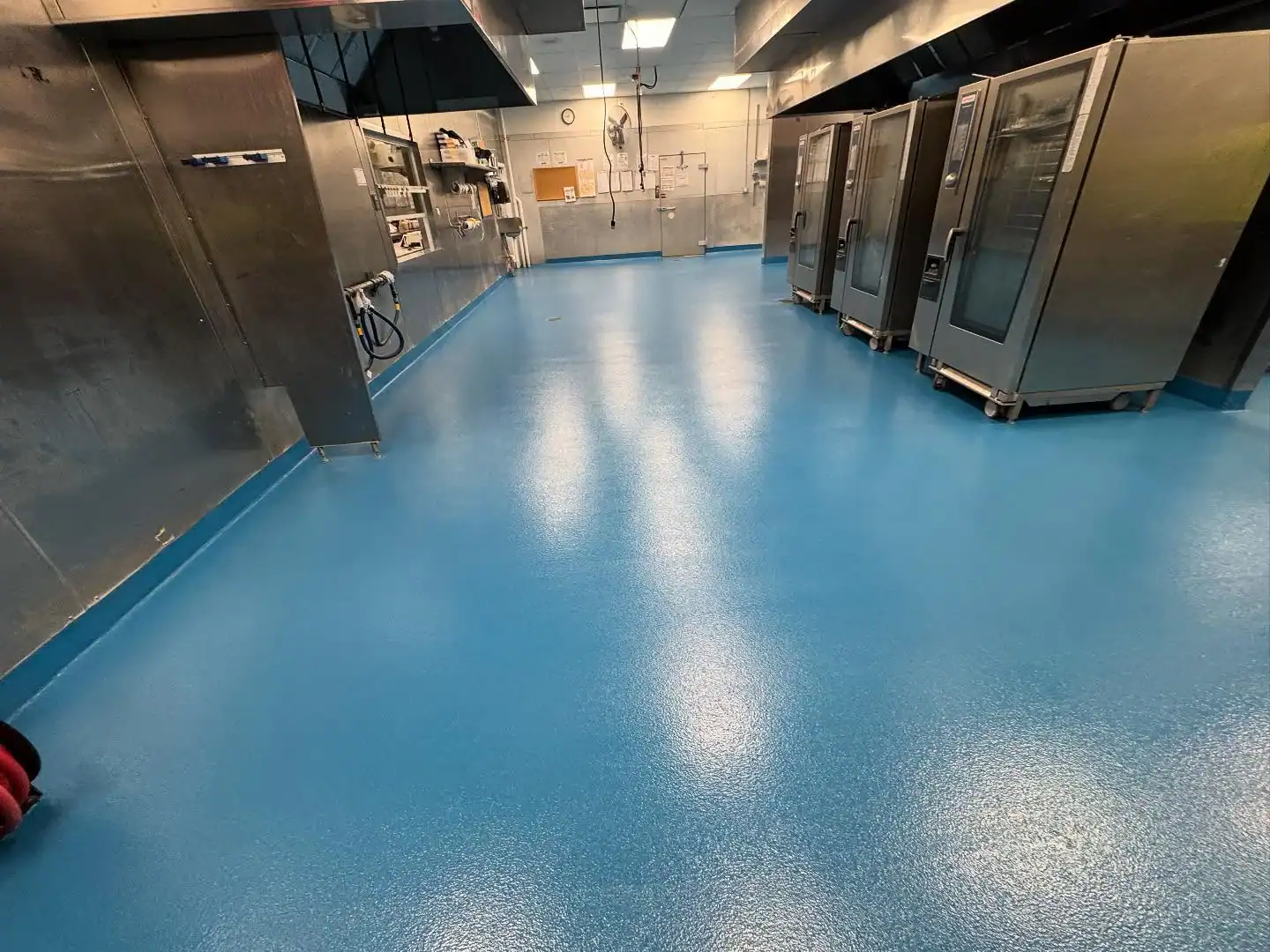
When we install kitchen floors in Oceanside, NY with proper moisture testing, correct surface preparation, and a system matched to your kitchen’s actual conditions, the outcome is completely different. You get a surface that’s seamless, non-porous, and sanitizable exactly what Nassau County health inspectors are looking for under FDA Food Code requirements. No grout lines trapping grease. No cracks giving bacteria a place to live. No citations on your next inspection report.
Oceanside’s South Shore environment is harder on floors than most people realize. The salt-laden humidity off the Great South Bay, the high water table in low-lying areas near the canals, and the legacy of flood damage from events like Hurricane Sandy have all left their mark on the concrete slabs under this town’s commercial kitchens. A properly installed, fully bonded epoxy system handles that environment. A rushed, untested installation doesn’t and you’ll know it within a year.
We’ve been installing commercial kitchen floors across Long Island for 35 years. That’s not a tagline it means we were doing this work in Nassau County before most of Oceanside’s current restaurant operators opened their doors. We’ve seen what Long Island’s coastal conditions do to floors when the installation is done correctly, and what they do when it isn’t.
We hold dual manufacturer certification Sherwin-Williams High Performance Flooring ATP certification and Res Tech certification. The Sherwin-Williams ATP program is one of the most rigorous credentials in resinous flooring, covering everything from concrete assessment to topcoat application. No local Oceanside flooring contractor we’re aware of holds equivalent credentials for commercial kitchen epoxy systems.
We’re based in Bohemia, NY, which puts us a straightforward drive down the Southern State Parkway and Meadowbrook Parkway from Oceanside. We know this area. We understand what South Shore substrates look like, how coastal humidity affects cure conditions, and why the older commercial building stock along Long Beach Road and Merrick Road requires a different level of prep than a brand-new slab. Oceanside’s postwar-era commercial buildings many of them built before modern concrete standards are exactly the kind of structures where our experience matters most.
Before anything goes on the floor, we test the concrete for moisture vapor transmission. In Oceanside, this isn’t optional it’s the most important variable in the entire installation. Buildings near the canal system, older postwar commercial structures along Long Beach Road, and any property that experienced flooding have concrete slabs that are more likely to carry elevated moisture levels. If we coat over that without testing, the floor will fail. So we test first, every time.
Once the slab clears moisture testing, we diamond-grind the surface to the correct profile for adhesion. This step removes surface contamination, opens the concrete’s pores, and gives the coating something real to bond to. In Oceanside’s older building stock much of it dating to the postwar era this prep work is what separates a floor that lasts fifteen years from one that starts peeling in eighteen months. We fill cracks, address any uneven areas, and don’t move to the next step until the substrate is genuinely ready.
From there, we apply the right system for your kitchen’s specific conditions. Active cooking zones near fryers and steam equipment get thermal shock-resistant formulations. Walk-in coolers get moisture-tolerant builds. Prep areas get chemical-resistant coatings that hold up to commercial sanitizers. We schedule around your operation overnight, weekends, or in phases so your kitchen closure is as short as possible. Modern polyaspartic topcoat systems allow return to service within 24 to 36 hours when timing is tight.
Ready to get started?
Commercial kitchen flooring in Oceanside, NY isn’t one product applied everywhere. The area in front of your fryer line has different demands than your walk-in cooler, your prep station, or your dishwashing area. Heat, steam, chemical exposure, standing water, and heavy foot traffic all behave differently depending on where they occur in the kitchen and the floor system needs to reflect that.
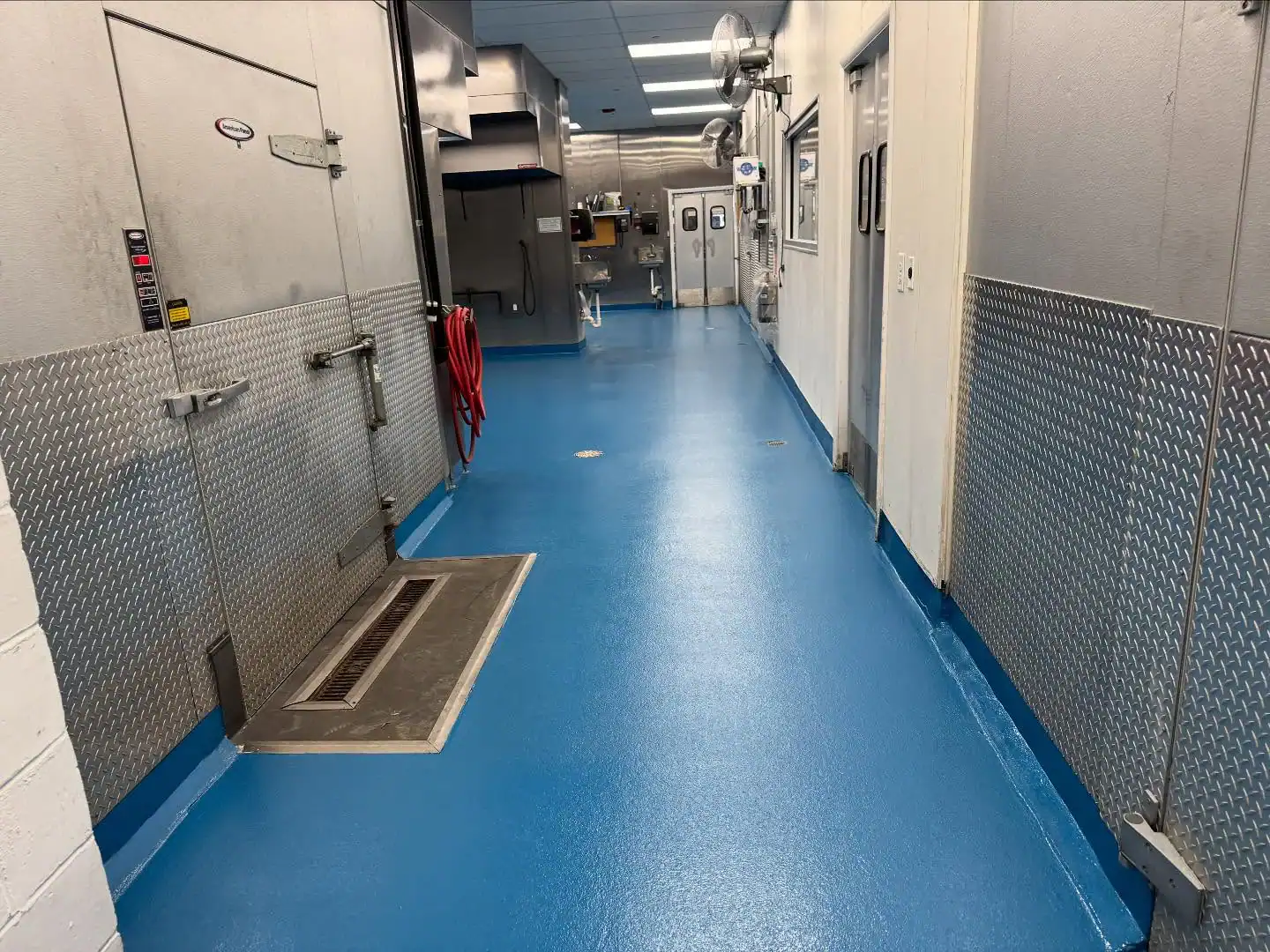
For high-heat cooking zones, we use urethane cement mortar systems that resist thermal shock the rapid temperature change between hot equipment and a cold steam-cleaning cycle that cracks standard epoxy over time. For areas with constant moisture exposure, we specify moisture-tolerant formulations that won’t lift or bubble. Throughout the entire kitchen, every system we install is seamless, non-porous, and coved at the base the coved base being a specific requirement that Nassau County health inspectors look for, because it eliminates the gap between the floor and the wall where bacteria accumulate.
Waterfront restaurant operators along Oceanside’s canal system, institutional food service operations at facilities like Mount Sinai South Nassau, and long-running community establishments all have different footprints and different demands. What stays consistent is our process: moisture test, proper prep, system-matched application, and a finished floor that’s built to pass inspection and hold up under real commercial kitchen conditions not just look good on installation day.
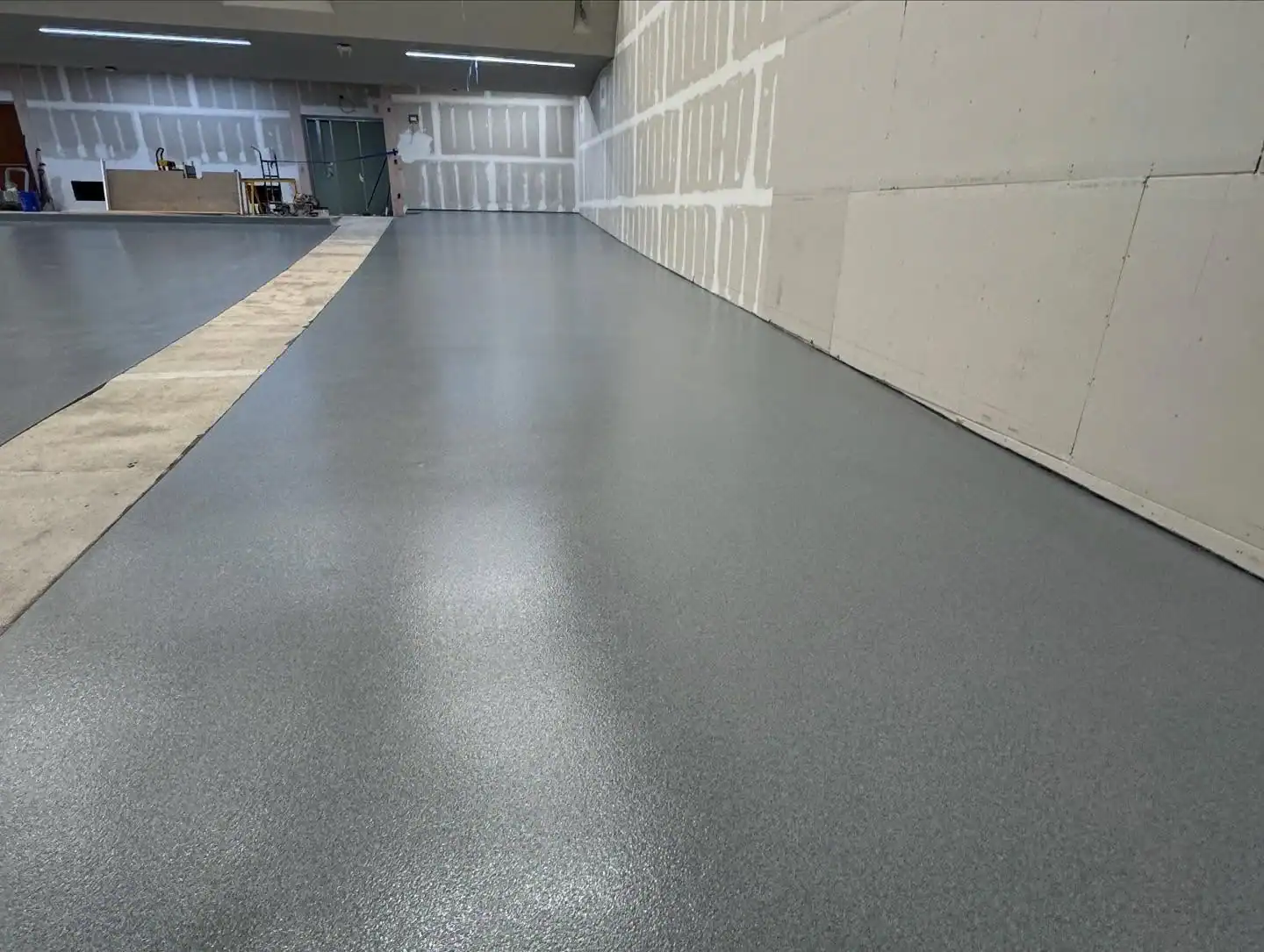
Yes and this is one of the most common things that catches restaurant operators off guard during a Nassau County health inspection. FDA Food Code Sections 6-201.11 and 6-501.11 require commercial kitchen floors to be smooth, non-porous, non-absorbent, and easily cleanable, with no cracks or gaps where food particles or bacteria can accumulate. Quarry tile with grout lines fails on multiple counts: the grout is porous, it traps grease, and it deteriorates under the chemical and thermal stress of a working kitchen.
A seamless epoxy system eliminates every one of those issues. There’s no grout line to cite, no crevice to harbor bacteria, and no surface that can’t be sanitized with commercial-grade cleaners. If your Oceanside kitchen is currently tiled and you’ve received a citation or you’re trying to get ahead of one a properly installed seamless floor is the direct solution to that specific compliance problem.
The single most common cause is moisture in the concrete slab and in Oceanside specifically, this is a bigger risk than in most inland communities. The town was built on former swampland, sits adjacent to active tidal canals and bays, and has a water table that keeps many older slabs at elevated moisture vapor levels year-round. When a contractor applies epoxy over concrete with excessive moisture vapor pressure without testing first, the moisture migrates through the slab and breaks the bond between the coating and the substrate. The floor delaminates. It’s predictable, and it’s preventable.
The second most common cause is inadequate surface preparation. Applying epoxy over contaminated, un-ground concrete even with the right product produces a floor that looks finished but isn’t bonded correctly. Under the thermal and chemical stress of a commercial kitchen, that floor will fail. Moisture testing and proper diamond-grinding are not optional steps. They’re the reason a floor either lasts or doesn’t.
A properly installed commercial kitchen epoxy floor with correct moisture testing, surface preparation, and a system matched to the kitchen’s actual conditions typically lasts 10 to 20 years in a working restaurant environment. The variance comes down to how hard the kitchen runs, what cleaning chemicals are used, and whether the right system was specified for each zone. A urethane cement mortar system in a high-heat cooking area will outlast a standard epoxy build in that same environment, because it’s designed for the thermal cycling that cooking equipment produces.
In Oceanside’s coastal environment, where humidity is persistent and older building stock adds moisture variables to the equation, the installations that reach the upper end of that lifespan are the ones where the prep work was done correctly from the start. Floors that were rushed skipped moisture testing, minimal grinding, one coat instead of a full build tend to show failure signs within two to three years. The cost difference between doing it right and doing it over is not small.
In most cases, the kitchen needs to be closed during the actual installation and cure window but how long that closure lasts depends heavily on scheduling and the topcoat system we use. For Oceanside operators running tight seasonal windows, particularly the waterfront restaurants that depend on summer revenue, minimizing downtime is a real operational priority. We account for that in how we schedule the work.
Overnight and weekend installations are standard for us. When timing is the primary constraint, modern polyaspartic topcoat systems allow return to light foot traffic within hours and full commercial use within 24 to 36 hours. For larger kitchens, phased installations completing one section at a time can keep part of the operation running while the rest is being done. The key is planning the schedule before the job starts, not trying to figure it out on installation day.
Yes. A coved base where the floor material curves up the wall several inches instead of meeting it at a hard 90-degree angle is a standard requirement under FDA Food Code guidelines and is something Nassau County health inspectors specifically look for during commercial kitchen inspections. The reason is straightforward: a hard joint between the floor and the wall creates a gap that’s nearly impossible to clean properly. Grease, food particles, and moisture accumulate there, and bacteria follow.
A seamless coved base eliminates that gap entirely. The floor surface continues up the wall in a smooth, unbroken curve that can be sanitized as easily as the rest of the floor. If your current kitchen has tile that meets the wall at a right angle with or without a grout joint that’s a potential citation point. Every commercial kitchen floor installation we do in Oceanside includes a properly formed coved base as part of the system, not as an add-on.
Hurricane Sandy completely flooded Oceanside in October 2012 and for commercial building owners whose properties were submerged, the effects on concrete slabs didn’t disappear when the water receded. Flood-exposed concrete can have increased porosity, elevated residual moisture content, and compromised structural integrity that isn’t visible on the surface. Applying a floor coating over a slab in that condition without a thorough assessment first is one of the fastest ways to end up with a failed floor.
Beyond Sandy, Oceanside’s position on the South Shore means ongoing exposure to coastal flood advisories, high water tables in low-lying areas near the canals, and persistent humidity from the Great South Bay. These aren’t abstract concerns they’re the specific conditions under the floors in this community. Our moisture testing and substrate assessment process is designed to identify exactly these kinds of issues before a single coat goes down, so the floor we install holds up in Oceanside’s environment rather than failing because of it.