
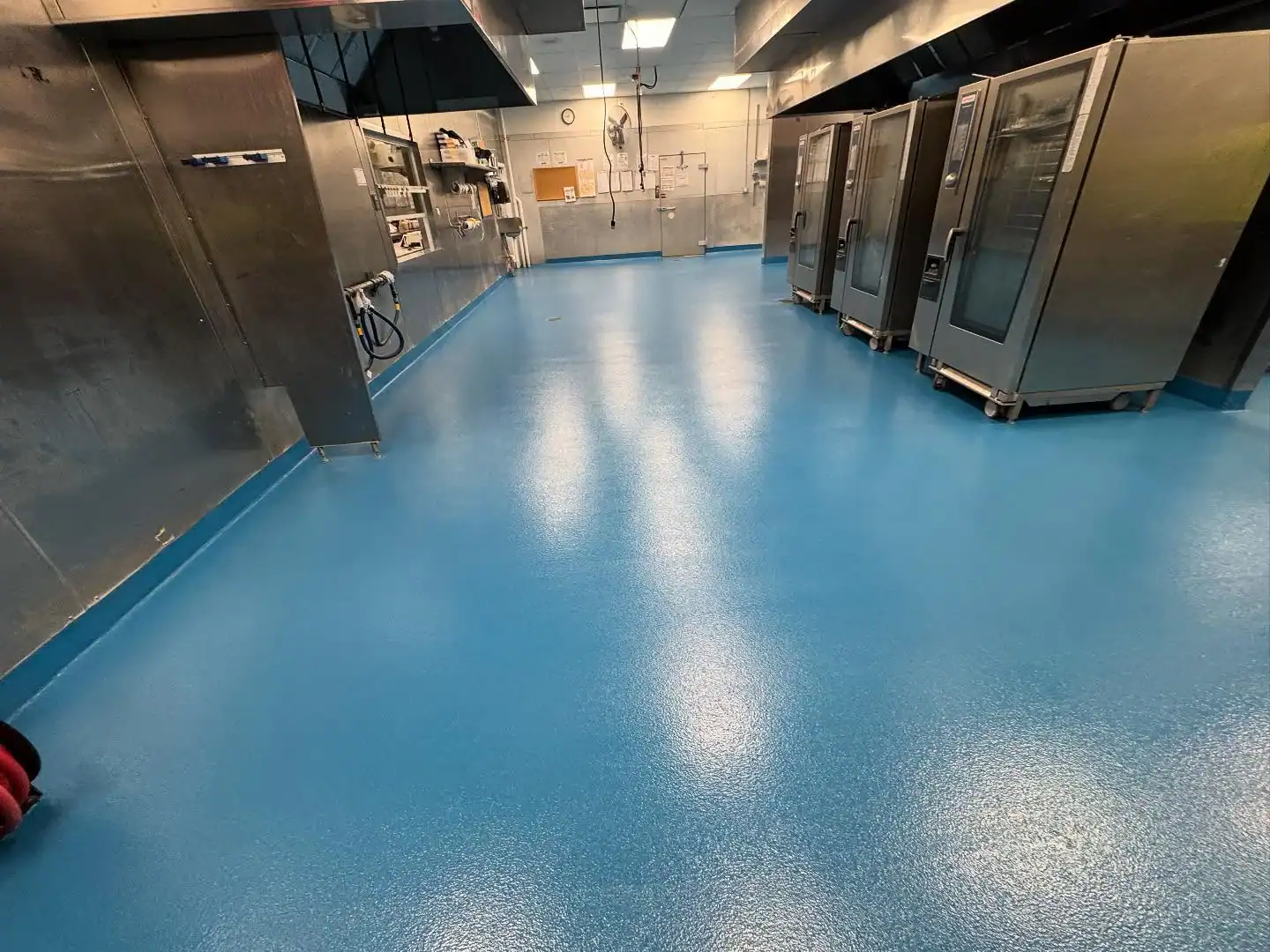
Commercial kitchen floors take a beating that most flooring products were never designed to handle. Hot water, grease, steam cleaning, constant foot traffic, dropped equipment and on top of all that, a Suffolk County health inspector who knows exactly what a non-compliant surface looks like. When your floor is cracked, pitted, or grouted, it is not just a maintenance issue. It is a citation waiting to happen.
A seamless epoxy system changes that. There are no grout lines for bacteria to settle into, no gaps at the base of the wall for moisture to collect, and no porous surface that absorbs grease and resists cleaning. What you get instead is a continuous, non-absorbent surface that can be sanitized quickly, holds up to commercial-grade chemicals, and meets the standards the New York State Sanitary Code requires for food prep areas.
Smithtown’s North Shore location adds another layer to this. The coastal humidity coming off Long Island Sound creates elevated moisture pressure in concrete slabs year-round and that moisture is the leading reason epoxy floors fail prematurely across this area. A floor installed without addressing that first is not a floor that lasts. That is why we test for moisture before any coating goes down. It is not optional here. It is the difference between a floor that performs for fifteen years and one that starts peeling before the first winter is over.
We have been installing commercial and industrial floors for 35 years, serving food service operators across Smithtown, Suffolk County, and beyond. We hold Sherwin-Williams High Performance Flooring ATP certification a rigorous, manufacturer-backed credential that covers everything from concrete assessment to full system application as well as Res Tech certification. Dual manufacturer credentials at this level are rare among Long Island flooring contractors. Most competitors in the Smithtown market cannot claim either one.
Based in Bohemia, we know the Smithtown area well. We understand the regulatory environment that food service operators here navigate including the Suffolk County Health Department requirements that govern every commercial kitchen from the Hauppauge Industrial Park corridor to the new restaurant spaces opening in Kings Park under the Downtown Revitalization Initiative. We have worked on kitchens throughout Smithtown’s commercial districts and know what passes inspection and what does not.
BBB accredited with no complaints on file. That record reflects 35 years of doing the work correctly the first time.
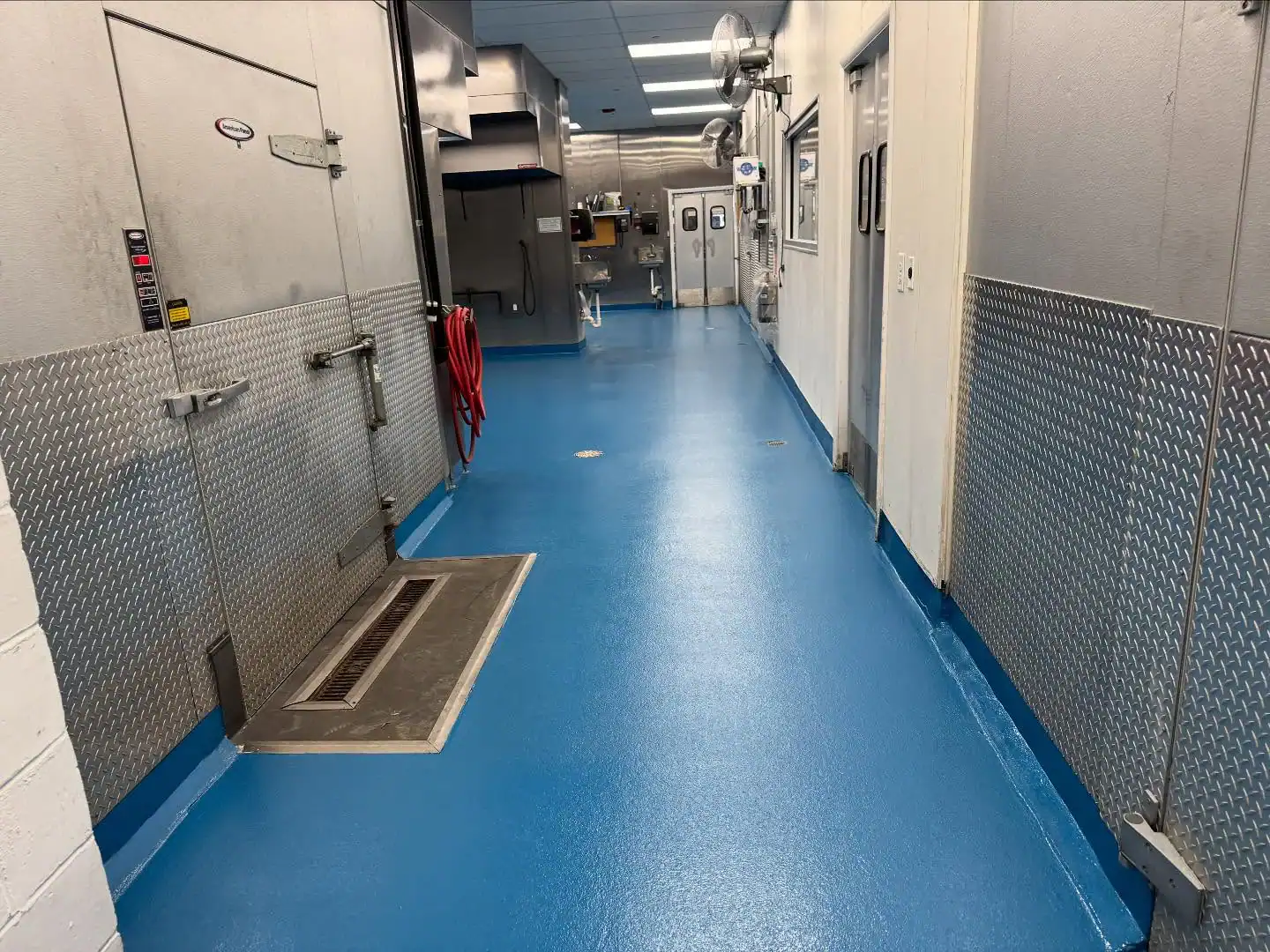
The first thing that happens on every job is a moisture test. Smithtown’s proximity to Long Island Sound means concrete slabs in this area are regularly exposed to coastal humidity and moisture vapor trapped beneath the surface is the single most common reason epoxy floors delaminate. Before any grinding or coating begins, we measure moisture levels. If they are too high, we install the right barrier system first. That step alone separates a floor that lasts from one that fails.
From there, we diamond grind the concrete to the correct surface profile for adhesion. Any cracks, chips, or uneven areas are repaired and leveled. This is the part most contractors rush or skip entirely when they are competing on price and it is the part that determines how long the finished floor actually holds up. Surface preparation is not prep work. It is the job.
Once the slab is ready, we select the system based on your kitchen’s specific zones. High-heat cooking areas and steam-cleaning zones get urethane cement mortar, which handles thermal shock that standard epoxy cannot. Prep and dish areas get a food-grade epoxy mortar system. Where minimizing downtime matters most, a fast-cure polyaspartic topcoat can have your kitchen back in service within 24 to 36 hours. If your Smithtown location needs a permit for the alteration through the Town of Smithtown Building Department, we discuss that process before work begins so nothing catches you off guard.
Ready to get started?
Not every part of a commercial kitchen has the same demands, and the floor coating needs to reflect that. The area in front of a cooking line deals with heat, grease, and the thermal shock of steam cleaning. A standard epoxy system will crack under those conditions. Urethane cement mortar is the correct product for that zone it bonds directly to the concrete, handles extreme temperature swings, and resists the chemical exposure that cooking environments produce daily. This is the system we install in high-heat areas for food service operators across Smithtown, from the Route 347 corridor to the industrial food operations in the Hauppauge area.
Prep areas, dishwashing zones, and walk-in coolers each have their own requirements. Food-grade epoxy mortar handles the seamless, non-porous surface standard that the New York State Sanitary Code requires for food contact areas. We install coved base at every floor-to-wall junction the detail health inspectors specifically look for and one of the most commonly cited deficiencies in Suffolk County food service inspections.
For operators who cannot afford extended downtime, a polyaspartic topcoat system cuts cure time dramatically. If you are one of the new food service businesses opening in connection with the Kings Park Downtown Revitalization Initiative or the broader commercial development underway in Smithtown, getting the floor system right before you open is far less expensive than correcting a failed installation after your first health inspection.
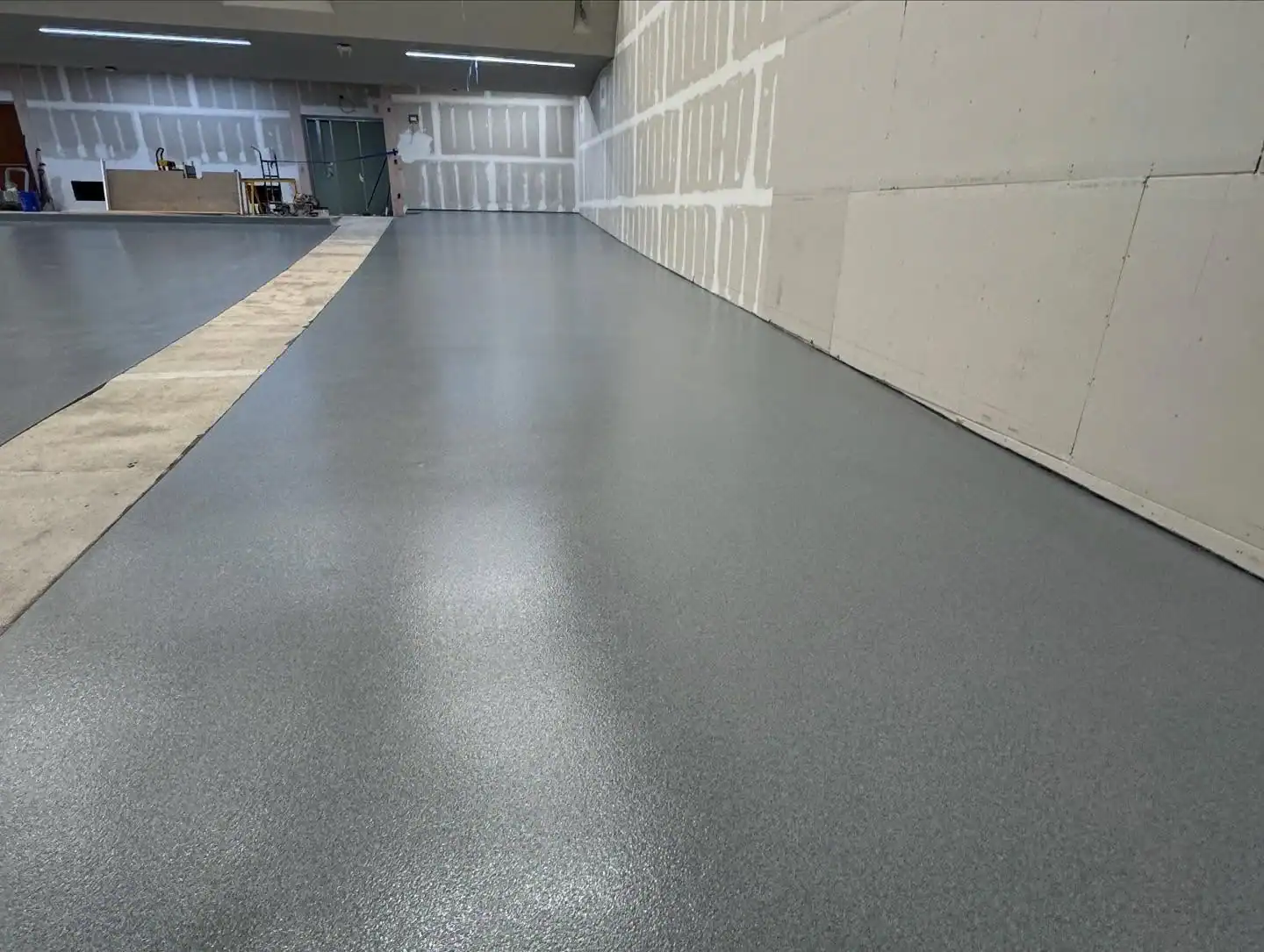
The New York State Sanitary Code enforced locally by the Suffolk County Health Department requires floors in food preparation areas to be smooth, non-porous, non-absorbent, and easily cleanable. That language comes directly from the FDA Food Code, and it rules out most standard flooring options. Tile with grout lines, bare concrete, and painted surfaces all fail this standard because they either absorb moisture, harbor bacteria in seams, or cannot withstand the chemical exposure involved in commercial kitchen sanitation.
A seamless epoxy or urethane cement mortar system is the practical answer for most commercial kitchens in Smithtown. These systems create a continuous surface with no joints, no grout lines, and no gaps exactly what the code requires and what health inspectors are trained to verify. The coved base at the floor-to-wall junction is also a code requirement that often gets missed, and we include it as a standard part of every installation.
Most commercial kitchen epoxy installations can be completed in one to two days, depending on the size of the space and the condition of the existing concrete. If the slab requires significant repair work or moisture mitigation before coating, that can add time but it is time that protects the investment. Skipping it to save a day is how floors end up failing within a year.
For operators on the Route 347 corridor or in the Smithtown and Kings Park commercial districts who cannot afford extended closures, a polyaspartic topcoat system is the right choice. Polyaspartic cures significantly faster than standard epoxy light use is typically possible within hours, and full commercial service can resume within 24 to 36 hours. We schedule installations overnight or over weekends for active food service businesses in Smithtown regularly.
The most common cause is moisture vapor in the concrete slab and it is almost always preventable. Smithtown’s location on Long Island’s North Shore means concrete slabs here are regularly exposed to coastal humidity from Long Island Sound, especially in the spring and summer months when ambient moisture levels are highest. When that moisture vapor has nowhere to go, it pushes up through the slab and breaks the bond between the concrete and the coating. The floor looks fine on day one and starts lifting within months.
The fix is straightforward: test the slab for moisture before any coating is applied. If levels are elevated, install the correct moisture barrier system first. This is a standard part of every installation we perform. The second most common cause is inadequate surface preparation specifically, skipping or rushing the diamond grinding step that creates the surface profile the coating needs to bond properly. Both of these failure modes are entirely avoidable with the right process.
It depends on the scope of the work. A like-for-like floor coating replacement applying a new system over an existing prepared surface typically does not require a permit from the Town of Smithtown Building Department. However, if the project involves structural changes, significant alterations to the existing floor assembly, or is part of a larger renovation that requires a certificate of occupancy, a permit may be required. The Town of Smithtown Building Department is located at 99 West Main Street and can be reached at (631) 360-7522 for project-specific guidance.
Separately, if you operate a food service establishment in Smithtown, the Suffolk County Health Department will want to verify that any floor work meets the sanitary code standards for your facility. This is not a separate permit process for the flooring itself it is part of your ongoing food service establishment permit compliance. We install systems that meet those standards, and we can provide documentation to support your compliance process with the county.
Epoxy is the right product for most areas of a commercial kitchen prep zones, dish areas, storage, and general floor space. It creates a hard, seamless, non-porous surface that is easy to clean, resistant to most kitchen chemicals, and durable under normal foot traffic and equipment loads. Food-grade epoxy systems meet the FDA Food Code requirements for food contact surface areas and hold up well in environments that stay within a reasonable temperature range.
Urethane cement mortar is a different product built for a different set of conditions. It is the industry standard for cooking lines, areas near steam equipment, and anywhere the floor is regularly exposed to extreme heat, boiling liquids, or rapid temperature changes like the thermal shock of steam cleaning a hot surface. Standard epoxy cannot handle that kind of temperature differential without cracking over time. Urethane cement bonds directly to the concrete and flexes slightly under thermal stress rather than cracking. For most commercial kitchens in Smithtown, the right answer is a combination of both systems, matched to the specific demands of each zone.
If you are opening a restaurant or food service space in connection with the Kings Park Downtown Revitalization Initiative or any of the new commercial development underway in Smithtown, you are starting from a position most existing operators do not have a clean slab and the ability to install the right system from day one. That is a real advantage, and it is worth using correctly.
New construction slabs still need to be tested for moisture before any coating is applied. Concrete releases moisture vapor as it cures, and new slabs can have elevated moisture levels for months after the pour. Installing a floor coating too early or without testing on a new Kings Park or Smithtown commercial space is one of the most common mistakes new restaurant operators make. The other is choosing a flooring system based on upfront cost rather than the actual demands of the kitchen. Getting the right system installed correctly before you open is significantly less expensive than dealing with a failed floor after your first Suffolk County Health Department inspection.