
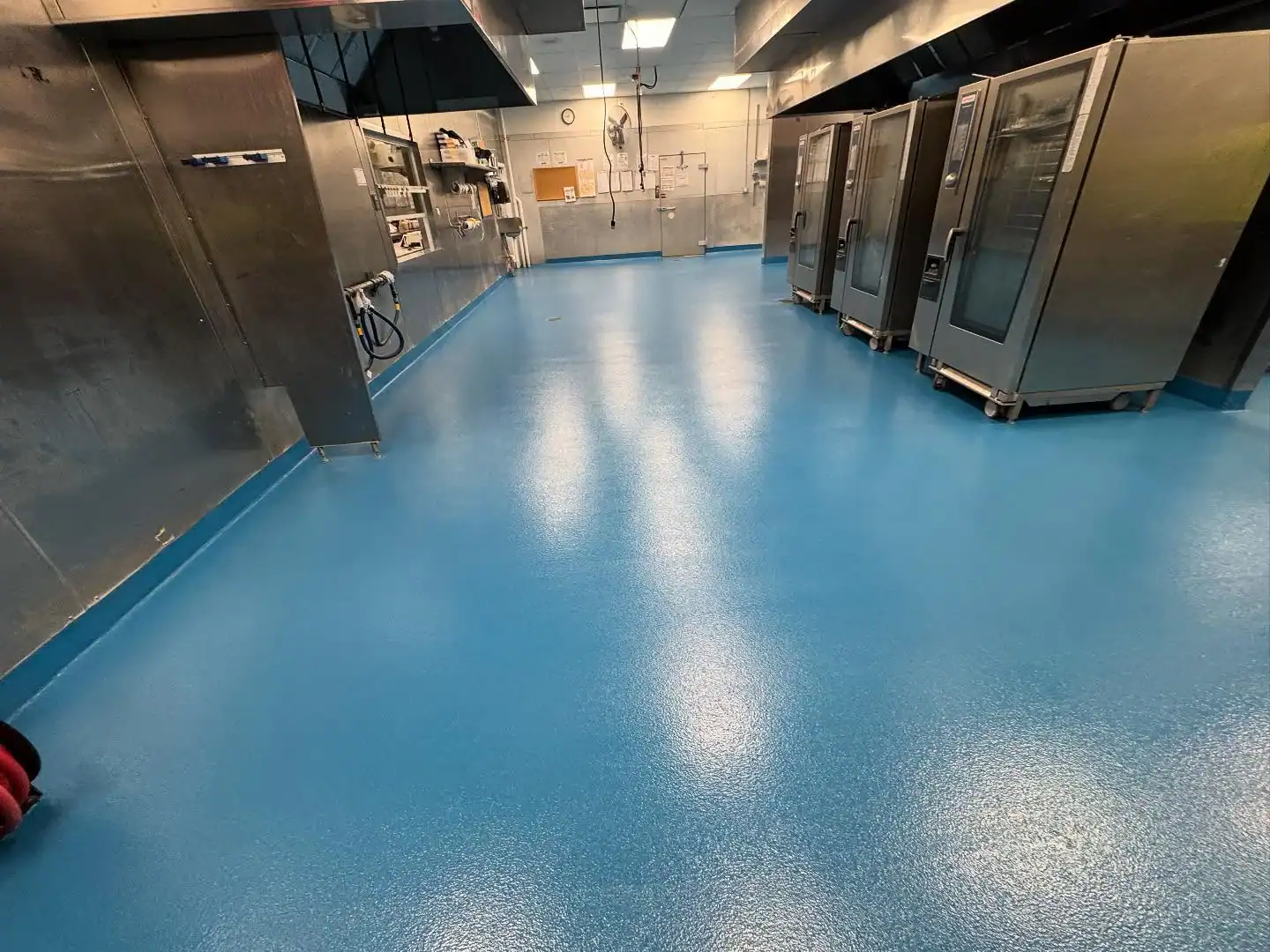
Most restaurant owners in Franklin Square don’t think about their kitchen floor until something goes wrong a health inspector writes it up, a tile cracks through, or a previous epoxy job starts lifting in sheets. By then, you’re already behind. A properly installed food-grade seamless floor changes that equation. No grout lines means nowhere for grease, bacteria, or moisture to accumulate. No seams means nothing for a Nassau County health inspector to cite. You get a surface that can be sanitized with commercial cleaners and actually holds up to the daily punishment of a working kitchen.
The buildings along Hempstead Turnpike are largely 70-plus years old. Concrete slabs from the early 1950s behave differently than new construction they’ve had decades to develop cracks, absorb moisture, and lose the surface integrity that a coating needs to bond to. Long Island’s humid summers make that worse. When seasonal humidity climbs and moisture vapor pushes up through an aging slab, a coating that wasn’t installed correctly will start to fail. The outcome you’re really buying isn’t just a new floor it’s a floor that was installed with your building’s actual condition in mind, not a generic one.
We’ve been installing commercial, industrial, and residential floors across Long Island for 35 years, and we’ve spent a significant portion of that time working in Franklin Square’s commercial kitchen corridor. That’s not a marketing number it means we’ve worked in buildings exactly like the ones on Hempstead Turnpike. Old concrete, coastal humidity, active food service environments. We’ve seen every failure mode this market produces, and our process is built around preventing them.
We hold Sherwin-Williams High Performance Flooring ATP certification and Res Tech certification two manufacturer-backed credentials that are genuinely uncommon in the Nassau County market. Most contractors applying epoxy in commercial kitchens don’t carry either one. These aren’t participation certificates. They represent demonstrated competency in concrete assessment, surface preparation, and full system application the things that determine whether a floor lasts two years or twenty.
We’re based in Bohemia, NY, and we work throughout Nassau and Suffolk Counties. We know the Nassau County Department of Health’s Plan Review requirements, and we install floors that are built to meet them.
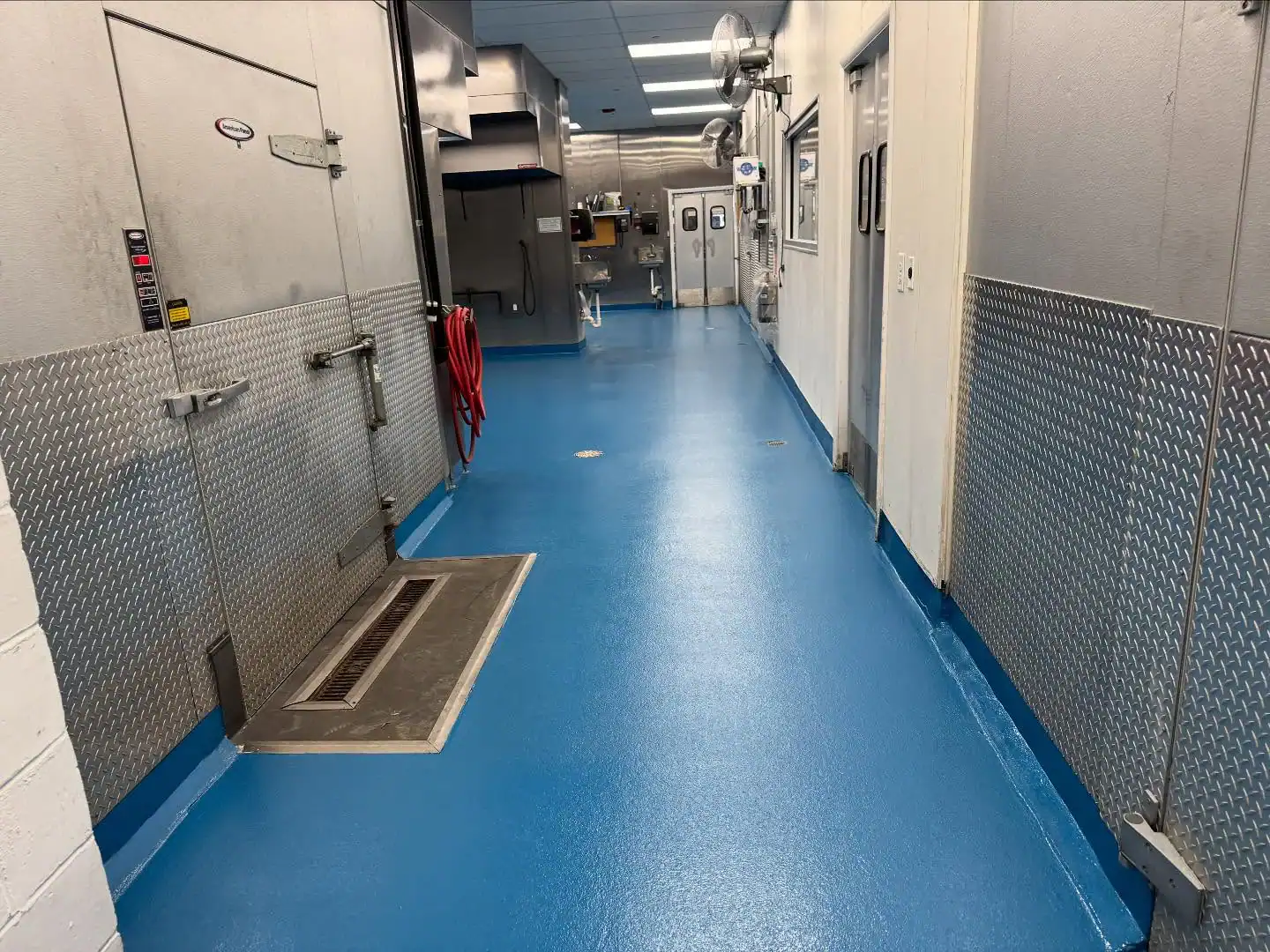
The first thing we do isn’t apply a coating it’s assess the concrete. On a slab that’s been sitting under a Franklin Square commercial kitchen since the Eisenhower administration, that assessment matters. We test for moisture vapor transmission before anything else. Moisture vapor is the number one reason epoxy floors fail prematurely, and it’s invisible until the floor starts bubbling. Most contractors skip this step. We don’t.
Once the slab is assessed, we diamond-grind the surface to the correct profile for adhesion, fill cracks, and level any uneven areas. If the concrete isn’t ready to receive a coating, the coating won’t hold it’s that straightforward. We don’t move forward until the substrate is prepared correctly. For commercial kitchens in Franklin Square that are going through a Nassau County Department of Health Plan Review, we also make sure the system we’re specifying meets the requirements outlined in the county’s Food Service Establishment Construction Guide before installation begins.
From there, we apply a multi-layer system matched to your kitchen’s specific environment. High-heat zones near cooking equipment get a cementitious urethane mortar system designed for thermal shock. Prep lines and dish areas get chemical-resistant build coats. Every surface gets a slip-resistant topcoat. We don’t rush the cure between coats that’s one of the most common shortcuts in this industry, and it’s one of the most reliable ways to produce a floor that fails within a year.
Ready to get started?
Commercial kitchens aren’t a single environment. The zone near your fryers runs hot and sees thermal shock. The prep line absorbs chemical sanitizers and constant foot traffic. The walk-in cooler entrance deals with moisture and temperature swings. The dish area handles steam and standing water. A contractor who applies the same product everywhere is cutting corners and you’ll see it in the floor within a year.
We evaluate each zone in your kitchen and specify the right system for each one. For high-heat areas common in the Italian, Greek, and Latin American kitchens that line Hempstead Turnpike in Franklin Square, that means cementitious urethane mortar the only system engineered to handle the kind of thermal shock that cracks standard epoxy. For prep and service areas, we use chemical-resistant multi-coat epoxy builds with slip-resistant finishes that meet ANSI A326.3 wet DCOF standards for commercial kitchens. Every system we install is food-grade and seamless, which means it meets FDA Food Code requirements for smooth, non-porous, non-absorbent, and easily cleanable surfaces the exact language Nassau County health inspectors use when they’re evaluating your floor.
We also work around your schedule. Overnight installs, weekend work, phased installation whatever keeps your kitchen on Hempstead Turnpike from losing a full week of revenue. Fast-cure topcoat systems can have you back in light service within hours and full kitchen operation within 24 to 36 hours of final coat.
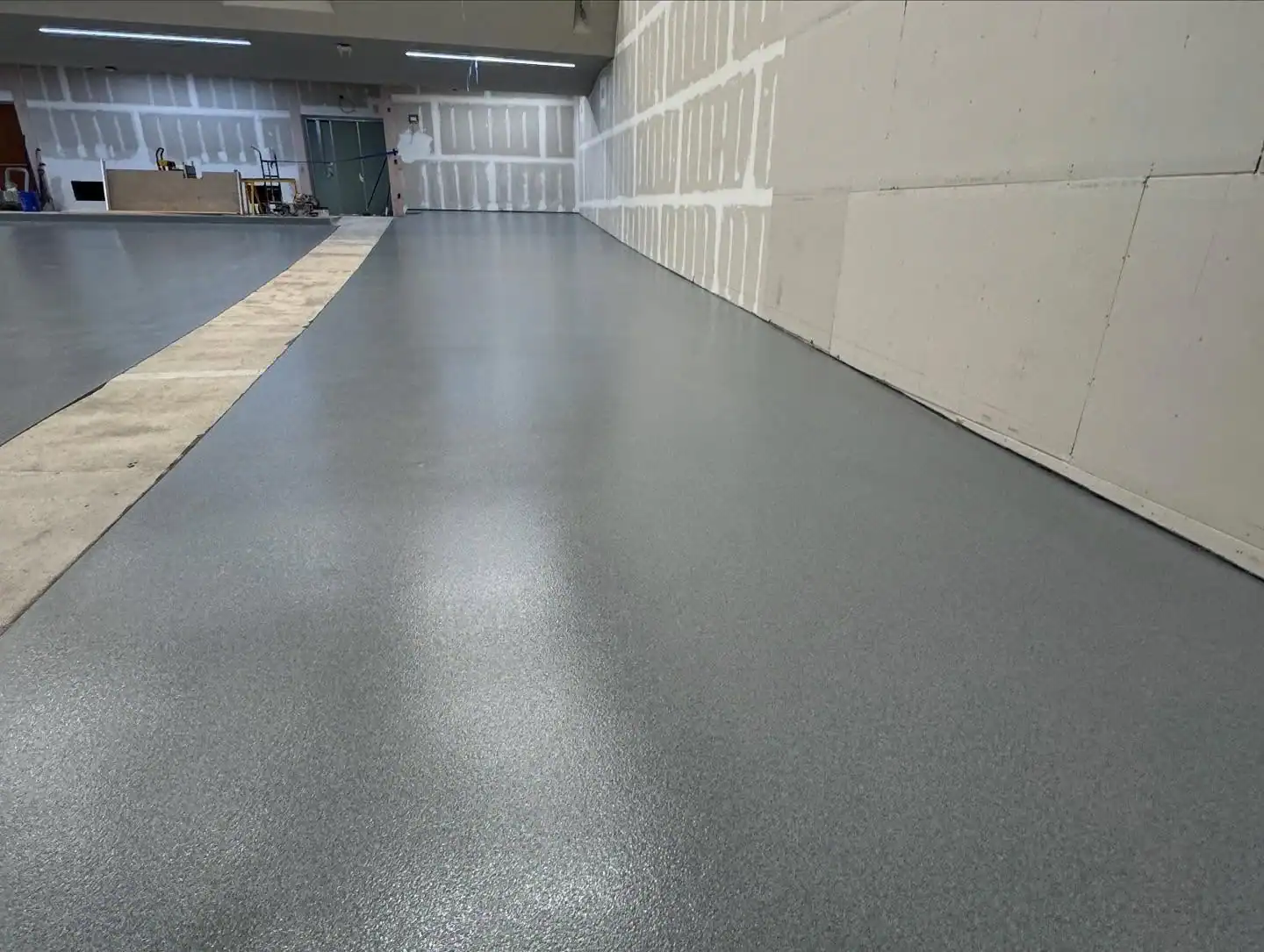
Yes and the Nassau County Department of Health’s Food Protection Division takes it seriously. Their inspectors evaluate kitchen floors against FDA Food Code standards, which require surfaces to be smooth, non-porous, non-absorbent, easily cleanable, and free of cracks, chips, and gaps. Coved base where the flooring extends four to six inches up the wall at every junction is also required to eliminate the bacteria-trapping crevice between the floor and wall.
If you’re doing any new construction or renovation in a Franklin Square food service establishment, the Nassau County DOH requires a Plan Review before work begins. That process includes a review of your floor materials and installation method against the county’s Food Service Establishment Construction Guide. A seamless food-grade epoxy system installed correctly will meet those requirements. Quarry tile with deteriorating grout lines typically won’t and that’s one of the most common citations in older Nassau County kitchens.
The most common reason epoxy fails in a commercial kitchen is moisture vapor transmission through the concrete slab. When moisture levels in the slab are too high and a coating is applied anyway, the vapor pushes up from below and breaks the bond between the coating and the concrete. The floor looks fine for a few months, then starts to bubble and peel. It’s not a product failure it’s an installation failure that was predictable from the start.
The fix is straightforward but requires a step that most contractors skip: moisture testing before any coating is applied. We test every slab before we touch it. In Franklin Square’s older commercial building stock most of it built in the early 1950s before vapor barriers were standard elevated moisture readings are common, not rare. When we find them, we address them with the right primer and preparation protocol before the coating goes down. The other common cause of premature failure is rushing the cure time between coats. We don’t do that either.
Standard epoxy is not the right choice for zones near fryers, high-BTU ranges, or steam equipment. The temperature differential between a hot cooking zone and a steam-cleaned or walk-in-adjacent floor creates what’s called thermal shock and it will crack a standard epoxy system within months. This is a real issue in the kind of high-heat kitchens you see along the Hempstead Turnpike corridor in Franklin Square, where Italian, Greek, and Latin American cooking operations run commercial fryers and open-flame equipment daily.
The right system for those zones is cementitious urethane mortar. It’s specifically engineered for thermal shock resistance and is the industry standard for commercial kitchens with heavy cooking equipment. It’s thicker than standard epoxy, bonds differently to the concrete, and handles temperature extremes that would destroy a conventional coating. We assess your kitchen layout before specifying anything if you have a high-heat zone, you’ll know exactly which system is going in there and why.
For most commercial kitchen floor installations, the work itself takes one to three days depending on the size of the space, the condition of the existing concrete, and the number of coats and zones involved. The bigger variable is cure time each coat needs to reach the correct cure state before the next one goes down, and we don’t compress that timeline to finish faster.
That said, we schedule around your operation. For Franklin Square restaurant operators on Hempstead Turnpike who can’t absorb a full week of lost revenue, we can work overnight, on weekends, or in phases to minimize your downtime. With polyaspartic topcoat systems, light foot traffic can resume within a few hours of the final coat, and full commercial kitchen use is typically possible within 24 to 36 hours. We’ll give you a realistic timeline before the job starts not an optimistic one that falls apart mid-installation.
It depends on the condition of the tile and what’s underneath it. In some cases, grinding down existing tile and applying a new system over the prepared surface is a viable approach. In others particularly where tile is loose, heavily cracked, or where there’s evidence of moisture issues beneath it the tile needs to come out entirely so the concrete can be properly assessed and prepared. Skipping that step and coating over a compromised substrate is a reliable way to produce a floor that fails within a year.
In Franklin Square’s older commercial buildings, we frequently find quarry tile that’s been in place for decades. The grout lines are saturated with grease and bacteria, the tile itself may be cracked or lifting, and the concrete underneath has often developed its own issues over 70-plus years. We assess what’s actually there before recommending an approach. If the tile can stay, we’ll tell you. If it can’t, we’ll tell you that too along with exactly why.
For most commercial kitchen flooring installations in Franklin Square, you’re typically looking at a range of $7 to $15 per square foot installed, depending on the system specified, the condition of the existing concrete, and the complexity of the space. A straightforward food-grade epoxy system in a kitchen with solid concrete and no significant prep work will come in toward the lower end. A multi-zone installation with cementitious urethane mortar in high-heat areas, crack repair, moisture mitigation, and coved base throughout will run higher.
The more useful number to think about is cost over time. A properly installed food-grade system lasts 15 to 20 years under normal commercial kitchen conditions. A cheap coating that fails in 18 months costs you the installation price twice plus the downtime, the health inspection pressure, and the disruption of doing it all over again. Franklin Square restaurant operators who’ve already been through one failed floor installation tend to understand this math clearly. We’ll give you a specific quote after seeing the space not a ballpark designed to get you on the phone.
Other Services we provide in Franklin Square