


You’re running forklifts and pallet jacks across your floor every single day. Maybe around the clock. That kind of traffic destroys standard concrete fast—cracking at the joints, spalling at the edges, pitting where impacts happen most.
A proper industrial warehouse floor epoxy in Valley Stream, NY stops that cycle. You get a seamless surface that distributes weight, resists impact, and holds up under the kind of abuse that would wreck untreated concrete in months. No more patching failing sections or worrying about safety hazards from uneven surfaces.
The floor becomes an asset instead of a liability. It’s easier to clean, safer to work on, and it lasts years longer than what you’re dealing with now. That means fewer disruptions, lower maintenance costs, and one less thing pulling your attention away from actual operations.
We’ve been handling large scale warehouse flooring in Valley Stream, NY and across Long Island for over 30 years. Every installer on our crew is OSHA 40 certified, and most have been with us for over a decade—they know what works and what fails.
Valley Stream’s industrial corridor sees everything from distribution centers to manufacturing facilities. We’ve worked in spaces where downtime costs thousands per hour, where floors need to handle temperature swings, and where forklift traffic never stops. That experience matters when you’re spec’ing a system that needs to perform for years.
We’re not the cheapest option you’ll find. But you’re not paying for the install alone—you’re paying for a floor that won’t need replacement in three years, that won’t create safety issues, and that actually reduces your long-term costs.

First, we test your slab for moisture. Warehouses in Valley Stream, NY often deal with uninsulated slabs that sweat when temperature and humidity shift—that condensation will destroy any coating system if it’s not addressed before installation. We measure it, document it, and design around it.
Next comes surface prep. We use diamond grinding for warehouses in Valley Stream, NY to open the concrete pores and create the mechanical bond that makes epoxy systems hold. This step removes any existing coatings, oils, or contaminants that would cause delamination later. If there’s joint damage or spalling, we repair it before coating.
Then we apply the epoxy system—usually a solid-based, high-build formula designed specifically for forklift traffic resistant coating in Valley Stream, NY. Depending on your operation, we may add a slip-resistant topcoat or a high-traction finish that meets NFSI standards. The system cures in stages, and we time it so you’re back to full operations as fast as possible without compromising durability.

Ready to get started?
You’re getting more than a coating. The system includes full concrete preparation, moisture testing, any necessary repairs to joints or damaged areas, and a customized epoxy formula based on your specific traffic patterns and load requirements.
Valley Stream’s proximity to JFK and the Southern State means many warehouses here handle high-volume logistics and distribution. That means floors take a beating from loaded pallet jacks, reach trucks, and order pickers running the same paths hundreds of times a day. We account for that when selecting resin types, aggregate sizes, and topcoat formulas.
We also include a high-traffic concrete sealer in Valley Stream, NY that protects against the chemicals most warehouses deal with—hydraulic fluid, battery acid, cleaning solvents, and whatever else hits the floor during normal operations. The sealer keeps those substances from penetrating and degrading the concrete underneath, which is what actually extends the life of your floor.
You’ll also get a system that’s easy to maintain. Sweep it, mop it with a neutral cleaner, and it stays clean. No waxing, no stripping, no ongoing treatments. Just a floor that works.
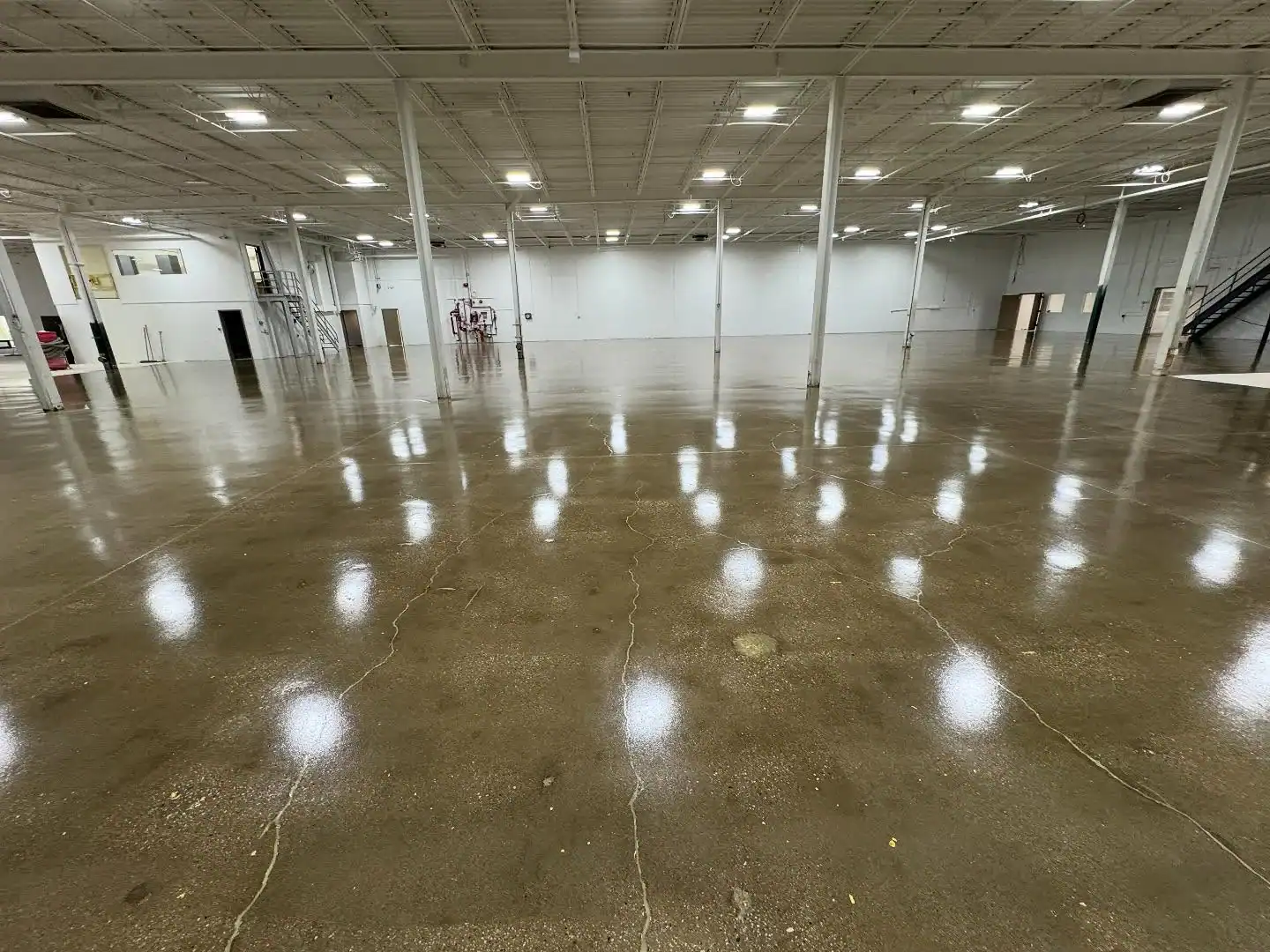
A properly installed industrial warehouse floor epoxy in Valley Stream, NY typically lasts 10 to 15 years under heavy forklift traffic, assuming normal maintenance. That lifespan depends on a few factors: the quality of surface prep, the resin system used, the weight and frequency of your traffic, and whether the floor was designed for your specific load requirements.
Solid-based epoxy systems handle impact and abrasion better than thin-mil coatings or standard garage floor products. If your operation runs forklifts 24/7, you need a system with higher solids content and a topcoat designed for hard-wheeled traffic. Cheaper systems might look fine initially but start showing wear at high-traffic zones within a year or two.
The concrete underneath also matters. If the slab has moisture issues or wasn’t properly cured when poured, even the best coating will fail early. That’s why moisture testing and surface prep aren’t optional steps—they’re what separates a floor that lasts from one that delaminates.
In most cases, yes—but it requires planning. We can phase the installation so you’re only losing access to sections of the floor at a time, not the entire warehouse. For large scale warehouse flooring in Valley Stream, NY, we’ll map out a schedule that keeps your critical pathways and staging areas operational while we work in zones.
Cure time is the main constraint. Depending on the system and temperature, you’re looking at 24 to 72 hours before the floor can handle light foot traffic, and up to a week before it’s ready for full forklift loads. Fast-cure systems exist, but they come with tradeoffs in durability and cost. If you can work around a section being down for a few days, standard systems usually make more sense.
We’ve done installs in active distribution centers where timing was everything—coordinating around shift changes, working overnight, or scheduling around your slowest days. It’s not always convenient, but it’s possible. The key is being upfront about your constraints so we can design a realistic timeline.
Epoxy is a two-part resin system that chemically bonds to concrete and cures into a rigid, durable surface. It’s thicker, harder, and more impact-resistant than urethane, polyaspartic, or acrylic coatings. For warehouse floors in Valley Stream, NY, epoxy is usually the right choice because it handles the combination of heavy loads, abrasion, and chemical exposure better than alternatives.
Polyaspartic coatings cure faster, which sounds appealing, but they’re typically used as topcoats over epoxy rather than standalone systems. They don’t have the same build thickness or impact resistance. Urethane is more flexible and UV-stable, so it works well in areas with sunlight exposure, but it’s not as hard as epoxy and won’t hold up as well under constant forklift traffic.
Acrylic sealers are cheaper and easier to apply, but they wear down quickly in high-traffic environments. You’d be reapplying them every year or two, which ends up costing more in downtime and labor than just installing a proper epoxy system from the start. For a warehouse floor that needs to perform, epoxy is the baseline.
We test for it first using calcium chloride or relative humidity probes. If your slab is reading above acceptable levels—usually 3 pounds per 1,000 square feet over 24 hours or 75% relative humidity—we need to address it before any coating goes down. Moisture vapor will push up through the concrete and cause the epoxy to delaminate, bubble, or fail completely.
In Valley Stream, NY, moisture problems are common in warehouses with uninsulated slabs on grade, especially older buildings. Temperature differences between the slab and the air cause condensation, and that moisture has nowhere to go but up. If the issue is minor, a moisture-mitigating primer can work. If it’s significant, you might need a vapor barrier system or even remediation of the slab itself.
Ignoring moisture is the number one reason warehouse floor coatings fail early. It’s not visible during installation, but it shows up weeks or months later when sections start peeling or blistering. Testing takes a few days, but it’s the only way to know what you’re dealing with and design a system that will actually hold.
Not much. Sweep or dust mop daily to keep grit and debris from getting ground into the surface. Mop with a neutral pH cleaner and water as needed—avoid acidic or highly alkaline chemicals that can dull the finish over time. If you spill something, clean it up promptly. That’s about it.
You don’t need to wax, strip, or recoat an epoxy floor under normal conditions. The surface is already sealed and non-porous, so contaminants sit on top rather than soaking in. That makes cleaning faster and prevents staining. For high-traffic concrete sealer in Valley Stream, NY, the topcoat does most of the work—it’s designed to take the abuse and protect the layers underneath.
Over time, you might see wear patterns in the highest-traffic zones. When that happens, those areas can be abraded and recoated without redoing the entire floor. But if the system was installed correctly and matched to your traffic, you’re looking at years before that’s necessary. The goal is a floor that stays functional without constant attention.
For a proper forklift-rated system in Valley Stream, NY, you’re typically looking at $5 to $12 per square foot, depending on the condition of your existing concrete, the complexity of the prep work, and the specific system you need. That includes surface prep, repairs, moisture mitigation if needed, and a multi-layer epoxy system with a protective topcoat.
If someone quotes you $2 or $3 per square foot, they’re either cutting corners on prep, using a thin-mil coating that won’t last, or leaving out steps that matter. Cheap installs fail fast, and then you’re paying to remove the failed coating and start over—which costs more than doing it right the first time.
Large scale warehouse flooring in Valley Stream, NY often benefits from volume pricing, especially if you’re doing 20,000 square feet or more. But the real cost comparison isn’t just the install price—it’s what you spend over the life of the floor. A system that lasts 15 years with minimal maintenance costs less annually than a cheaper option that needs replacement every three to five years.
Other Services we provide in Valley Stream