


Your forklifts stop bouncing over cracks and uneven spots. Drivers aren’t complaining about back pain from rough surfaces anymore.
The concrete dusting that’s been settling on your inventory and clogging equipment filters disappears completely. You’re not sweeping the same dust every shift or dealing with respiratory complaints.
Chemical spills wipe clean instead of soaking in and leaving permanent stains. Oil doesn’t penetrate. Acids don’t etch. Your floor becomes a sealed, non-porous surface that actually protects the concrete underneath instead of exposing it to constant damage.
Your lighting improves without changing a single bulb because the high-gloss finish reflects light back up into the space. You might see up to 300 percent better brightness in work areas, which means better visibility and fewer safety incidents.
And when you’re not constantly patching, repairing, or replacing sections of damaged concrete, your maintenance budget drops significantly. The floor you install now should still be performing twenty years from now without major intervention.
We’ve been handling commercial and industrial flooring across Long Island since the 1980s. Our president has over forty years of hands-on installation experience, and most of our crew has been with us for more than a decade.
We’ve worked in distribution centers, manufacturing plants, and fulfillment facilities throughout Nassau County. Hicksville’s industrial corridor has plenty of warehouse space, and we’ve seen what happens when floors aren’t built to handle the load. We’ve also seen what proper industrial warehouse floor epoxy in Hicksville, NY can do when it’s installed correctly from the start.
Our team is OSHA-certified. We handle moisture testing, concrete prep, repairs, and full system installation. If you’re operating in a space that needs to stay functional while we work, we’ll schedule around your operations—nights, weekends, whatever minimizes your downtime.

We start with moisture testing. Concrete that looks dry on the surface can still have moisture issues underneath, and if we don’t catch that before installation, your coating will fail. We test, document, and address any moisture problems before moving forward.
Next comes surface prep. This usually means diamond grinding for warehouses in Hicksville, NY to remove old coatings, smooth out uneven areas, and open up the concrete pores so the epoxy bonds properly. If there are cracks, spalls, or structural issues, we repair those first. Applying a coating over damaged concrete just hides the problem temporarily.
Once the surface is prepped and clean, we apply the epoxy system. This isn’t a single coat. It’s a multi-layer process that includes a primer, build coats, and a topcoat designed specifically for high-traffic concrete sealer in Hicksville, NY applications. We can add slip-resistant aggregates, color coding for safety zones, or line striping depending on what your operation needs.
Cure times vary depending on the system, but we’ll give you a clear timeline upfront. Most floors are ready for light traffic within 24 hours and full operational loads within 72 hours.

Ready to get started?
You’re getting a complete system, not just a coating slapped over concrete. That means moisture testing, surface grinding, crack and spall repair, primer application, epoxy build coats, and a urethane or polyaspartic topcoat depending on your needs.
We also handle customization. If you need color-coded zones for foot traffic versus forklift lanes, we build that in. If you want slip-resistant texture in certain areas or high-gloss finish in others, we adjust the system accordingly.
Hicksville’s position in Nassau County makes it a logistics hub. You’ve got access to major highways and proximity to distribution networks across Long Island. That means your facility is likely running at high capacity, and your floor needs to match that intensity. A forklift traffic resistant coating in Hicksville, NY isn’t optional when you’re moving pallets all day—it’s the baseline.
We also know that downtime is expensive. If your operation runs around the clock, we’ll work in phases or off-hours to keep disruption minimal. The goal is to get you a floor that lasts without shutting down your business to install it.
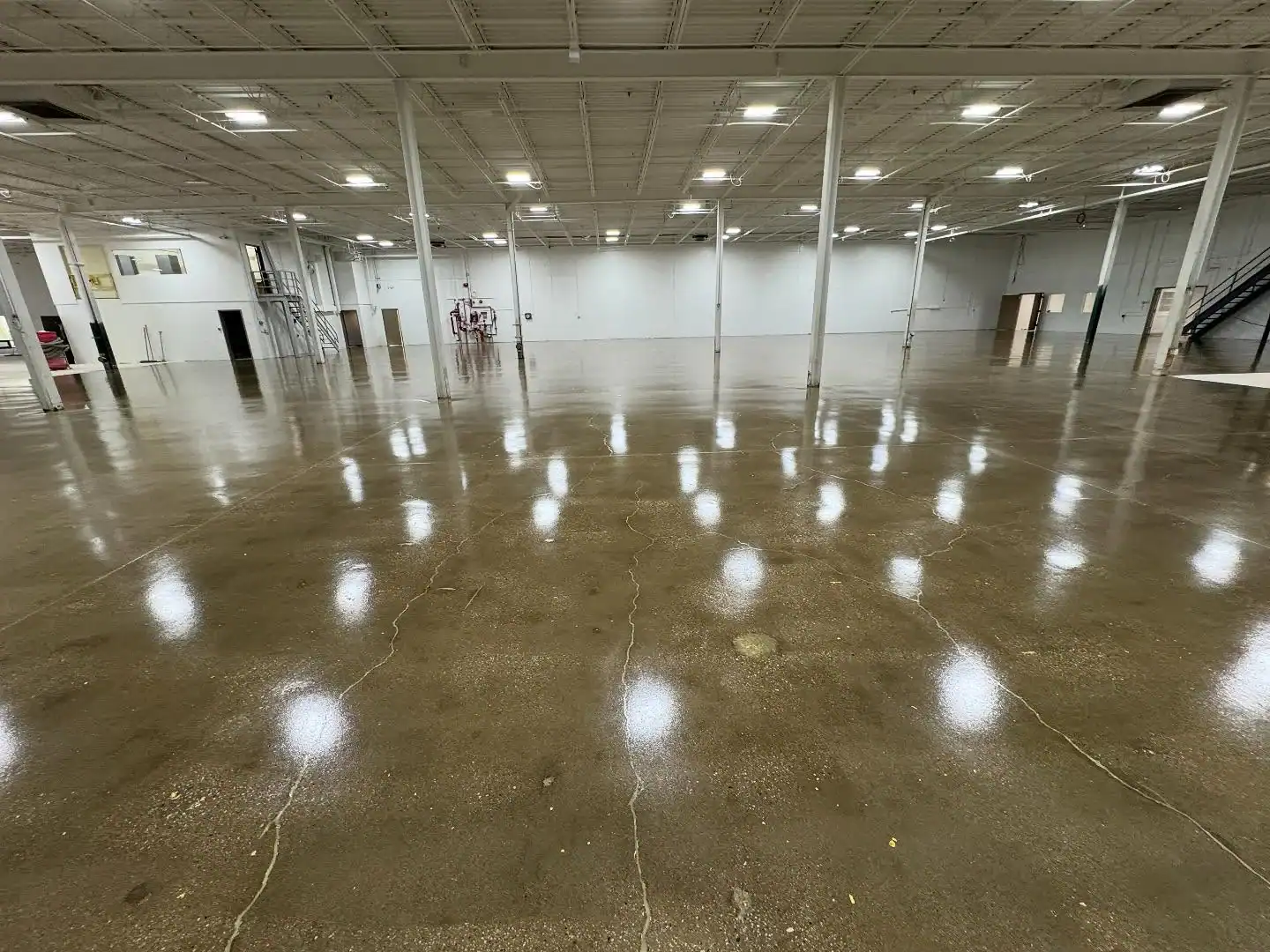
If it’s installed correctly with proper prep and the right system, you’re looking at twenty to thirty years of performance. That assumes normal wear from forklifts, pallet jacks, and daily operations.
The key is in the prep work. If the concrete isn’t ground properly or moisture issues aren’t addressed, the coating can delaminate within a year or two. But when the surface is prepped right and the epoxy bonds fully, it becomes part of the concrete—not just a layer sitting on top.
You’ll also want to make sure the system is rated for your specific load requirements. Not all epoxy coatings are built the same. A system designed for light foot traffic won’t hold up under 10,000-pound forklifts making tight turns all day.
Yes. Concrete dusting happens when the surface starts breaking down and releasing fine particles into the air. It’s common in older warehouses where the concrete was never sealed or the existing coating has worn through.
Epoxy creates a seamless, non-porous barrier over the concrete. Once that’s in place, the concrete underneath is protected from abrasion, impact, and the freeze-thaw cycles that cause deterioration. No more dust floating around or settling on your racking and inventory.
This also means your equipment filters stay cleaner and your air quality improves. If you’ve been dealing with dust complaints from your crew or constantly sweeping the same areas, a proper floor coating eliminates that issue entirely.
We repair it before applying any coating. Cracks, spalls, and uneven areas need to be addressed first, or they’ll just telegraph through the new surface and cause problems later.
For minor cracks, we’ll rout them out, clean them, and fill them with an epoxy crack filler that bonds to the surrounding concrete. For larger structural issues—like slab displacement or areas where the subgrade has settled—we may need to do more extensive concrete repair or even remove and repour sections.
The goal is to create a stable, level surface before the coating goes down. Skipping this step is why a lot of warehouse floors fail prematurely. You can’t coat over problems and expect them to go away.
Most systems allow light foot traffic after 24 hours and full operational loads—including forklifts—after 72 hours. Some fast-cure systems can cut that down even further if you’re in a situation where downtime is critical.
We’ll give you an exact timeline based on the system we’re installing and the conditions in your facility. Temperature and humidity affect cure times, so if we’re working in the middle of winter or during a humid stretch, that factors into the schedule.
If you can’t afford any downtime, we can work in phases. We’ll section off areas, complete the installation, let them cure, and then move to the next section while you continue operating in the finished areas.
Yes, that’s one of the main reasons warehouses use it. Epoxy is chemically resistant, which means oils, solvents, acids, and most industrial chemicals won’t penetrate or damage the surface.
When a spill happens, it sits on top of the coating instead of soaking into the concrete. You wipe it up, and there’s no stain, no odor, and no lasting damage. Compare that to bare concrete, which is porous and absorbs everything. Once oil or chemicals soak in, you can’t get them out.
The level of chemical resistance depends on the specific system. If your operation deals with particularly aggressive chemicals, we’ll recommend a coating formulated for that environment. But for general warehouse use—hydraulic fluid, diesel, cleaning agents—standard epoxy systems handle it without issue.
Epoxy offers the best combination of durability, chemical resistance, and cost-effectiveness for high-traffic warehouse environments. Other options like polyurethane or polyaspartic coatings have their place, but epoxy is the standard for a reason.
Polyurethane topcoats are often used over epoxy base layers because they add UV resistance and flexibility. Polyaspartic coatings cure faster, which is useful if you need the floor back in service quickly. But for the base system that’s taking the impact and abrasion, epoxy is hard to beat.
Some facilities use polished concrete, which looks clean and can handle traffic, but it doesn’t offer the same chemical resistance or seamless finish. Paint and sealers are cheaper upfront but wear through quickly under forklift traffic. You end up reapplying them every year or two, which costs more in the long run than installing a proper epoxy system once.