
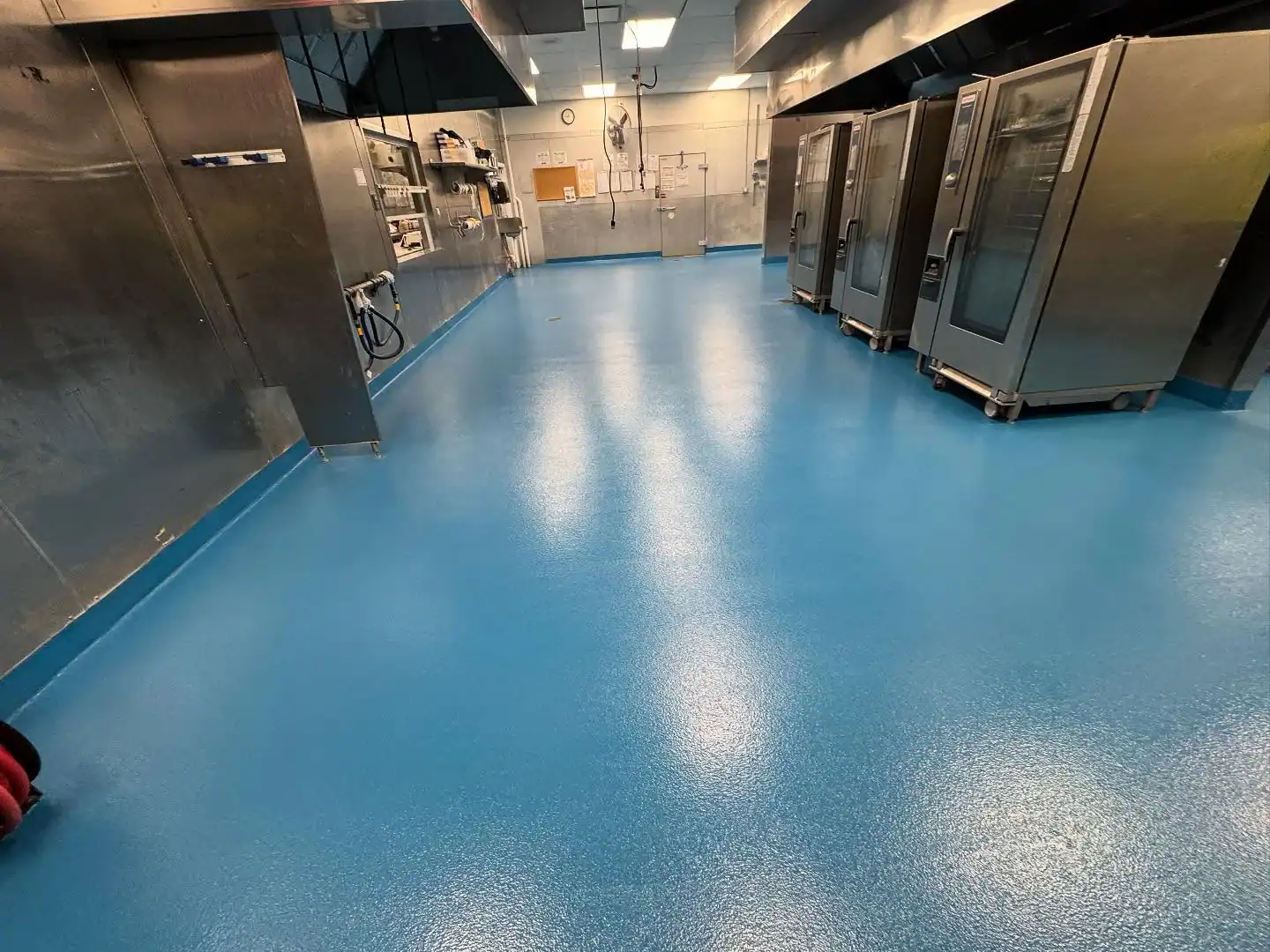
The most immediate difference is what disappears. No more grout lines trapping grease after a busy dinner service. No more cracked tile edges that your cleaning crew works around instead of through. No more dreading the next Nassau County Department of Health inspection because you already know the floor isn’t going to pass. A properly installed seamless floor eliminates those problems at the source not temporarily, but for the long haul.
Hicksville’s commercial building stock is largely mid-20th century construction. A lot of those slabs were never designed with modern moisture vapor barriers, and Nassau County’s coastal humidity makes that a real problem. When moisture vapor pushes up through concrete and there’s a coating on top that wasn’t applied over a tested, prepared surface, delamination is the outcome usually within a year or two. That’s not bad luck. That’s a skipped step. A floor installed correctly, with moisture testing done first and proper surface preparation done before any product goes down, doesn’t behave that way.
For the South Asian restaurants along Hicksville’s Broadway corridor kitchens running tandoor ovens, high-BTU commercial ranges, and aggressive steam cleaning cycles the floor system matters even more. Standard epoxy can’t handle the thermal shock those kitchens produce. The right system for that environment is a urethane cement mortar, and that’s exactly what those kitchens need to stop replacing their floors every few years.
We’ve been installing commercial kitchen floors for 35 years, with work across the United States and the Bahamas. Our company was built around a simple observation: too many commercial floors were failing, and almost every failure traced back to the same root cause a contractor who didn’t understand the science behind what they were applying, or who skipped the steps that actually determine how long a floor lasts.
We hold Sherwin-Williams High Performance Flooring ATP certification and Res Tech certification two manufacturer-backed credentials that cover concrete assessment, surface preparation, primer and topcoat systems, and full application methodology. Those aren’t decorative. They represent a level of technical training that most general flooring contractors working in Nassau County simply don’t have.
Hicksville’s restaurant operators from the food court tenants at Broadway Commons to the owner-operated Indian and South Asian restaurants along Broadway deserve a contractor who actually understands what their kitchen demands. That’s what we show up with.

The first thing we do before any product gets mixed or any equipment gets unloaded is test your concrete for moisture. In Nassau County, where coastal humidity creates elevated moisture vapor conditions in slabs especially in older buildings this step is non-negotiable. If moisture levels are too high and we coat over it anyway, the floor will fail. We address moisture issues before moving forward, full stop.
Once the slab is confirmed ready, we grind the concrete to the correct surface profile for maximum adhesion, fill any cracks or voids, and level uneven areas. This is the part of the job most people never see, but it’s the part that determines everything. After that, we apply the base coat, then the build coats that give the floor its impact and chemical resistance, and finally a slip-resistant topcoat engineered to meet OSHA and ANSI COF standards for commercial kitchen environments.
If your kitchen runs the kind of high-heat operation common in Hicksville’s South Asian restaurant corridor tandoor ovens, heavy steam, extreme temperature swings we install a cementitious urethane mortar system in those zones instead of standard epoxy. It’s the only system that handles thermal shock reliably. We also install integral coved base at every floor-to-wall junction, which is required under Nassau County Department of Health food service regulations and eliminates the bacterial harborage points that grouted tile creates. Before we start, you’ll know exactly how long your kitchen will be out of service. We can work overnight or over a weekend to minimize your downtime.

Ready to get started?
Every commercial kitchen floor we install in Hicksville is a seamless, non-porous, non-absorbent system that meets the floor surface standards in the Nassau County Sanitary Code and the FDA Food Code specifically Sections 6-201.11 and 6-501.11, which require surfaces to be smooth, easily cleanable, and free of cracks, chips, and gaps. If your renovation requires plan review through the Nassau County Department of Health Food Protection Division, we understand what those submissions need to reflect. That’s not something every contractor working in this market can say.
For standard commercial kitchen environments delis, catering operations, food court tenants, and general restaurant kitchens we install a multi-layer epoxy system: moisture-tested and prepared concrete, base coat, build coats for impact resistance, and a slip-resistant topcoat. For high-heat zones like those found in the South Asian restaurants along Hicksville’s Broadway corridor, we use cementitious urethane mortar, which is engineered specifically for thermal shock resistance and steam cleaning compatibility. Both systems include integral coved base installation at floor-to-wall junctions.
If you’re operating out of one of Hicksville’s older commercial buildings the kind built during the town’s post-World War II development boom we pay particular attention to slab condition and moisture levels during prep. Those structures have a history of moisture-related flooring failures, and we’re not going to add to it.

Yes, and this is one of the more commonly overlooked requirements for Hicksville restaurant operators. The Nassau County Department of Health Food Protection Division requires plan review approval before any material change to a food service establishment’s kitchen including flooring. That means if you’re replacing quarry tile with a seamless epoxy or urethane cement system, you need to submit plans and receive approval before the work begins. Operating without that approval is a violation in its own right.
The plan review process involves submitting documentation that demonstrates the new floor system meets Nassau County’s sanitary code requirements smooth, non-porous, non-absorbent, easily cleanable, properly coved at wall junctions, and sloped to floor drains where required. We understand what those submissions need to show, and the systems we install are spec’d to meet those requirements. If you’re unsure where to start, the Nassau County Department of Health Plan Review Officer can be reached at 516-227-9717.
Standard epoxy is not the right answer for a kitchen running a tandoor oven or high-BTU commercial ranges. The problem is thermal shock the stress that rapid temperature changes create in a coating. When the floor near a tandoor gets extremely hot and then gets hit with cold water or a steam cleaner, standard epoxy expands and contracts at a rate the bond can’t sustain. It cracks and delaminates, usually in the zones closest to the heat sources.
The system designed for that environment is cementitious urethane mortar. It handles thermal shock, stands up to boiling oil spills, and is fully compatible with the aggressive steam cleaning protocols that South Asian restaurant kitchens typically use. It’s also non-porous and seamless, which means it meets Nassau County health inspection standards for food preparation surfaces. If your kitchen runs the kind of equipment common in Hicksville’s Broadway restaurant corridor, that’s the system your floor zones actually need not a standard garage-grade epoxy product.
Almost every premature epoxy failure in a commercial kitchen traces back to one of two causes: skipped moisture testing or inadequate surface preparation. On Long Island, and particularly in Nassau County where coastal humidity creates elevated moisture vapor conditions in concrete slabs, moisture is the dominant failure driver. When a coating is applied over concrete with moisture vapor pushing up through it, the bond breaks down from underneath and there’s nothing you can do to fix it short of stripping the floor and starting over correctly.
The second cause is surface prep. If the concrete wasn’t ground to the right profile, if contamination from previous coatings wasn’t fully removed, or if cracks and voids weren’t properly filled before the system went down, the floor will fail regardless of what product was used. Hicksville’s older commercial buildings many of them built in the mid-20th century often have slabs with previous coating residue, surface contamination, and structural irregularities that have to be addressed before anything new will bond correctly. That prep work is where the job is actually won or lost, and it’s also the step that gets rushed or skipped most often.
That depends on the size of the kitchen and the system being installed, but for most commercial kitchen floors in Hicksville, you’re looking at one to three days from start to return-to-service. With a polyaspartic topcoat system, return to light foot traffic is possible within hours, and full commercial use is typically achievable within 24 to 36 hours. Urethane cement mortar systems require slightly longer cure windows, but the timeline is still workable around a restaurant schedule.
We can schedule installations overnight or over a weekend to avoid disrupting your service hours. Before we start, you’ll get a specific timeline based on your kitchen’s square footage, current slab condition, and the system being installed not a vague estimate. Hicksville’s restaurant corridor runs at high volume, and we understand that every day your kitchen is down has a real dollar cost. Planning the installation around your schedule isn’t a courtesy it’s part of how the job gets done right.
In most cases, the answer is no and it’s worth understanding why before you get a quote from someone who says yes without qualifications. Quarry tile with intact grout and a fully bonded surface can sometimes serve as a substrate, but the grout lines create a profile problem: the coating has to bridge those joints, and over time, the movement in the grout lines telegraphs through the coating and causes it to crack. More commonly in older Hicksville kitchens, the tile has loose sections, failing grout, or previous coating residue that makes it an unreliable base regardless.
The standard approach is to remove the existing tile, assess the concrete slab underneath, address any moisture issues or surface irregularities, and install the new system directly over properly prepared concrete. This adds time and cost upfront, but it’s the only way to guarantee the floor bonds correctly and lasts. A coating installed over questionable tile is a floor that’s already scheduled to fail you’re just paying twice instead of once.
For most commercial kitchen floors in Hicksville, installed cost typically runs between $8 and $18 per square foot depending on the system, the condition of the existing slab, and whether tile removal is required. A standard multi-layer epoxy system for a mid-size restaurant kitchen generally lands in the $4,000 to $9,000 range. Urethane cement mortar systems for high-heat zones run higher typically $12 to $18 per square foot because of the material cost and installation complexity involved.
What drives cost up most in Hicksville specifically is slab condition. The town’s older commercial building stock frequently presents slabs with previous coating residue, moisture issues, or structural irregularities that require additional prep time before any system can go down correctly. Skipping that prep to hit a lower price point is how floors fail in 18 months instead of lasting 15 to 20 years. When you’re comparing quotes, the most useful question isn’t who’s cheapest it’s whether moisture testing and full surface preparation are included in the scope, or whether those are the steps being left out to get the number down.