


You’re not dealing with a showroom. Your floor sees forklifts making sharp turns, pallets sliding, trucks backing in, and spills that sit too long because everyone’s busy.
When your warehouse floors in Freeport, NY are done right, you stop worrying about cracks turning into potholes. You stop watching small nicks become safety hazards. Your forklifts move smoothly instead of jarring drivers over every bump, and your loads stay stable instead of shifting when equipment hits uneven spots.
A proper forklift traffic resistant coating in Freeport, NY means seamless surfaces that don’t collect debris in cracks. It means chemical resistance when something spills. It means you can hose down the floor at the end of a shift without wondering if you’re making the problem worse. Most importantly, it means your operation keeps moving without surprise shutdowns for emergency floor repairs.
We work with warehouse and distribution operations across Long Island. Our installers are OSHA 40 certified, and our field supervisors bring over 40 years of combined experience to every job in Freeport, NY.
We’re not a residential flooring company trying to figure out industrial work. We understand forklift traffic patterns, load requirements, and what happens when a floor system isn’t specced correctly for the environment. Most of our team has been with us over 10 years because we focus on doing the work right, not just doing it fast.
Freeport’s proximity to major distribution routes means warehouses here run hard. Your floor needs to match that pace, and we build systems that do.

We start with diamond grinding for warehouses in Freeport, NY to prep the concrete properly. This isn’t optional. If the surface isn’t prepared right, nothing we put on top will hold up to your traffic.
Next, we assess what your floor actually needs based on your operation. A facility running three forklifts on day shift needs a different system than a 24/7 distribution center with constant heavy equipment. We’re looking at your traffic patterns, what you’re moving, and where the wear concentrates.
Then we install the system that matches those demands. For most warehouse applications, that means a high-traffic concrete sealer in Freeport, NY or a heavier epoxy system depending on load requirements. We can go up to 1/4″ trowel down systems for extreme conditions. The installation is timed to minimize disruption, and we’re clear about cure times so you know exactly when you can get back to full operations.

Ready to get started?
Every warehouse floor project includes surface preparation through diamond grinding, which removes weak concrete and creates the profile needed for proper adhesion. You get a system specced to your actual traffic, not a one-size-fits-all coating.
We install seamless warehouse flooring that eliminates the joints where damage starts. The system includes chemical resistance for whatever you’re handling, impact resistance for dropped pallets and equipment contact, and abrasion resistance for constant forklift traffic. If you need line striping for traffic lanes, pallet zones, or battery charging areas, that’s integrated during installation so it lasts as long as the floor.
In Freeport, NY, warehouse operations often deal with temperature swings and humidity from coastal proximity. We account for that in system selection and installation timing. You also get a realistic timeline upfront. We don’t promise two-day miracles on large-scale warehouse flooring in Freeport, NY, because proper installation takes the time it takes. But we do minimize your downtime by working in phases when possible and being clear about when each area will be ready for traffic.
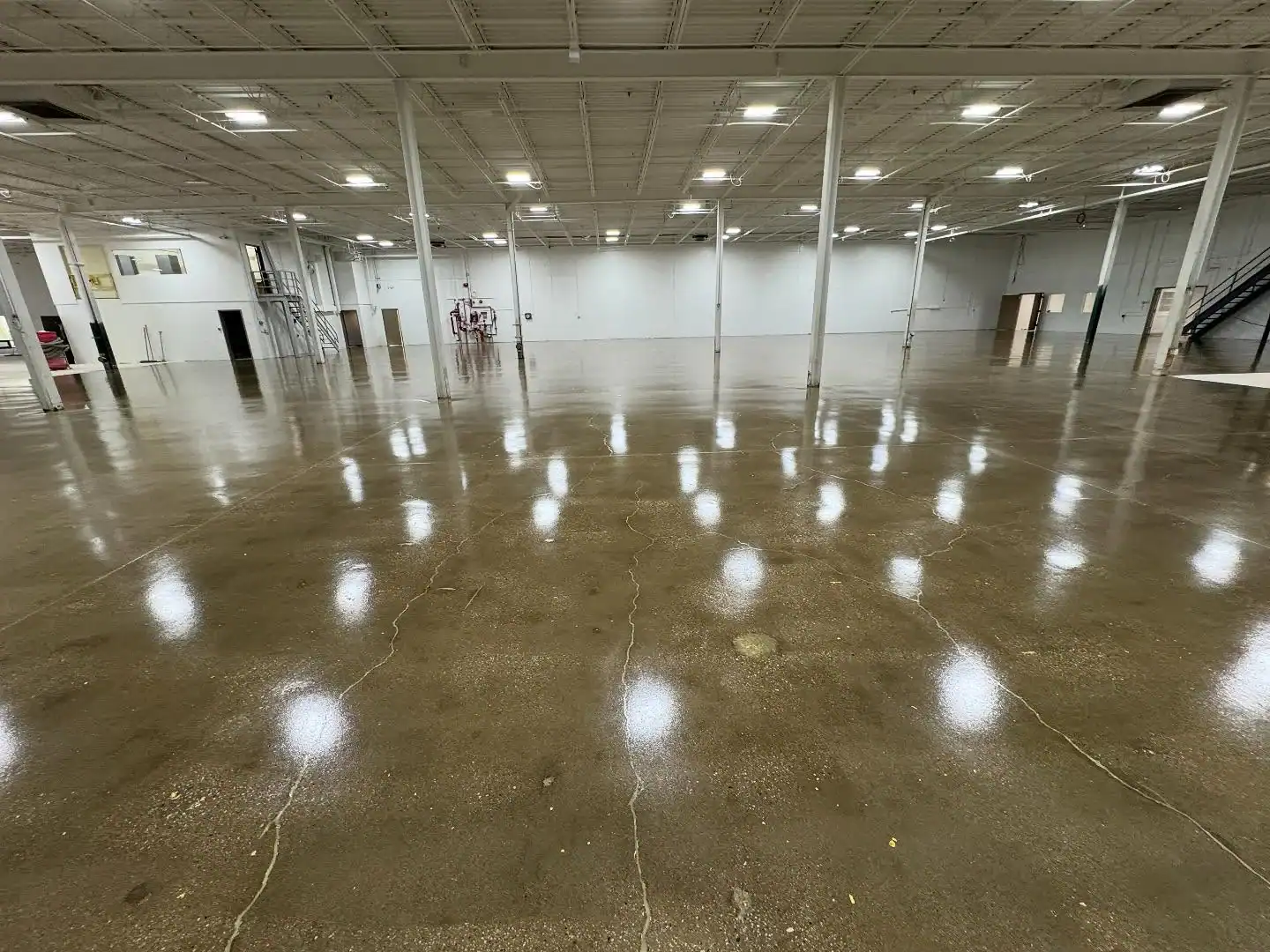
It depends entirely on the system and how it’s installed. A thin coating might give you two to three years before you’re patching it. A properly specced epoxy system for industrial warehouse floor epoxy in Freeport, NY should give you 10 to 15 years or more with normal wear.
The difference comes down to thickness, preparation, and matching the system to your traffic. If you’re running forklifts all day, you need a system built for that, not a standard coating. We typically recommend at least a 1/8″ system for consistent forklift traffic, and 1/4″ trowel down systems for heavy operations.
The other factor is maintenance. Even the best floor won’t last if you ignore small damage. Catching a crack early means a simple repair. Letting it spread means you’re eventually replacing sections.
Yes, and that’s usually how we approach larger facilities. We work in phases so you can keep operating in other areas while we’re installing.
The key is planning the sequence right. We map out which sections can be done first based on your traffic flow and staging needs. Most warehouse floors in Freeport, NY can be done in sections over a few weeks rather than shutting everything down for a week straight.
Cure time is the limiting factor. You’ll need to stay off each section for 24 to 48 hours minimum, with full cure taking about a week depending on the system. Light foot traffic comes first, then equipment. We’re upfront about those timelines during planning so you can schedule around them.
Sealed concrete is a thinner system, usually a penetrating sealer or a thin topical coating. It works for lighter traffic and gives you dust control, easier cleaning, and some chemical resistance. It’s faster to install and less expensive.
Epoxy systems are thicker and more durable. A forklift traffic resistant coating in Freeport, NY is typically an epoxy or urethane system that builds up a protective layer on top of the concrete. It handles heavier impacts, more aggressive chemicals, and constant abrasion better than a sealer.
If you’re running forklifts daily, moving heavy pallets, and dealing with spills, you probably need epoxy. If your traffic is lighter or mostly foot traffic with occasional equipment, a high-traffic concrete sealer in Freeport, NY might be enough. We can assess your specific situation and recommend what actually makes sense instead of just selling you the most expensive option.
Texture. We add slip-resistant aggregate to the topcoat, which creates traction even when the floor is wet from cleaning or spills.
The amount of texture depends on your operation. Too much and it’s harder to clean. Too little and you’ve got a safety issue when someone hoses down the floor or a forklift drips hydraulic fluid. We typically add enough to meet OSHA standards without making the surface rough enough to catch debris.
For warehouse environments, we’re usually adding a medium broadcast texture. It gives you traction for foot traffic and doesn’t create problems for forklift wheels. If you have specific concerns about certain areas, like loading docks where water tracks in, we can adjust texture levels by zone.
Small damage like surface scratches or minor chips usually doesn’t need immediate attention. They’re cosmetic. Larger gouges, cracks, or areas where the coating is delaminating should be repaired before they spread.
Most damage in warehouse settings comes from impacts, like a dropped pallet or a forklift hitting the same spot repeatedly. If we catch it early, repairs are straightforward. We grind out the damaged area, prep it, and patch it with the same system. It’s not invisible, but it’s solid.
The bigger issue is ignoring damage. A small crack becomes a bigger crack. Water or chemicals get under the coating. Then you’re looking at a larger repair or even replacing a section. We recommend quarterly inspections where you just walk the floor and mark anything that looks off. Catching problems early saves money and downtime compared to waiting until something fails during a busy period.
For most warehouse applications in Freeport, NY, you’re looking at $3 to $8 per square foot depending on the system. A basic grind and seal runs on the lower end. A heavy-duty 1/4″ epoxy system runs higher.
The variables are square footage, current floor condition, and what system you actually need. If your concrete is in bad shape, we need to repair it first. If you need extensive line striping or multiple colors for zone marking, that adds cost. If you’re doing 50,000 square feet, your per-square-foot cost drops compared to a 5,000 square foot space.
We don’t quote over the phone because too many factors matter. But we can walk your facility, assess what you’re dealing with, and give you a real number based on your actual needs. That includes breaking down what you’re paying for so you understand where the money goes and what you’re getting for it.