
When your kitchen floor fails whether it’s delaminating epoxy, cracked quarry tile, or grout lines that no amount of scrubbing can fully clean the problem isn’t just cosmetic. In Nassau County, a floor-related violation on a health inspection report is a real event with real consequences. For a restaurant in Great Neck or a dining room near the Americana Manhasset, that kind of citation doesn’t stay quiet.
A properly installed, seamless epoxy floor eliminates the grout lines that trap grease and bacteria, gives inspectors nothing to cite, and holds up under the daily punishment of a commercial kitchen. You get a surface that can actually be sanitized not just cleaned.
North Hempstead’s waterfront communities add a layer that most contractors don’t account for. Great Neck is surrounded by water on three sides. Port Washington sits on Manhasset Bay. The moisture vapor that pushes up through concrete slabs in these areas is the leading cause of epoxy delamination and it’s more likely to happen here than in any dry inland town. When your floor is installed with a proper moisture assessment from the start, you’re not gambling on how long it holds.
We’ve been installing commercial and industrial floors for 35 years throughout Long Island, across the United States, and into the Bahamas. Our company was built around a straightforward observation: too many commercial floors were failing, not because of bad luck, but because contractors were skipping the steps that actually determine whether a floor holds.
That’s still true today. And it’s especially true in North Hempstead, where older commercial buildings in places like Great Neck Plaza and Port Washington’s village centers have slabs with decades of history previous coatings, freeze-thaw damage, grease penetration, and moisture issues that a standard install-and-go approach can’t handle.
We hold Sherwin-Williams High Performance Flooring ATP certification and Res Tech certification dual manufacturer credentials that most Long Island epoxy contractors simply don’t have. When an institutional buyer at a Northwell Health facility or a restaurant operator in Manhasset asks for documented qualifications, those credentials are there.

The first thing that happens on every job before any grinding, before any product is moisture testing. This isn’t a formality. In North Hempstead’s waterfront communities, concrete slabs regularly show elevated moisture vapor readings that would cause a standard epoxy application to delaminate within months. Testing first means you know what you’re working with before it becomes a problem.
From there, we grind the concrete to the correct surface profile for proper adhesion. Cracks are filled, voids are leveled, and the slab is fully prepared before a base coat goes down. Each layer base coat, build coats for thickness and impact resistance, slip-resistant topcoat gets full cure time before the next is applied. That’s not a slow process; it’s the process that determines whether your floor lasts three years or twenty.
For North Hempstead operators, scheduling is part of the conversation from the start. The late winter window January through March is when most restaurants and food service facilities in the area schedule capital work before the spring and summer season picks up. Fast-cure topcoat systems allow light foot traffic within hours and full commercial service within 24 to 36 hours. For larger kitchens, phased installation keeps partial operations running throughout the project. Our goal is always to get you back to full service as quickly as the process honestly allows.

Ready to get started?
Not every commercial kitchen in North Hempstead has the same floor requirements, and the system that works in a corporate cafeteria isn’t automatically the right call for a high-volume Asian restaurant in Great Neck or a hospital food service kitchen at a Northwell facility in New Hyde Park. The heat load from a wok station, the steam output from commercial cooking equipment, the chemical concentration of industrial sanitizers these factors determine which coating system actually belongs in your kitchen.
Every installation starts with an assessment of your kitchen’s specific environment: heat zones, moisture levels, traffic patterns, drain placement, cleaning protocols, and the condition of your existing slab. For older buildings in North Hempstead’s village centers where mid-century concrete slabs often carry layers of previous coatings, surface damage, and unresolved moisture history that assessment does real work before a single product decision is made.
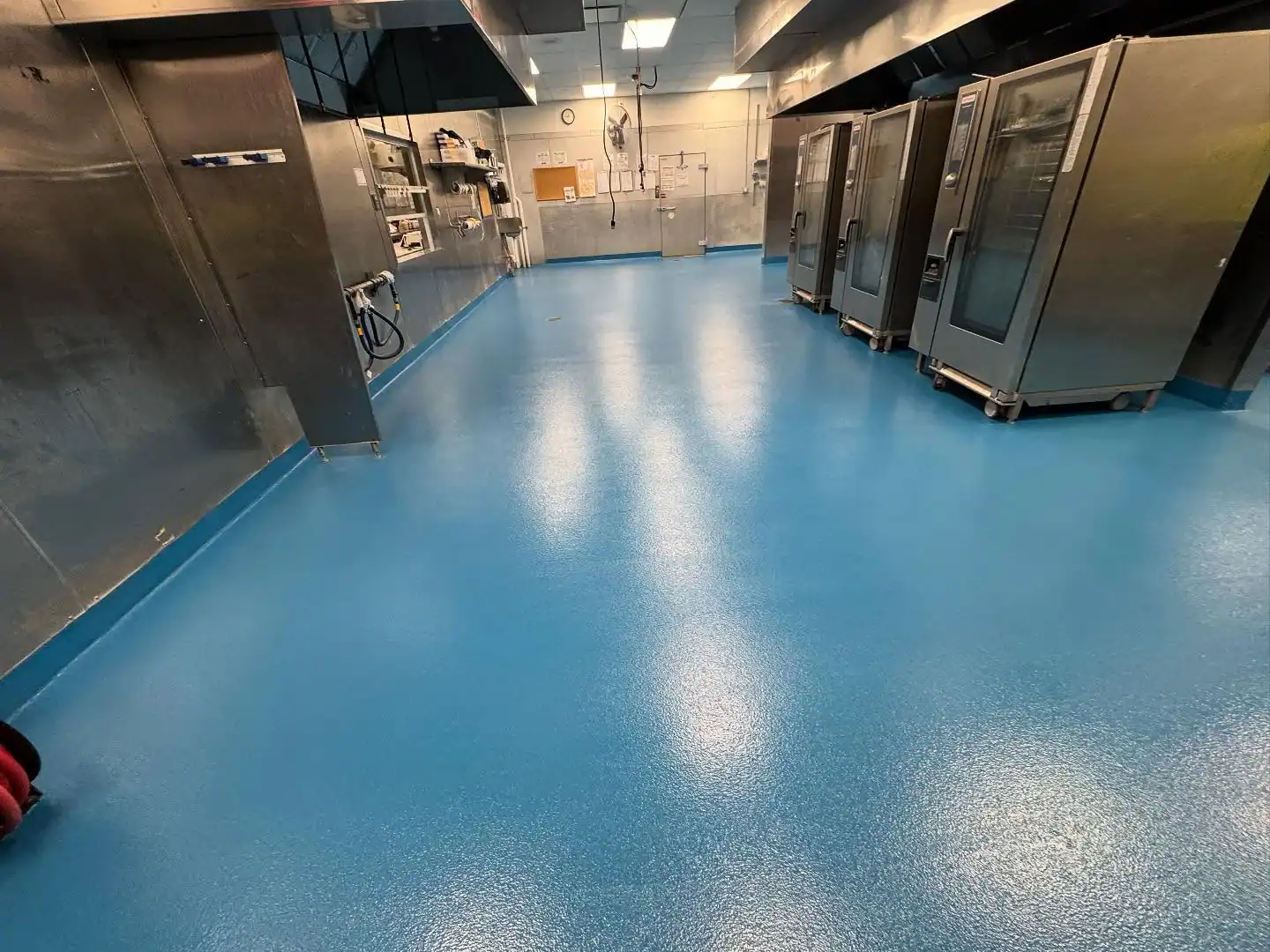
The finished system is seamless, non-porous, and coved at the floor-to-wall junction meeting FDA Food Code requirements under Sections 6-201.11 and 6-501.11, and designed to hold up under Nassau County Department of Health inspections. Whether you’re running a full-service restaurant near the Americana Manhasset corridor, managing an institutional food service operation, or operating out of an older commercial building in Port Washington, the system is matched to what your floor actually needs.

Not technically but grouted surfaces like quarry tile are one of the most commonly cited floor-related violations in Nassau County food service inspections. The FDA Food Code requires commercial kitchen floors to be smooth, non-porous, non-absorbent, and easily cleanable. Grout lines are porous by nature, and no matter how aggressively you clean them, they trap grease, food particles, and bacteria in ways that standard kitchen cleaning protocols can’t fully address.
Nassau County Department of Health inspectors enforce these standards under New York State Sanitary Code and the Nassau County Public Health Ordinance. A floor that’s technically permitted but visibly deteriorated cracked grout, pitted tile, worn surfaces can still generate a non-critical violation that requires correction. A seamless epoxy system eliminates every one of those citation points. For a restaurant in an affluent North Hempstead community like Great Neck or Manhasset, where a health inspection result can circulate quickly among a knowledgeable clientele, that’s worth thinking about seriously.
For most commercial kitchens, the full installation process surface prep, base coat, build coats, and topcoat takes two to three days from start to finish. Fast-cure polyaspartic topcoat systems allow light foot traffic within a few hours of the final coat and full commercial service within 24 to 36 hours. That means a Friday night close and a Monday morning open is a realistic schedule for many operators.
For larger kitchens, we offer phased installation. One zone is completed while the other stays operational, so you’re not shutting down the entire kitchen at once. The late winter window January through March is when most North Hempstead food service operators schedule this kind of work, taking advantage of slower business periods before the spring and summer dining season. If your timeline is tighter, the scheduling conversation happens upfront so there are no surprises.
The short answer is moisture. Great Neck is a peninsula surrounded by Long Island Sound and its tributaries on three sides. Port Washington sits directly on Manhasset Bay. Both communities sit on glacially formed terrain with clay-heavy soils that hold water and transmit moisture vapor upward through concrete slabs. That moisture vapor pressure is the leading cause of epoxy delamination and it’s measurably more likely to occur under a slab in these waterfront communities than under a slab in a dry inland town.
When a contractor skips moisture testing before applying an epoxy system, they’re essentially guessing. In a building in Roslyn or Mineola, that guess might work out. In a waterfront building in Great Neck or Port Washington, it’s a near-guarantee of early failure. We make moisture testing the mandatory first step on every installation not an optional add-on because skipping it in this market isn’t a shortcut. It’s a predictable way to end up with a floor that needs to be replaced in a year.
Standard epoxy systems have a heat tolerance ceiling, and certain commercial kitchen environments push past it. High-volume wok stations, commercial steam cooking equipment, and industrial dishwashing areas generate heat and moisture conditions that a standard epoxy build coat can’t reliably handle long-term. In those zones, urethane cement or epoxy mortar systems are the appropriate specification they’re engineered for thermal shock resistance and can handle the rapid temperature swings that come with hot-water cleaning cycles and steam exposure.
This matters specifically in North Hempstead because the town’s significant Asian-American population particularly concentrated in Great Neck and New Hyde Park has driven a robust Asian restaurant scene with high-volume, high-heat kitchens that put real stress on floor systems. Our assessment process before any installation includes identifying which zones in your kitchen require a heat-tolerant specification versus which zones can be handled with a standard build. The right system in the right zone is what gives a kitchen floor a real service life.
The honest answer is that it depends on your slab condition, your kitchen’s heat and moisture load, your cleaning protocols, and how your kitchen is laid out. There’s no single system that’s right for every commercial kitchen in North Hempstead a hospital cafeteria kitchen at a Northwell facility in New Hyde Park has different requirements than a full-service restaurant near the Americana Manhasset corridor, and both are different from a small food service operation in an older Port Washington building with a moisture-compromised slab.
Our assessment process covers all of it: existing slab condition, moisture readings, heat zones, drain placement, traffic patterns, and what cleaning chemicals your staff uses. Some chemicals particularly high-alkalinity sanitizers common in institutional food service can degrade certain coating systems over time if the wrong topcoat is specified. Getting the system right from the start means you’re not dealing with a premature failure or a mid-service floor problem. That conversation happens before any product decisions are made.
For a straight resurfacing applying a new coating system over an existing concrete slab without structural changes a building permit is typically not required. However, North Hempstead is made up of 30 incorporated villages, each with its own building department and permitting authority. A restaurant in the Village of Great Neck Plaza operates under different local jurisdiction than one in unincorporated Port Washington or in the Village of Mineola. If your kitchen renovation involves any structural work, drain relocation, or changes to the floor substrate beyond resurfacing, the permitting picture changes depending on exactly where your business is located within the town.
Nassau County Department of Health oversight applies across the entire town regardless of village boundaries your finished floor needs to meet health code standards whether you’re in Kings Point or New Hyde Park. We recommend confirming the specific requirements with your village building department before work begins, especially if the project scope goes beyond a standard resurfacing. We’ve worked throughout Nassau County and can help you navigate the process without unnecessary delays.
Other Services we provide in North Hempstead