
Most kitchen floors in Islip don’t fail because of heavy traffic or harsh cleaning chemicals. They fail because the contractor who installed them skipped moisture testing. In a coastal town sitting directly on the Great South Bay where average humidity peaks at 77% in late spring moisture vapor migrates through concrete slabs and destroys the bond between the coating and the floor. The result is peeling, bubbling, and delamination that shows up within a year or two of installation.
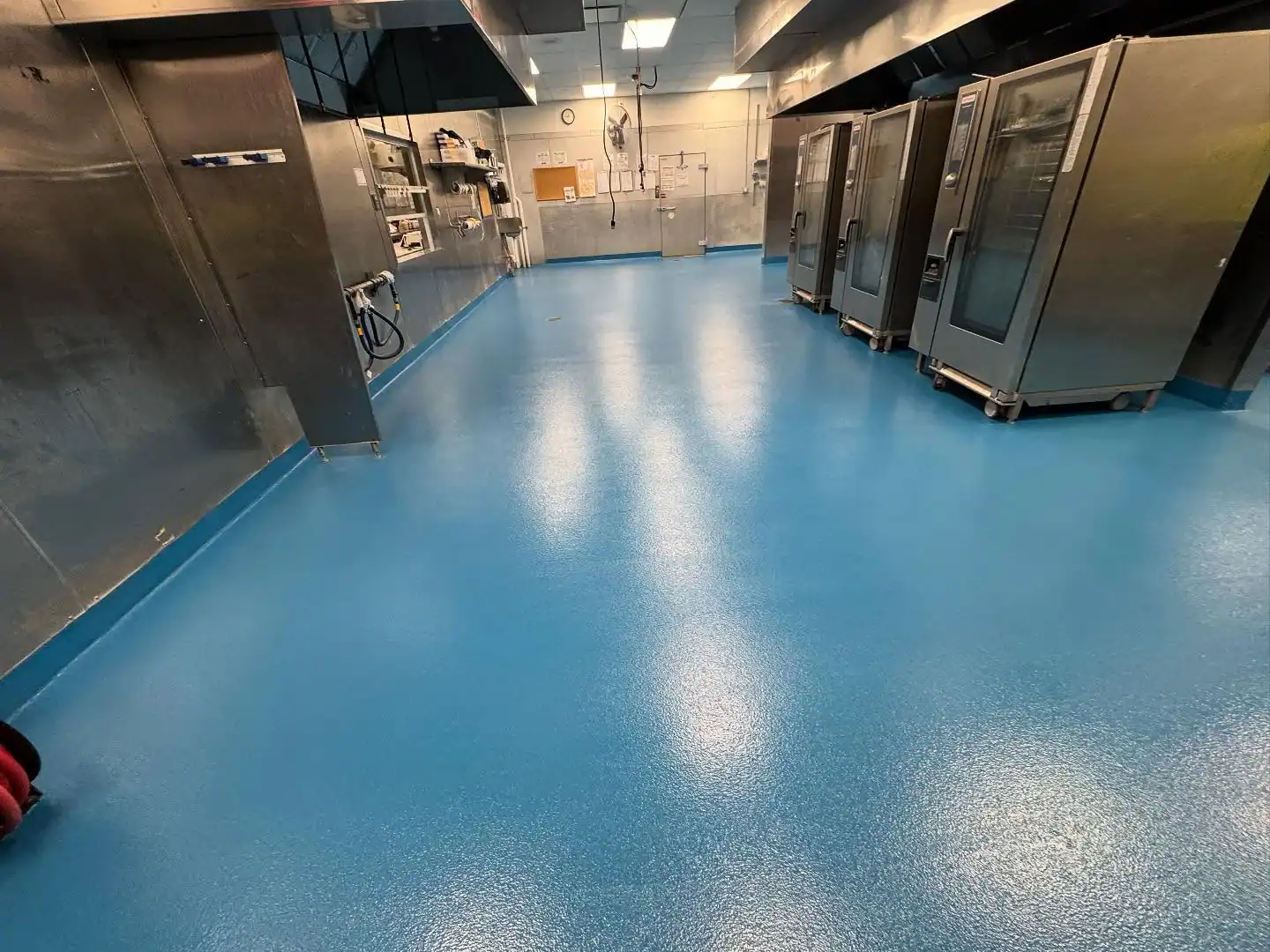
When your floor is installed correctly, the difference is immediate and lasting. No more grout lines trapping grease and bacteria. No more cracked tile that fails a Suffolk County health inspection. No more closing your kitchen for a week because the floor gave out at the worst possible time. You get a seamless, sanitary surface that can take the heat literally from steam equipment, fryers, and commercial cleaning chemicals without breaking down.
For operators along Islip’s Main Street corridor, where many of the buildings date back decades and the concrete slabs underneath them reflect that age, this matters even more. Older slabs crack, shift, and absorb moisture differently than new construction. The right floor system accounts for all of that before a single coat goes down.
We’re based in Bohemia a hamlet within the Town of Islip itself. That’s not a coincidence or a marketing angle. It means we’ve been working in Islip’s climate, on Islip’s building stock, and under Suffolk County’s health inspection standards for 35 years. We know what the south shore does to a floor that wasn’t installed properly.
We hold Sherwin-Williams High Performance Flooring ATP certification and Res Tech certification dual manufacturer credentials that are rare in this market and that reflect a genuine investment in understanding coating systems, not just applying them. Those certifications exist because we believe the science behind the installation matters as much as the labor.
When you call us, you’re not getting a general contractor who picked up epoxy as a side service. You’re getting a team that has spent three and a half decades installing commercial kitchen floors across Long Island and beyond and that knows exactly what it takes to build one that lasts in Islip.

The first thing we do before any coating touches your floor is test for moisture. In Islip’s coastal environment, this step isn’t optional it’s the single most important factor in whether your floor holds up or starts peeling within a year. If moisture levels are too high, we address them before moving forward. Most contractors skip this entirely. We don’t.
From there, we grind the concrete surface to the correct profile for adhesion, fill any cracks, and level uneven areas. In older commercial buildings along Islip’s Main Street some of which have slabs that have been there for 50 or 60 years this prep work is often more involved than it would be in newer construction. We take the time to do it right regardless, because the prep is what the rest of the system depends on.
Once the substrate is ready, we select the right product for each zone of your kitchen. Active cooking areas near fryers and steam equipment get a thermal shock-resistant system. Prep lines and walk-in coolers get formulations matched to those specific conditions. We apply each coat and give it the cure time it actually needs no rushing between layers to hit an arbitrary schedule. When the floor is done, it’s done correctly, and you can return to service on a timeline that works around your kitchen, not ours.

Ready to get started?
Every commercial kitchen floor we install in Islip, NY is designed to meet the standards enforced by the Suffolk County Department of Health Services Food Protection division. That means seamless, non-porous surfaces with no grout lines, an integral cove base at every floor-to-wall junction, proper slope to drains, and a slip-resistant topcoat. These aren’t extras they’re what a Suffolk County health inspector expects to see, and what your kitchen needs to function safely.
For food service operators in Islip, the flooring system we install depends on where in your kitchen it’s going. High-heat cooking zones get urethane cement mortar, which handles the thermal shock that standard epoxy can’t. Prep areas and general kitchen floors get food-grade epoxy build coats selected for chemical resistance and cleanability. Walk-in coolers get systems that handle temperature differentials without cracking or losing adhesion. Every zone gets what it actually needs not a single product applied everywhere because it was easier.
We also work around your schedule. For Main Street restaurants that depend on spring and summer foot traffic from Islip’s waterfront dining scene, a week-long kitchen closure isn’t realistic. We can schedule overnight and weekend installations, and fast-cure topcoat systems allow you to return to service within 24 to 36 hours of completion. Industrial kitchen operators and food processing facilities in the Town of Islip’s commercial and industrial parks are also well within our scope the same certified process applies regardless of the size or type of operation.

Yes and it’s one of the most common reasons kitchen floors in south shore communities like Islip fail earlier than expected. Islip sits directly on the Great South Bay, and average relative humidity in the area peaks around 77% in late spring and early summer. That sustained moisture doesn’t just affect the air it affects the concrete slab beneath your kitchen floor. When moisture vapor migrates upward through the slab and the coating above it wasn’t installed with that in mind, the bond breaks down. You get bubbling, peeling, and delamination.
The fix isn’t a different product it’s a proper installation process. Moisture testing before any coating is applied tells you exactly what you’re working with. If levels are elevated, moisture mitigation steps are taken before the system goes down. Skipping that test is the single most common reason floors fail in coastal environments like Islip, and it’s a step we never skip.
Suffolk County’s Department of Health Services Food Protection division enforces standards that align with the FDA Food Code for all food service establishments in Islip. The requirements are specific: floors must be smooth, non-porous, non-absorbent, and easily cleanable. They must be free of cracks, chips, and gaps. Floor-to-wall junctions require a coved base to eliminate the seam where grease and bacteria accumulate. Drains need to be properly sloped so water doesn’t pool.
Seamless epoxy systems are the recognized standard for meeting these requirements. Unlike quarry tile which is still common in older Islip commercial kitchens and creates grout lines that can’t be fully sanitized epoxy creates a continuous, monolithic surface with no seams. If your current floor has cracks, failing grout, or a surface that’s become porous over time, it’s likely already a violation waiting to be cited. A properly installed epoxy system resolves all of those issues in a single installation.
A properly installed epoxy floor in a commercial kitchen typically lasts 15 to 20 years under normal use sometimes longer, depending on the volume of traffic and how well it’s maintained. The key phrase there is “properly installed.” Floors that were applied without moisture testing, on poorly prepped concrete, or with a product that wasn’t matched to the specific conditions of that kitchen tend to fail in two to five years. That’s not a product failure it’s an installation failure.
In Islip’s older commercial buildings along Main Street, where concrete slabs may have been in place for decades, the prep work is often the most labor-intensive part of the job. Cracks need to be filled, surfaces need to be ground to the correct profile, and any existing coatings need to be removed. When that foundation work is done correctly and the right system is selected for each zone of the kitchen, the floor holds up. Rushing any part of that process is where longevity gets cut in half.
In most cases, yes with the right scheduling. We regularly work overnight and on weekends to minimize disruption to kitchen operations. For restaurants in Islip that depend on consistent service, especially during the spring and summer season when the waterfront dining scene along Main Street is at its busiest, a full-week closure isn’t an option. We plan installations around your schedule, not ours.
Fast-cure polyaspartic topcoat systems allow for return to light service within hours of application and full commercial use within 24 to 36 hours. For larger kitchens, we can phase the installation completing one section at a time so part of the kitchen stays operational throughout the process. The best time to discuss scheduling is during the initial walkthrough, when we can assess the size of the space, the condition of the existing floor, and map out a realistic timeline that protects your revenue.
Both are seamless flooring systems used in commercial kitchens, but they’re designed for different conditions. Epoxy is the right choice for most prep areas, general kitchen floors, and spaces where chemical resistance and cleanability are the primary concerns. It’s durable, food-grade compliant, and holds up well under normal commercial kitchen use.
Urethane cement mortar is the better choice for high-heat cooking zones areas near fryers, ovens, and steam equipment where the floor is regularly exposed to dramatic temperature swings. Epoxy can crack or delaminate under repeated thermal shock. Urethane cement is formulated to flex with those temperature changes without losing adhesion or structural integrity. In a full commercial kitchen, you often need both systems epoxy in the prep and storage areas, urethane cement in the active cooking zone. Installing a single product throughout the entire kitchen to save time is one of the most common mistakes we see, and it’s why cooking line floors fail faster than the rest of the space.
The honest answer is that it depends on the condition of the concrete underneath, not just the surface you can see. If your floor has surface cracks, worn coating, or minor pitting, a repair and recoat may be sufficient. But if the existing coating is delaminating, if there are widespread cracks in the concrete itself, or if the floor has failed a Suffolk County health inspection for being non-cleanable or porous, a full replacement is almost always the better investment.
In Islip’s older commercial buildings particularly those along the Main Street corridor where some structures date back 80 to 100 years the concrete slabs often have a history that isn’t visible until you start the prep work. Previous coatings, moisture damage, and years of thermal cycling from kitchen equipment all affect what the slab looks like beneath the surface. The only way to know for certain what you’re working with is a proper assessment and moisture test before any work begins. That’s how we start every job, and it’s what allows us to give you an honest recommendation rather than a guess.