
You’re dealing with constant foot traffic, equipment wheels, chemical spills, and cleaning protocols that would destroy most floors in months. The flooring in your facility isn’t just a surface—it’s part of your infection control strategy.
Seamless medical-grade epoxy in Oceanside, NY eliminates the grout lines and seams where bacteria grow. No gaps means no hiding spots for pathogens. The surface stays intact under the weight of imaging equipment, crash carts, and everything else that rolls through your hallways daily.
When your environmental services team disinfects, they’re working with a non-porous surface that actually responds to cleaning. Blood, urine, and other biological materials wipe away without penetrating the floor. You’re not just meeting standards—you’re making their jobs possible.
Mount Sinai South Nassau and other facilities in the area understand this. Your flooring either supports your protocols or undermines them. There’s no middle ground when patient safety is on the line.
We’ve been installing commercial flooring systems since before antimicrobial coatings were standard practice. Over 30 years in this industry means we’ve seen what fails and why. Our installers are OSHA 40 certified because healthcare environments demand that level of training.
When you’re working near patient care areas or in active medical facilities, you can’t learn on the job. Our field supervisors have over 40 years of combined experience in medical-grade installations. We’ve handled projects across the country, including facilities with stricter requirements than most hospitals face.
Oceanside’s healthcare facilities—from Mount Sinai South Nassau to the outpatient centers along Long Beach Road—need contractors who understand both the technical requirements and the operational realities. You can’t shut down an entire wing for a week. We plan installations around your schedule because downtime in healthcare isn’t just inconvenient—it’s costly.
First, we test your concrete for moisture. Medical facilities often have moisture issues they don’t know about, and installing over wet concrete guarantees failure. We handle the testing and any necessary moisture mitigation before we touch the coating.
Next comes surface preparation. We’re removing any existing coatings, repairing cracks, and creating the profile the epoxy needs to bond properly. This step determines whether your floor lasts two years or twenty. There’s no shortcut here.
The installation itself uses self-priming systems designed for healthcare. We’re applying USDA/FDA compliant flooring in Oceanside, NY that meets every regulatory requirement you’re held to. The antimicrobial additives are EPA registered. The VOC levels stay low enough that adjacent areas can remain operational.
Curing time depends on the system thickness and your facility’s temperature, but we’re typically talking 24-48 hours before you can walk on it, 72 hours before rolling equipment. We coordinate with your facilities team so you know exactly when each area comes back online.

Ready to get started?
The flooring system we install is 160 mils thick—that’s roughly three times thicker than standard epoxy coatings. You’re getting a surface that won’t crack under point loads from equipment or show wear patterns in high-traffic areas. Operating rooms, laboratories, sterile processing departments—these spaces need floors that look the same in year five as they did on day one.
Low-VOC healthcare coatings in Oceanside, NY matter when you’re working in occupied facilities. You can’t evacuate an entire hospital wing because the fumes are overwhelming. Our systems are 100% solids with minimal odor during application and zero off-gassing after cure.
The slip resistance is built into the texture, not added as an afterthought. You can specify smooth for areas where you need easy cleaning, or textured for spaces where slip prevention is critical. The antimicrobial protection is throughout the coating, not just on the surface, so it doesn’t wear away.
Chemical resistance covers everything your EVS team uses—quaternary ammonium compounds, bleach solutions, hydrogen peroxide, all the disinfectants that destroy vinyl and tile. The floor doesn’t react, doesn’t discolor, doesn’t break down. You’re looking at a surface that requires detergent and water for daily cleaning. No waxing, no stripping, no ongoing maintenance contracts.
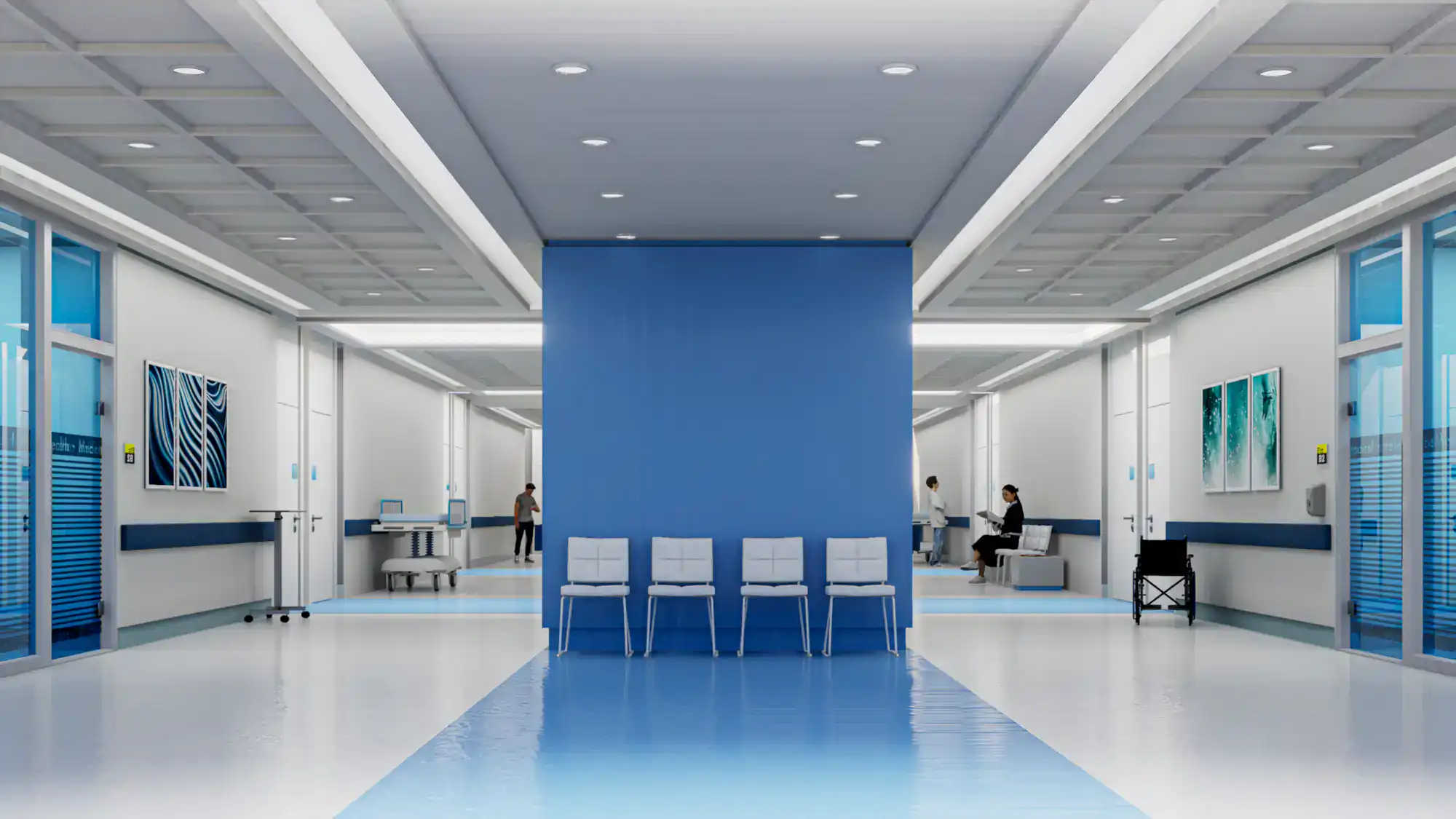
You should expect 15-20 years minimum in high-traffic hospital corridors if the floor is installed correctly. That timeline assumes daily cleaning with hospital-grade disinfectants and constant equipment traffic.
The failure point usually isn’t the coating itself—it’s the installation. If the concrete wasn’t properly prepared or had moisture issues that weren’t addressed, you’ll see delamination within the first few years. That’s why we test and prep before we coat.
Operating rooms and sterile processing areas often see even longer lifespans because the traffic is controlled and the cleaning protocols are consistent. We’ve seen properly installed systems in surgical suites still performing at 25+ years. The antimicrobial properties don’t degrade over time because they’re integrated throughout the coating thickness, not just surface-applied.
Medical-grade systems meet USDA and FDA requirements for healthcare environments. That means specific standards for chemical resistance, antimicrobial properties, and surface porosity that regular commercial epoxy doesn’t address.
The seamless aspect is critical in healthcare. Standard epoxy might be applied in sections with seams, or it might not extend up the wall base to create a coved edge. Medical-grade installations are truly seamless—no joints, no transitions, no gaps where biological materials can collect. The floor flows into the wall base in one continuous surface.
You’re also looking at different thickness requirements. Commercial spaces might use 40-60 mil coatings. Healthcare facilities need 160 mil systems to handle the combination of heavy equipment, chemical exposure, and constant cleaning. The antimicrobial additives in medical-grade systems are EPA registered specifically for healthcare use, which isn’t required for standard commercial applications.
Yes, but it requires detailed planning with your facilities and operations teams. We phase the installation so you maintain access to critical areas throughout the project.
Most healthcare facilities work in sections—we’ll complete one wing or one floor at a time. The low-VOC coatings we use mean adjacent areas can stay operational during installation. You’re not evacuating patient rooms because of fumes. We schedule around your census, your surgical schedule, and your patient flow.
The bigger consideration is the cure time. You need 24-48 hours before foot traffic and 72 hours before equipment. We map out the timeline so you know exactly when each area goes offline and comes back online. For 24-hour facilities, we often work overnight shifts in high-traffic areas to minimize disruption. The goal is maintaining your operations while upgrading your infrastructure—it’s doable, but it’s not something you figure out on the fly.
The coating is formulated specifically to resist the harsh disinfectants used in healthcare. Quaternary ammonium compounds, sodium hypochlorite, hydrogen peroxide, phenolics—all the chemicals that destroy vinyl and eat through tile grout have no effect on properly installed medical-grade epoxy.
Your EVS team can follow their standard protocols without worrying about damaging the floor. The non-porous surface means chemicals sit on top rather than penetrating. When they wipe or mop, they’re removing both the disinfectant and whatever biological material was present. There’s no absorption, no staining, no degradation of the coating.
We’ve seen facilities try to use standard epoxy in sterile processing departments, and the floors start showing chemical damage within months. The disinfectant concentrations in healthcare are significantly higher than what commercial spaces use. Medical-grade systems are tested against these specific chemicals at healthcare-use concentrations. You’re not guessing whether your floor can handle your protocols—you know it can.
We test for moisture before installation because it’s the most common reason healthcare flooring fails prematurely. If we find elevated moisture levels, we address it before applying any coating.
The solution depends on the moisture level and the source. Sometimes it’s a simple vapor barrier. Other times we need to use moisture-mitigating primers or even address drainage issues in the substrate. Medical facilities often have moisture problems from decades of plumbing, HVAC condensation, or original construction issues that were covered up by previous flooring.
Here’s what matters: installing over moisture guarantees failure. The coating will delaminate, usually starting at the edges or in the wettest areas. You’ll see bubbling, peeling, and eventually complete failure. We’d rather delay a project to fix moisture issues than install a floor that fails inspection or needs replacement in two years. The testing takes a few days, and the mitigation adds time to the project, but it’s the difference between a floor that lasts decades and one that fails before your warranty expires.
The low-VOC systems we install for healthcare facilities actually outperform older high-VOC formulations in most measurable ways. The technology has advanced significantly in the past decade.
You’re getting better chemical resistance, better impact resistance, and better long-term durability with modern low-VOC formulations. The difference is in how they cure, not in the final performance. Traditional epoxy relied on solvent evaporation, which created the strong odor and high VOC levels. Current systems are 100% solids—everything you apply stays in the floor. There’s nothing evaporating, which means no odor and no VOC emissions.
For occupied healthcare facilities, this is critical. You can install flooring in one wing while patient care continues in the adjacent wing. The infection control team doesn’t need to worry about fumes affecting immunocompromised patients. Your staff isn’t dealing with headaches or respiratory irritation during installation. The performance is identical or better, the environmental impact is lower, and the installation is safer for everyone in the building.