
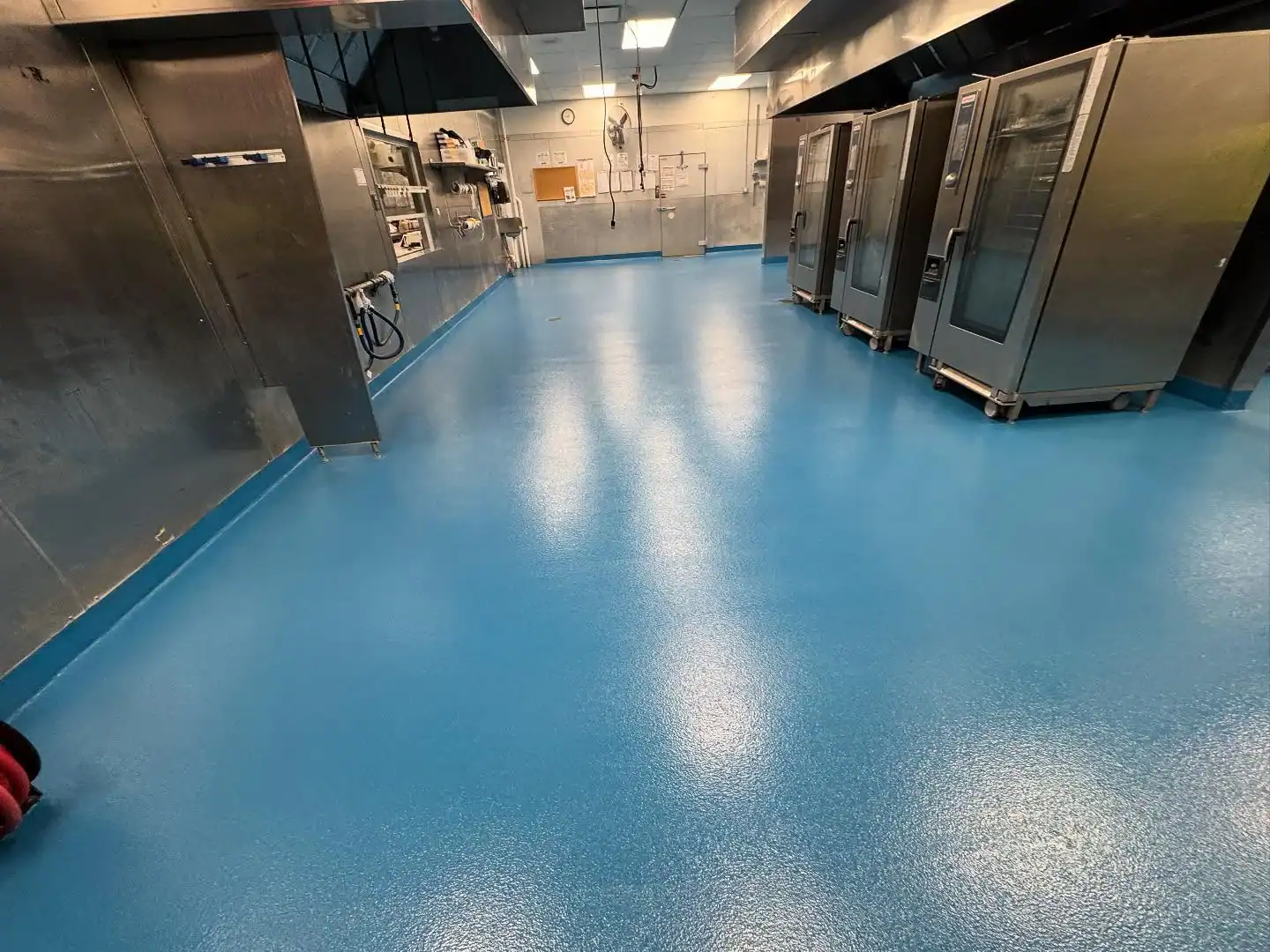
When a kitchen floor fails in West Islip, it’s rarely a surprise. It usually starts small a bubble here, a soft spot there and then a Suffolk County health inspector puts it in writing. At that point, you’re not just dealing with a repair bill. You’re dealing with a timeline, a citation, and a kitchen that can’t operate the way it needs to.
The right commercial kitchen flooring changes that. A properly installed, food-grade seamless floor gives you a surface that’s fully sanitizable from wall to wall no grout lines, no crevices, nothing for bacteria to hide in. It holds up to steam cleaning, commercial degreasers, dropped equipment, and the daily grind of a working kitchen. And it doesn’t require you to redo it in two years.
West Islip’s proximity to the Great South Bay means the water table here is higher than in most inland Long Island communities. Concrete slabs in this area hold moisture. That’s not a reason to avoid epoxy it’s a reason to work with someone who tests for it before applying anything. When that step gets skipped, the floor delaminates. When it’s done right, the floor lasts.
We’re based in Bohemia, NY within the Town of Islip, the same town that governs West Islip. That’s not a footnote. It means we operate under the same Suffolk County regulatory environment your West Islip kitchen does, we understand the building and health code requirements that apply here, and we know what Long Island’s South Shore does to a concrete slab over time.
We’ve been installing commercial and industrial floors for 35 years. We hold Sherwin-Williams High Performance Flooring ATP certification and Res Tech certification two manufacturer-backed credentials that require demonstrated competency, not just a membership fee. Dual certification like that is uncommon in this market, and it matters when you’re deciding who to trust with a floor that needs to pass inspection and hold up for the long haul.
We’re not a national chain. We’re a local specialist, and we’ve been doing this work in this county long enough to know exactly what it takes.
Before anything goes on your floor, we test the concrete slab for moisture. In West Islip, this step is non-negotiable. The tidal creeks and high water table in this area mean moisture vapor transmission is a real and common problem and it’s the number one reason epoxy floors delaminate prematurely. We test first. If moisture levels are elevated, we address it before we coat. Not after.
Once the slab passes, we grind the concrete to the correct surface profile for adhesion, repair any cracks or voids, and level uneven areas. Older commercial buildings along the Montauk Highway corridor have often had years of moisture working on their slabs that prep work is what separates a floor that bonds properly from one that looks fine on day one and starts failing by spring.
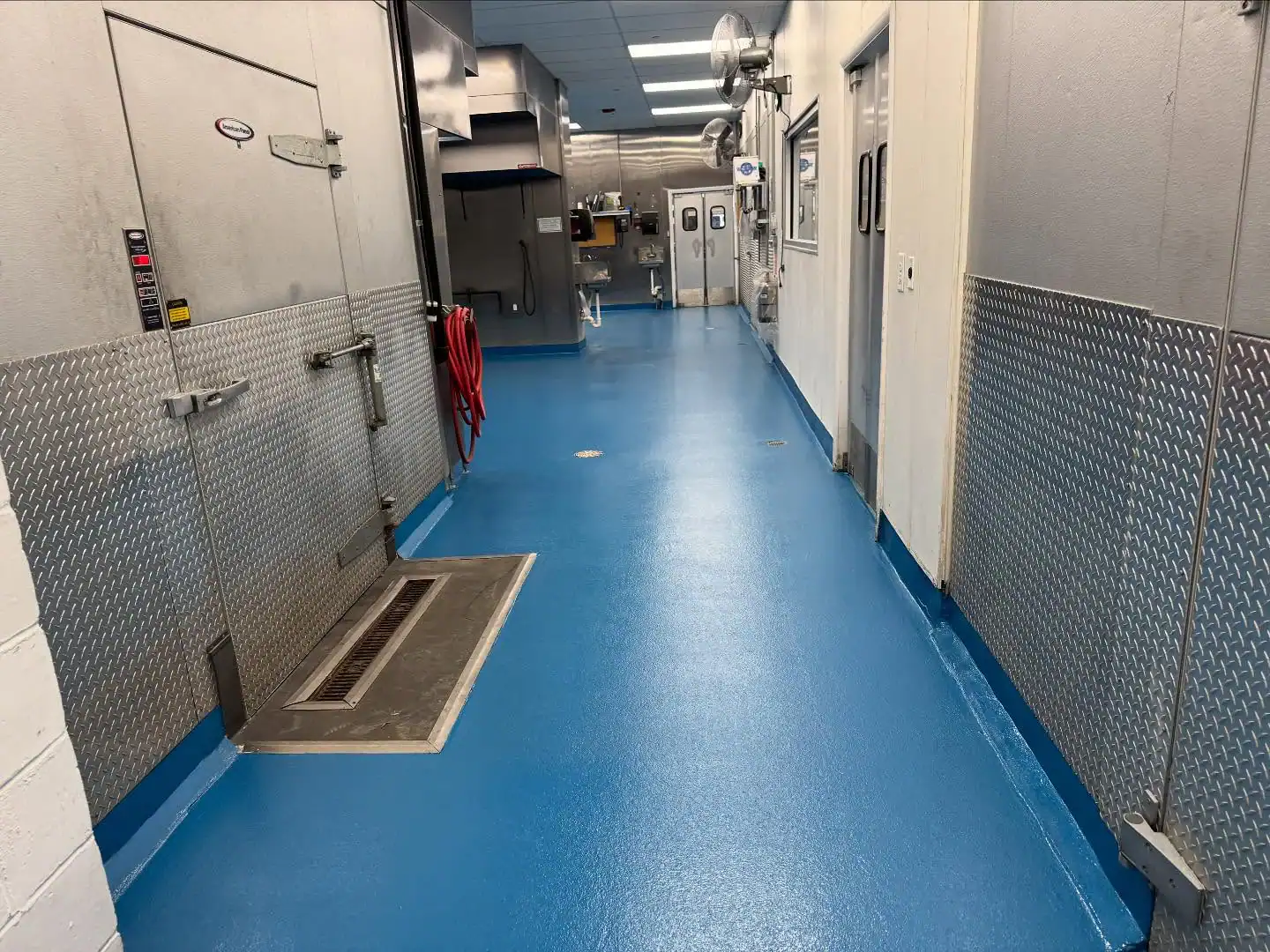
From there, we apply the system in layers: base coat, build coats matched to your kitchen’s specific demands, and a slip-resistant topcoat. High-heat zones near cooking equipment get formulations that handle thermal shock. Cooler thresholds get moisture-tolerant chemistry. Every coat gets the cure time it needs we don’t rush it. The result is a floor with the bond strength the system was actually engineered to deliver. We also install integral coved base at your floor-to-wall junctions, which is a requirement under the Suffolk County Sanitary Code and something health inspectors check.
Ready to get started?
A commercial kitchen isn’t one environment it’s several. The area in front of your fryers and steam table sees rapid temperature swings that standard epoxy can’t handle. Your walk-in cooler threshold is exposed to moisture and temperature differentials that require a different formulation entirely. Your prep line needs chemical resistance against the degreasers your cleaning crew uses every night. We evaluate each zone and specify accordingly.
For food service operations in West Islip whether you’re running a restaurant on Montauk Highway, managing food service operations at Good Samaritan University Hospital, or operating a catering commissary the floor system needs to meet both FDA Food Code standards and Suffolk County Department of Health Services requirements. That means seamless, non-porous surfaces that can be fully sanitized, proper slope to floor drains, and coved base at every wall junction. We build all of that into every installation.
Fast-cure polyaspartic topcoat systems are available when your schedule demands it return to light use in hours, full commercial service within 24 to 36 hours. We can work overnight or on weekends to keep your kitchen’s downtime as short as possible. Along the Montauk Highway corridor, where competition from neighboring Babylon Village is real, a closed kitchen costs you more than just the repair bill. We plan around your schedule from day one.
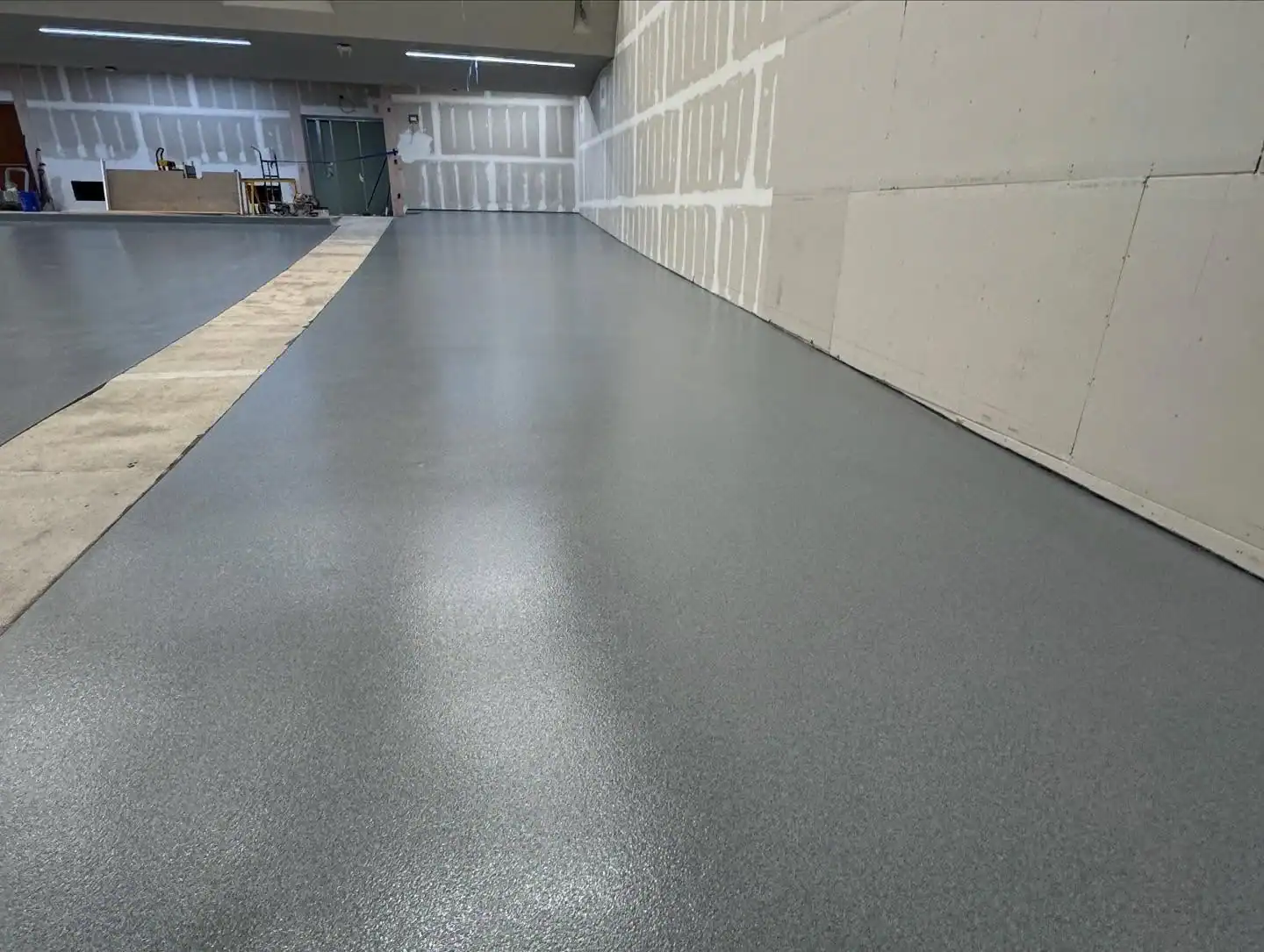
The most common cause is moisture vapor transmission from below the slab and it’s a problem that’s more prevalent in West Islip than in drier, inland Long Island communities. West Islip sits adjacent to the Great South Bay, with Sampawams Creek and other tidal waterways running through the area. The water table is high, and concrete slabs here hold more moisture than most contractors account for. When a coating is applied over a slab with elevated moisture levels, the bond fails. It might look fine for a few months, but the floor will bubble, lift, and peel.
The fix isn’t a different brand of epoxy it’s testing the slab before applying anything. We test every slab for moisture vapor transmission before any coating goes down. If levels are too high, we address the root cause first. That single step eliminates the most common reason epoxy floors fail in West Islip, and it’s a step most general contractors skip entirely.
The Suffolk County Department of Health Services inspects food service establishments under both the New York State Sanitary Code and the Suffolk County Sanitary Code. For floors specifically, inspectors look for surfaces that are smooth, non-porous, non-absorbent, and free of cracks, chips, and open joints. They also look for proper coved base at floor-to-wall junctions that curved transition that eliminates the gap where grease and bacteria accumulate and adequate slope toward floor drains.
A compliant material in poor condition is still a violation. Cracked tile, peeling epoxy, or grout lines that can no longer be properly sanitized will draw a citation regardless of what the floor was made of originally. Our food-grade seamless systems are designed around these requirements from the ground up no grout lines, integral cove base, chemical-resistant topcoats, and surfaces that hold up to the cleaning protocols Suffolk County inspectors expect to see in active use.
A properly installed food-grade epoxy or urethane cement system in a commercial kitchen should last 10 to 20 years with normal maintenance. The range depends on how demanding the environment is a high-volume restaurant kitchen with heavy equipment traffic and daily steam cleaning will put more stress on a floor than a lower-volume catering commissary. The bigger variable, though, is the quality of the original installation.
On Long Island’s South Shore, the coastal humidity and high water table conditions accelerate failure in floors that weren’t properly specified or prepared. A floor installed over an untested slab, with rushed cure times between coats, in a system that wasn’t matched to the kitchen’s thermal and chemical demands, might look acceptable for a year. Then it doesn’t. A floor that was done right tested slab, correct system, full cure at every stage holds up through Long Island’s humidity swings, freeze-thaw cycles, and the daily demands of a working kitchen without requiring you to spend money on it again for a decade or more.
For a straightforward floor coating replacement where you’re applying a new system over existing concrete without structural changes a building permit is typically not required in the Town of Islip. However, if your project involves drainage modifications, concrete removal, or any structural work associated with the floor replacement, you should confirm requirements with the Town of Islip Division of Building before starting. They administer the New York State Uniform Building Code and the Town of Islip Zoning Code, and the threshold for what triggers a permit can depend on the scope of work.
Separately, if your kitchen is undergoing a more significant renovation alongside the floor work, Suffolk County Department of Health Services may require notification or re-inspection of the food service establishment. It’s worth a quick call to SCDHS before you start if you’re making multiple changes at once. We’re familiar with how this process works in the Town of Islip and can help you understand what to expect before the project begins.
Standard epoxy is a strong, chemical-resistant coating that works well in most commercial kitchen environments. But in high-heat zones directly in front of fryers, under steam tables, or anywhere your floor experiences rapid temperature swings standard epoxy can crack over time because it doesn’t flex with those thermal changes. That’s where urethane cement mortar becomes the better choice. It’s formulated specifically to handle thermal shock, and it bonds directly to damp concrete, which makes it particularly well-suited for West Islip kitchens where the slab may carry elevated moisture.
In practice, most commercial kitchens benefit from a combination of both systems urethane cement in the high-heat zones and properly specified epoxy in prep areas, service corridors, and lower-stress sections of the kitchen. Using the same product throughout a kitchen regardless of what each zone actually experiences is one of the most common specification mistakes in this industry. We evaluate your kitchen’s zones before recommending any system, and we don’t apply a one-size-fits-all solution to a space that clearly has more than one set of demands.
The late winter and early spring window roughly January through March is when most West Islip restaurant operators schedule major kitchen renovations. It’s after the holiday rush and before the South Shore’s spring and summer dining season picks up, which means your kitchen is already running at lower volume and the disruption costs less. That timing also works in your favor from an installation standpoint: ambient temperatures and humidity levels are within the ranges that allow epoxy systems to cure correctly.
Summer in West Islip brings high humidity off the Great South Bay, which affects application conditions and can cause problems with coatings that aren’t properly specified for that environment. It’s not impossible to install in summer it just requires more attention to conditions and the right product selection. If you’re dealing with a floor that’s already failed or drawn a health inspection citation, we can work around your schedule year-round, including overnight and weekend installations to minimize your downtime. The off-season window is ideal when you have the luxury of planning ahead but we’re not going to tell you to wait six months if your floor needs attention now.