
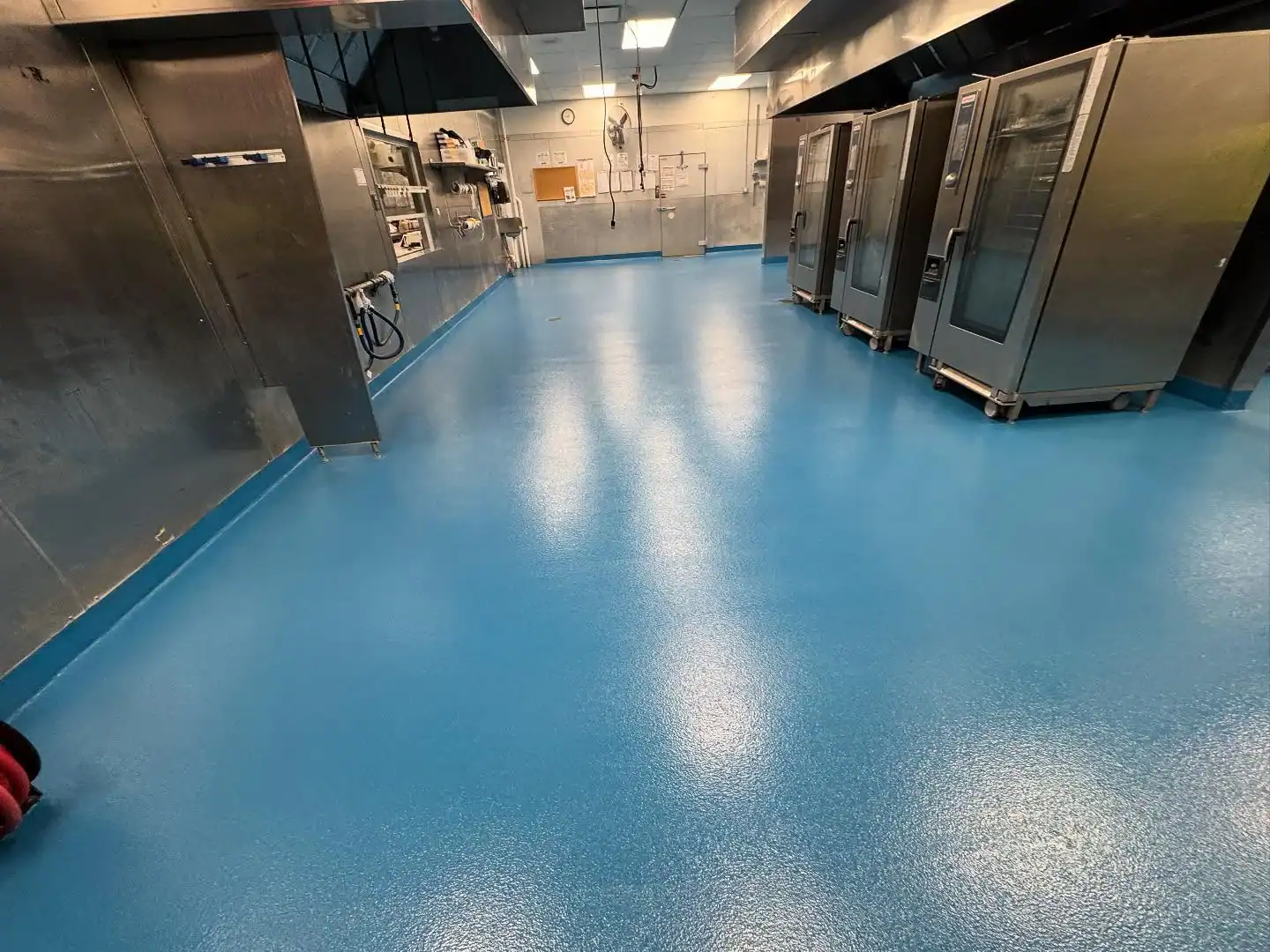
When your kitchen floor starts cracking, pitting, or peeling, it’s not just an eyesore it’s a Suffolk County health code violation waiting to happen. The Department of Health Services requires smooth, non-porous, non-absorbent surfaces in every food prep area. A floor that was fine at installation but has since deteriorated is still a citation. That’s the part most operators in Deer Park don’t find out until an inspector is standing in their kitchen.
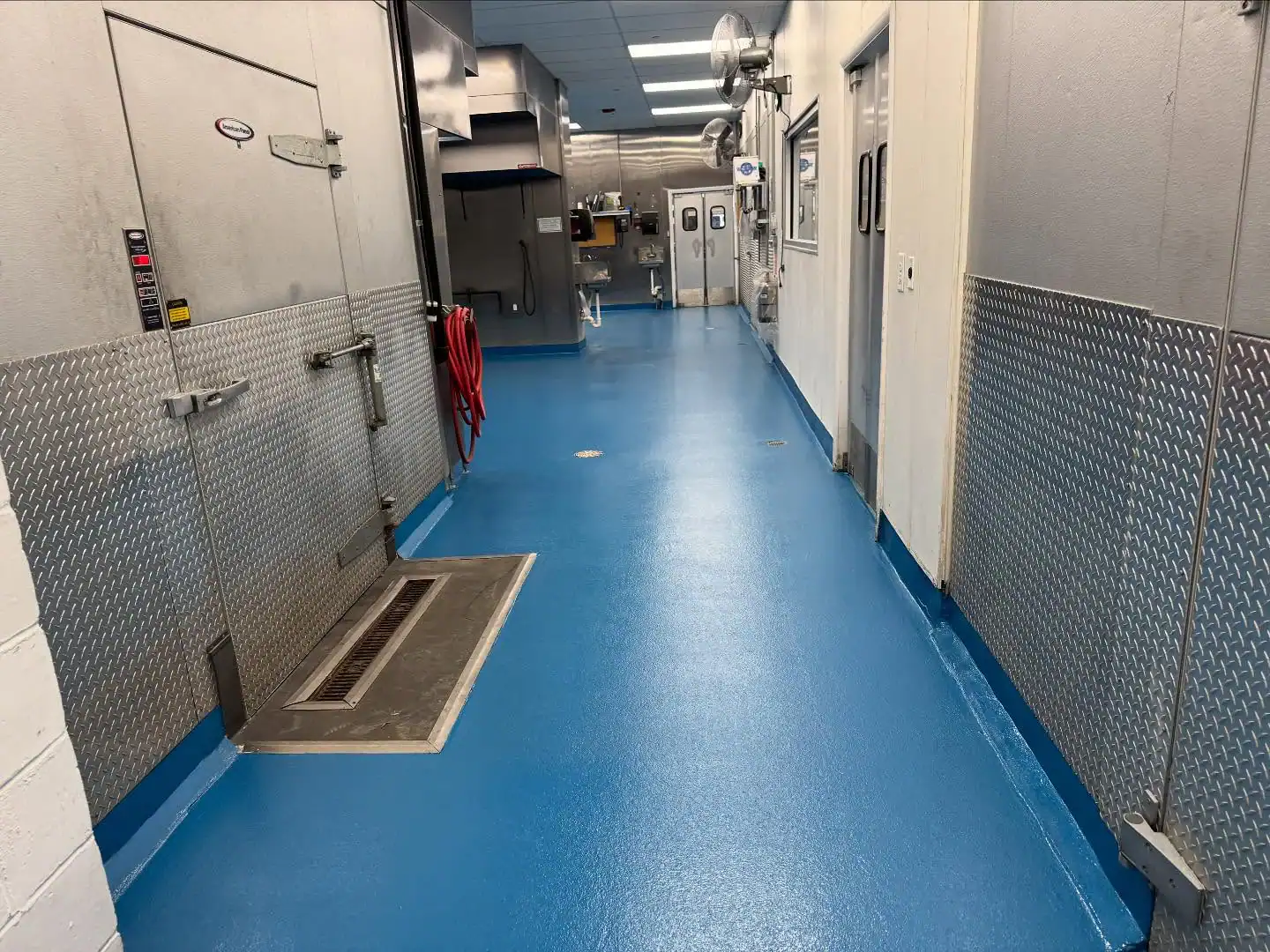
What changes after a proper installation is straightforward. No more grout lines trapping grease and bacteria. No more rough patches your cleaning crew can’t fully sanitize. No more anxiety every time an inspection rolls around. You get a seamless, continuous surface from wall to wall including the coved base along every floor-to-wall junction that meets the code and holds up to daily commercial use.
Deer Park’s building stock adds another layer to this. A lot of the commercial spaces along Deer Park Avenue and around the Tanger Outlets area were built during the post-war construction boom concrete slabs from the 1950s and 1960s that have had decades to develop cracks, moisture issues, and surface irregularities. On top of that, Deer Park sits at the edge of Long Island’s Central Pine Barrens, where sandy, permeable soil and a naturally high water table push moisture vapor up through slabs constantly. That moisture is the number one reason epoxy floors fail early and it’s exactly why the prep work matters as much as the coating itself.
We’ve been installing commercial and industrial flooring across Long Island for 35 years, based out of Bohemia about 10 to 15 miles east of Deer Park along the Long Island Expressway. That’s not a commute. That’s a local contractor who knows Suffolk County’s permitting environment, knows what the Department of Health looks for, and has worked on the same kind of aging concrete slabs you’re dealing with in Deer Park.
We hold Sherwin-Williams High Performance Flooring ATP certification and Res Tech certification both manufacturer-backed credentials that cover concrete assessment, surface preparation, moisture evaluation, and full system application. These aren’t general contractor licenses. They’re specific to the kind of work being done in your kitchen.
What’s driven this business for three and a half decades is a simple idea: most floors fail because contractors skip steps. Moisture goes untested. Concrete goes unrepaired. The wrong system gets applied to the wrong environment. We were built around fixing that and the track record across Long Island, the rest of the United States, and even the Bahamas reflects it.
Before anything gets applied to your floor, the concrete gets assessed. That means moisture testing first a step most contractors skip entirely, but one that’s especially important in Deer Park given the sandy, high-water-table soil conditions beneath the pine barrens. If moisture vapor is migrating through your slab and it goes undetected, the coating will delaminate. It’s not a question of if, it’s when. Testing takes that variable off the table.
From there, the concrete gets ground to the correct surface profile for proper adhesion, and any cracks, uneven areas, or previous coating failures get repaired before a single coat goes down. This is where older buildings and there are plenty of them in and around the Deer Park Avenue corridor require the most attention. Skipping this step is the reason so many floors look fine on day one and start failing within a year.
Once the surface is ready, we select the system based on your kitchen’s actual conditions. High-heat zones near cooking equipment get cementitious urethane mortar, which handles thermal shock from steam cleaning and temperature swings that standard epoxy cannot. Prep areas and lower-heat zones get food-grade epoxy with antimicrobial properties. The final layer is a slip-resistant topcoat engineered for the wet, greasy conditions of a working commercial kitchen. If your timeline is tight which it usually is fast-cure polyaspartic topcoat options can get you back to light use within hours and full commercial operation within 24 to 36 hours.
Ready to get started?
Commercial kitchen flooring in Deer Park, NY isn’t one-size-fits-all, and the system we install in a high-volume restaurant at the Tanger Outlets is going to look different from what goes into a smaller prep kitchen on Deer Park Avenue. The environment dictates the system heat exposure, chemical use, traffic volume, and moisture conditions all factor into what we specify and how we apply it.
Every installation includes proper coved base work flooring that runs 4 to 6 inches up the wall at every junction to eliminate the bacteria-trapping crevices that health inspectors flag. Slip resistance is built into the topcoat selection, targeting the coefficient of friction levels that meet OSHA and ANSI standards for wet commercial surfaces. Chemical resistance is factored in from the start, because the sanitizers and degreasers used in commercial kitchens will break down a coating that wasn’t formulated to handle them.
For operators in the Town of Babylon, commercial renovation work may require a building permit depending on scope. Our familiarity with local requirements means that conversation happens upfront, not after the fact. Whether you’re running a full-service restaurant, a commissary kitchen, or a food service operation that needs to pass its next Suffolk County inspection without a floor violation on the report, we design the system around your actual situation not a generic template.
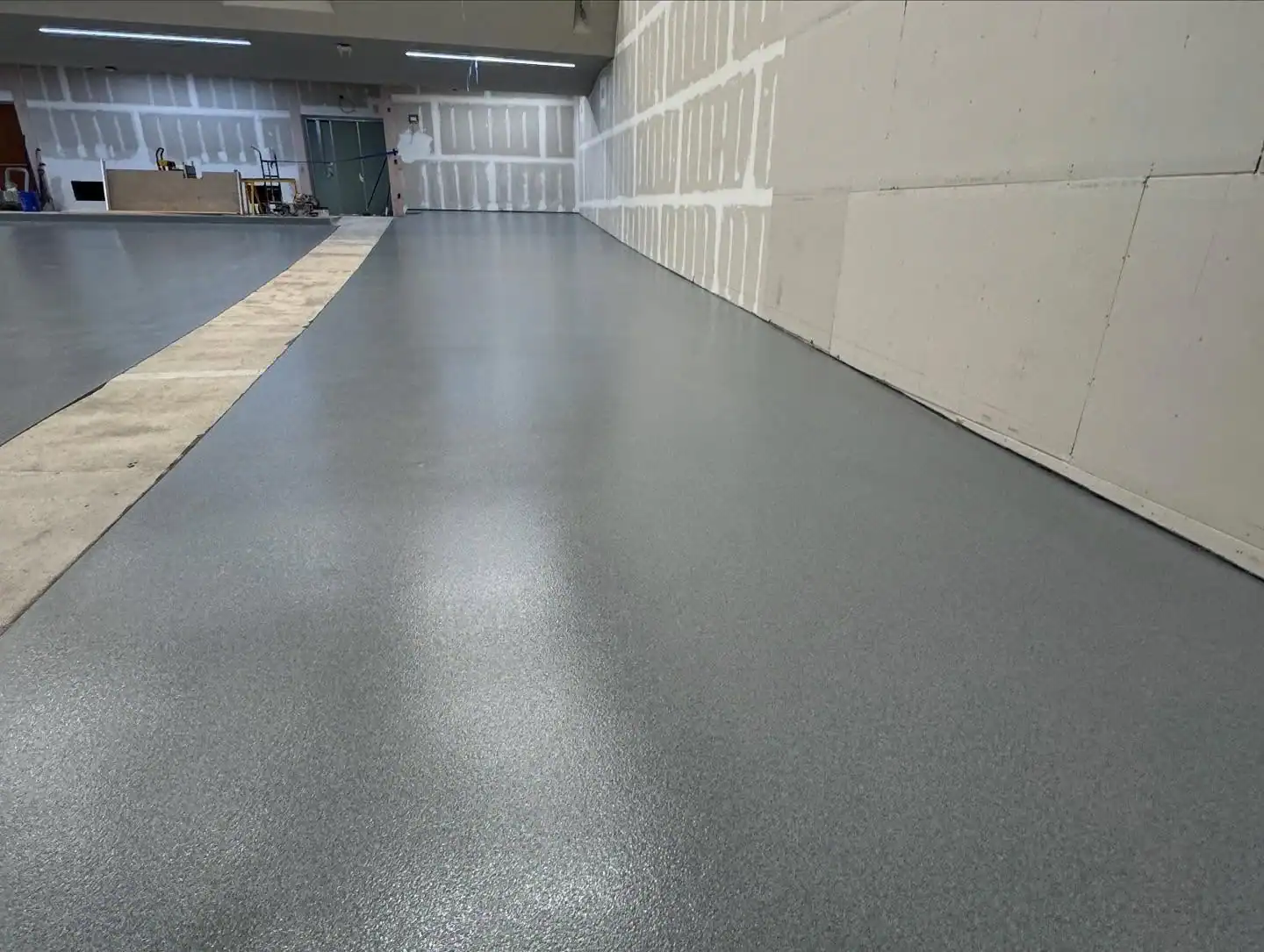
The Suffolk County Sanitary Code which governs food service establishments in Deer Park requires kitchen floors to be smooth, non-porous, non-absorbent, and easily cleanable. That language rules out tile with grout lines, bare concrete, and any surface with cracks or gaps where food particles and bacteria can collect. In practice, that points to seamless resinous flooring systems: epoxy, urethane cement, or polyaspartic coatings depending on the specific zone of your kitchen.
Which system is right depends on what your kitchen actually deals with. High-heat areas near fryers and cooking equipment need cementitious urethane mortar because standard epoxy can’t handle the thermal shock from steam cleaning and temperature swings. Prep areas and lower-heat zones work well with food-grade epoxy that includes antimicrobial properties. Walk-in cooler thresholds and transition zones have their own requirements. The point is that a properly specified commercial kitchen floor in Deer Park isn’t a single product it’s a system matched to your environment.
Most commercial kitchen floor installations take one to three days depending on the size of the space, the condition of the existing concrete, and the system being applied. The concrete prep work grinding, crack repair, moisture mitigation takes the most time and can’t be rushed without compromising the final result. That’s especially true in older Deer Park buildings, where the slab may need more repair work before any coating goes down.
For operators who can’t afford extended downtime particularly those running high-traffic kitchens near the Tanger Outlets or along Deer Park Avenue fast-cure polyaspartic topcoat systems are an option that can get you back to light use within hours and full commercial use within 24 to 36 hours. We also schedule overnight or weekend work when it makes sense for your operation. The goal is always to minimize how long your kitchen is out of service without cutting corners on the installation itself.
The most common reason commercial kitchen epoxy fails is moisture vapor coming up through the concrete slab. When moisture isn’t tested for before installation, it gets trapped beneath the coating and eventually forces it to delaminate sometimes within months. In Deer Park specifically, this is a real concern because the sandy, permeable soils at the edge of Long Island’s Central Pine Barrens create persistent moisture pressure beneath slabs, particularly in older buildings that weren’t built with modern vapor barriers.
The second most common reason is inadequate surface preparation. If the concrete isn’t ground to the right profile, the coating doesn’t bond properly. If cracks and uneven areas aren’t repaired first, they telegraph through the new surface over time. And if the wrong system gets applied standard epoxy in a high-heat zone, for example thermal shock will crack it regardless of how well it was installed. Preventing failure means doing the prep work correctly every time, not just applying a coating and hoping it holds.
It depends on the scope of work. Resurfacing an existing floor with an epoxy or urethane coating is generally considered a maintenance activity and may not require a permit. However, if the project involves structural repairs to the slab, significant alterations to the floor system, or work that’s part of a larger kitchen renovation, the Town of Babylon Building Department may require a permit before work begins.
The safest approach is to confirm with the Town of Babylon Building Department before starting any commercial renovation project. We’ve been working in Suffolk County for 35 years and are familiar with the local requirements, so that conversation can happen early in the process before scheduling, before any work begins. Getting the permitting question answered upfront avoids delays and keeps your project on timeline, especially if you’re working against a Suffolk County health inspection deadline.
In some cases, yes but it depends on the condition of the existing tile and what’s underneath it. If the quarry tile is well-bonded, flat, and free of hollow spots, certain epoxy mortar systems can be applied directly over it after proper surface preparation. This can save time and reduce the disruption of a full tile removal. However, if the tile is loose, cracked, or sitting on a compromised substrate, installing over it creates a weak foundation that will cause the new coating to fail.
The only way to know which situation you’re in is to assess the floor before making that call. That’s part of the evaluation process on every project. If the tile needs to come out, it’s better to know that at the start than to find out six months after a new floor has been installed. For restaurant operators in Deer Park dealing with aging kitchen infrastructure, that upfront assessment is often where the most important decisions get made.
Commercial kitchen flooring costs vary based on square footage, the condition of the existing concrete, the system being installed, and any prep work required. For a typical restaurant kitchen in Deer Park, you’re generally looking at a range of $7 to $14 per square foot for a professionally installed food-grade epoxy system, with urethane cement and more specialized systems running higher depending on the zone and application requirements. A 500-square-foot kitchen might come in between $3,500 and $7,000 or more depending on those variables.
What’s worth keeping in mind is the cost of not doing it right. A cheaper installation that fails in two years means another closure, another installation cost, and potentially a Suffolk County health inspection violation in between. The floors that hold up in demanding commercial kitchens the kind running full service five or six nights a week are the ones where the prep work was done correctly and the system was matched to the actual environment. That’s where the real value shows up, not in the upfront number.