
Most commercial kitchen floors in Plainview don’t fail because of heavy traffic or hard use. They fail because whoever installed them skipped the steps that actually matter moisture testing, proper concrete prep, and matching the right system to the right zone. In a Nassau County building that’s been around since the 1960s, that shortcut shows up fast.
Plainview’s humidity is real. Long Island summers regularly push relative humidity past 70 to 80 percent, and that moisture doesn’t stay in the air it works its way up through older concrete slabs. If a contractor applies coating over a slab that hasn’t been tested and prepped for moisture, you’re looking at delamination within months. That’s the most common outcome when the prep gets rushed.
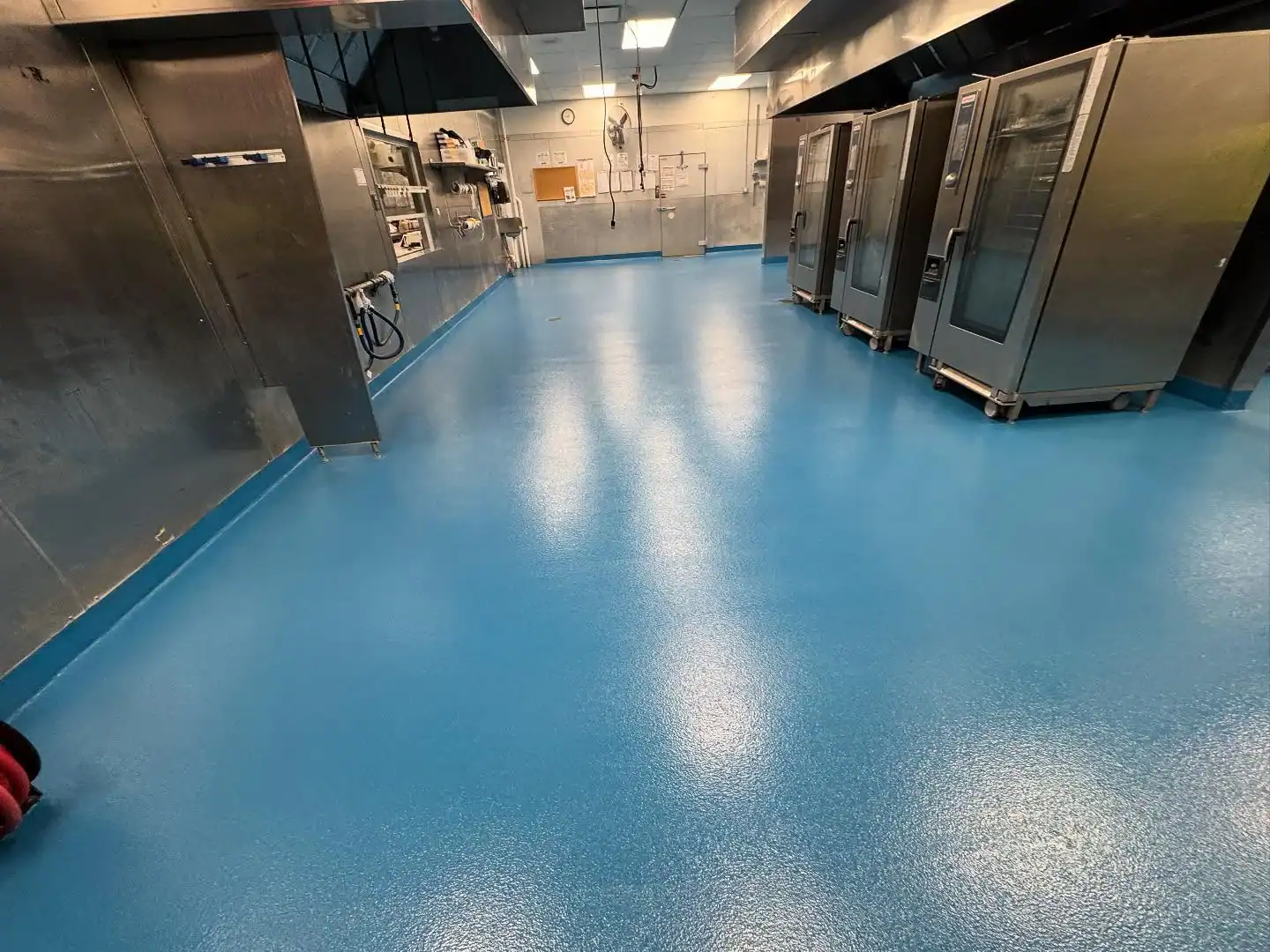
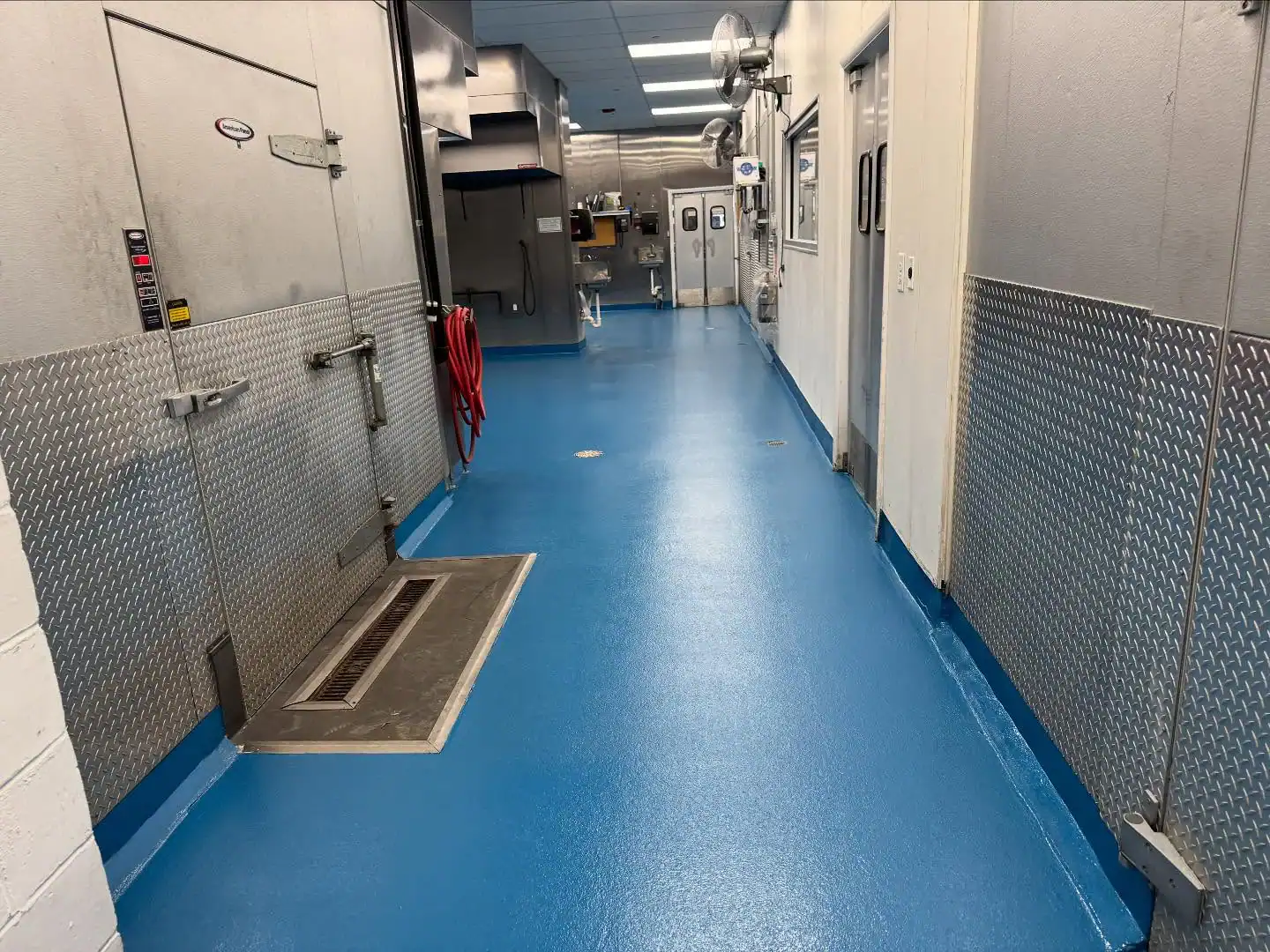
When the floor is done right, the difference is immediate and lasting. You get a seamless, non-porous surface that cleans fast, holds up under rolling equipment and thermal cycling, and gives a Nassau County Department of Health inspector nothing to cite. For a kitchen serving Plainview’s year-round dining community, that’s not a luxury it’s the baseline.
We’ve been installing commercial kitchen floors for 35 years not garage floors with a commercial upsell, but food-grade, health-code-compliant systems built specifically for the demands of working kitchens. We’re based in Bohemia, NY and have worked across Nassau and Suffolk County long enough to know exactly what Long Island’s coastal conditions do to an improperly installed floor. That experience matters in Plainview, where many of the commercial buildings along Old Country Road and the Route 135 corridor date back to the 1950s and 1960s.
What separates us from most contractors you’ll find is verifiable: we hold both Sherwin-Williams High Performance Flooring Applicator Training Program certification and Res Tech certification. Dual manufacturer credentialing at this level is uncommon in the Long Island market. It means the people installing your floor have been evaluated by the manufacturers behind the products not just trained on YouTube.
For Plainview operators whether you’re running a restaurant on South Oyster Bay Road, managing a food service operation near Plainview Hospital, or overseeing a facility in the Route 135 commercial corridor this is the kind of background that actually matters when your floor has to perform.
The first thing that happens on every commercial kitchen project in Plainview is a moisture test. Not a visual inspection an actual test of the concrete slab. Given the age of most commercial buildings along Old Country Road and the Route 135 corridor, and Nassau County’s consistently humid summers, this step is non-negotiable. If moisture vapor transmission is too high and coating goes down anyway, the floor will delaminate. Testing first is how that outcome gets avoided.
Once the slab is assessed, we grind the concrete to the correct surface profile for adhesion, fill existing cracks, and level uneven areas. This is the prep phase, and it’s where most failed floors trace their problems back to. No coating system bonds correctly to a slab that hasn’t been properly prepared regardless of how good the product is.
From there, we match the system to the zone. The area near your cooking equipment and steam sources gets a urethane cement mortar system built for thermal shock resistance. Walk-in coolers get a moisture-tolerant formulation. Prep lines and dish areas get the appropriate chemical-resistant build. Each layer cures fully before the next goes down, and the final topcoat is slip-resistant and food-grade. The result is a floor that meets Nassau County Department of Health requirements and is built to last 10 to 20 years in a working commercial kitchen.
Ready to get started?
A commercial kitchen isn’t one environment it’s several. The zone next to your fryers and steam equipment experiences temperature swings that standard epoxy simply can’t handle. The walk-in cooler has moisture conditions that require a completely different formulation. The prep line sees chemical cleaning agents daily. We account for all of it, and the system we install in your kitchen reflects the actual demands of each area not a one-size-fits-all product rolled out across the whole floor.
Every installation includes the full process: moisture testing, concrete grinding, crack repair, leveling, multi-layer application with full cure time between coats, and a slip-resistant, food-grade topcoat. Coved base installation at floor-to-wall junctions is available and recommended for Nassau County food service operations where NCDOH inspectors look specifically for seamless transitions that eliminate bacterial harborage points.
For Plainview operators running larger or more complex facilities institutional kitchens, multi-station food service operations, or facilities connected to healthcare or education we have the commercial project experience to handle the scale. We’ve installed floors across the United States and the Bahamas. Whatever your kitchen looks like, the process is the same: assess it honestly, prep it correctly, and install a system that performs.
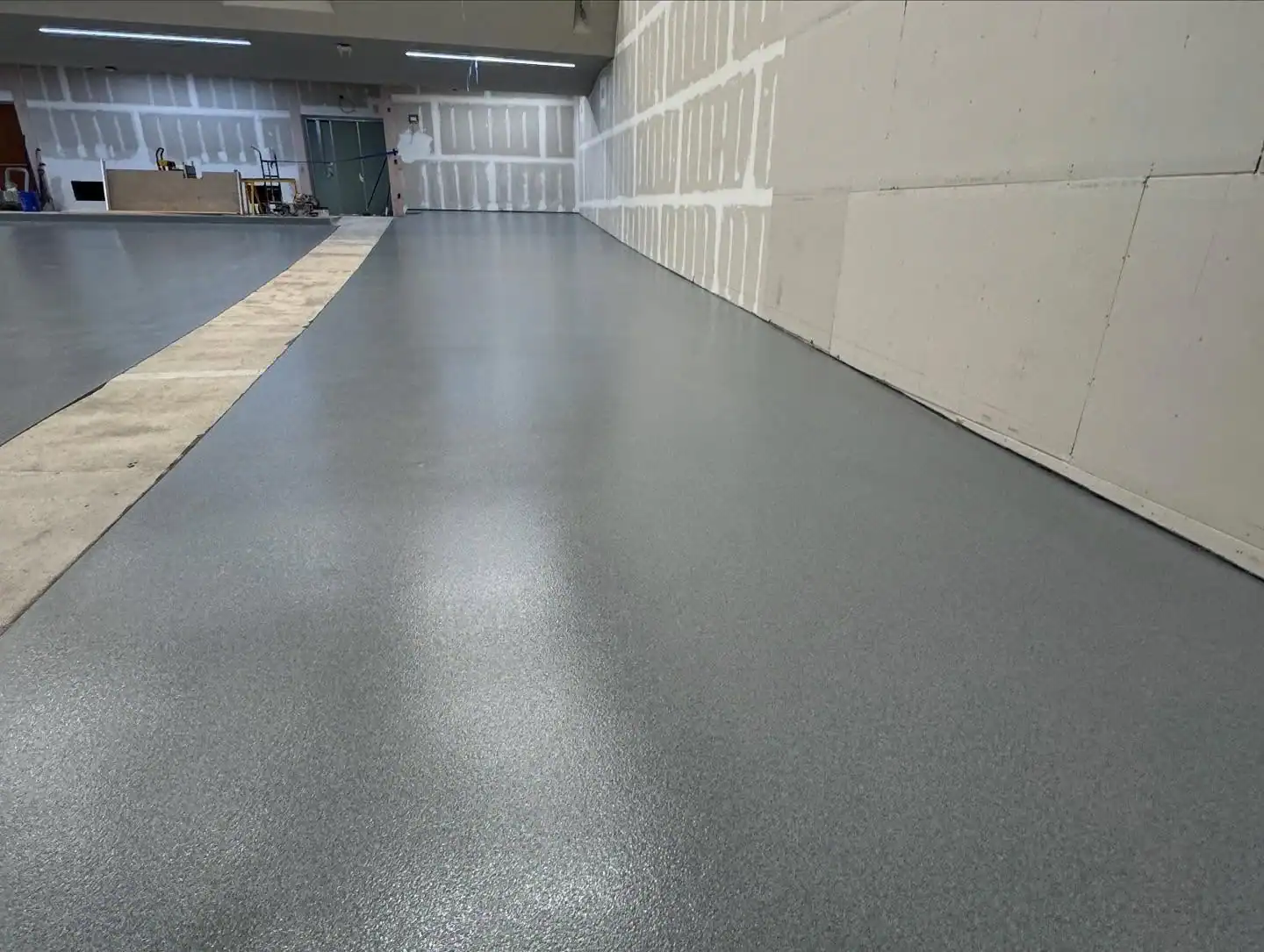
Nassau County’s Department of Health enforces food service floor requirements that align with the FDA Food Code: floors in food preparation areas must be smooth, non-porous, non-absorbent, and easily cleanable. Cracks, chips, and gaps are cited as violations. Grout lines in quarry tile are a common problem because they trap grease, food particles, and bacteria that are nearly impossible to fully clean and inspectors know exactly where to look.
The NCDOH also has a Plan Review process that evaluates physical construction, including flooring, before a permit is issued for a new or renovated food service establishment. That means your floor has to meet code before you open, not after your first inspection. If you’re planning a renovation or building out a new kitchen space in Plainview, the flooring decision isn’t just aesthetic it’s a gating requirement for your operating permit. A seamless epoxy system installed to food-grade standards satisfies these requirements and gives inspectors nothing to cite.
A properly installed commercial kitchen epoxy floor lasts 10 to 20 years or more under normal commercial use. The range comes down to two things: the quality of the installation and the specific conditions of the environment. In Plainview’s older commercial buildings many of which were built during the post-war development boom of the 1950s and 1960s the concrete slab condition and moisture levels play a significant role in how long any coating system performs.
When the slab is tested for moisture, prepped correctly, and the right system is matched to each zone of the kitchen, the floor holds. When those steps are skipped which is common with general contractors who treat kitchen floors like garage floors delamination, cracking, and surface breakdown often show up within two to three years. The installation process is what separates a floor that lasts a decade from one you’re replacing before your lease is up.
In most cases, yes. We use fast-cure systems including polyaspartic topcoats that allow a kitchen to return to light service within hours and full commercial use within 24 to 36 hours of the final coat. For Plainview restaurant operators who serve a year-round residential community, that kind of turnaround matters. Every day of closure is revenue lost from a dining base that has plenty of other options.
The installation can also be scheduled in phases or during off-hours overnight or on weekends to minimize the impact on your operation. The honest answer is that the timeline depends on the size of your kitchen, the condition of your existing slab, and how much prep work is needed before coating can begin. A kitchen with significant crack repair and leveling work will take longer than a straightforward installation on a well-maintained slab. We walk through the process with you before any work starts, so you know exactly what to expect.
Standard epoxy is a strong, durable coating system that works well in most commercial kitchen environments but it has a known weakness: thermal shock. When a floor near cooking equipment goes from cold to hot repeatedly, or when steam cleaning hits a surface that’s still warm, standard epoxy can crack and delaminate over time. That’s not a defect in the product it’s a limitation that matters a great deal in high-heat kitchen zones.
Urethane cement mortar is specifically engineered for thermal shock resistance. It’s the correct system for the areas of your kitchen closest to fryers, ovens, steamers, and dishwashing equipment. It also bonds well to damp concrete, which is relevant for Plainview kitchens in older buildings where moisture in the slab is a consistent factor. The right answer isn’t always one or the other many commercial kitchens use both, with urethane cement in the high-heat zones and epoxy in lower-stress areas like walk-in coolers and storage. Matching the system to the zone is how you avoid premature failure.
It depends on what’s underneath the damage. Surface cracks, minor chips, and areas where a previous coating has begun to peel can often be addressed during the prep phase we fill cracks, remove loose material, and grind the slab to a clean, stable surface before the new system goes down. In many cases, a full tear-out isn’t necessary.
Where it gets more complicated is when the damage goes deeper structural cracks in the slab itself, significant moisture-related failure, or a previous installation that used the wrong system and bonded poorly. Plainview’s older commercial buildings sometimes have concrete that’s been through multiple coating attempts, each one applied over the problems left by the last. The only way to know what you’re actually working with is to assess the slab honestly before quoting the job. That assessment is part of our process, and it determines whether repair is the right call or whether a full removal and reinstallation is the more cost-effective path long-term.
Concrete prep is where most failed commercial kitchen floors trace their problems back to. The coating system no matter how good the product is can only bond as well as the surface it’s applied to. If the slab hasn’t been ground to the right surface profile, if cracks haven’t been properly filled, or if moisture vapor transmission hasn’t been tested and accounted for, the coating will eventually fail. It’s not a question of if it’s a question of when.
In Nassau County, and specifically in Plainview’s commercial building stock along Old Country Road and the Route 135 corridor, many of the slabs in active use were poured in the 1950s and 1960s. Older concrete is more likely to have surface irregularities, existing coating residue from previous installations, and moisture conditions that require specific formulations to address. Long Island’s coastal humidity compounds this elevated ambient moisture during the summer months keeps vapor transmission active in slabs that weren’t sealed or prepped with that factor in mind. Skipping or rushing the prep phase is the single most common reason commercial kitchen floors in this area fail before their time.