
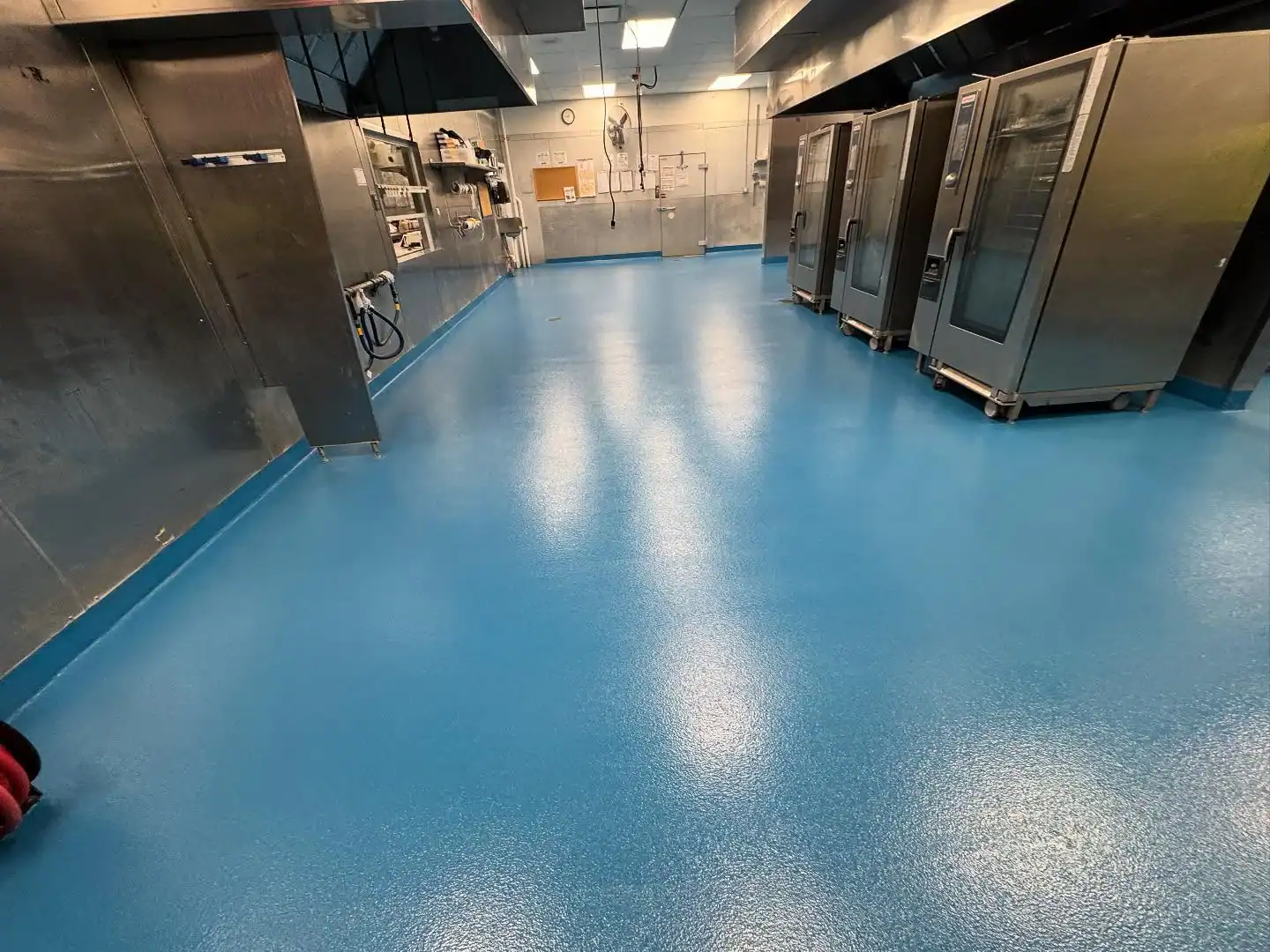
When your kitchen floor is done right, you stop thinking about it. No peeling edges near the dish pit. No grout lines trapping grease between your prep tables. No health inspector circling your floor on a clipboard during your busiest month of the year. That’s what a properly installed commercial kitchen floor actually gives you one less thing on the list.
Lindenhurst’s waterfront geography makes this more than a general statement. The village is canal-ribbed, sits on Great South Bay, and took on up to six feet of water south of Montauk Highway during Hurricane Sandy. Even years after that storm, concrete slabs throughout Lindenhurst especially in buildings near the water carry elevated moisture levels that most contractors never check. If epoxy goes down over a slab that hasn’t been tested, it will delaminate. It’s not a matter of if. It’s a matter of when.
The other reality for Lindenhurst food service operators is the Suffolk County Department of Health Services. SCDHS inspectors enforce FDA Food Code requirements: smooth, non-porous, non-absorbent floors with no cracks, no gaps, and coved base at every wall junction. A floor that fails those standards doesn’t just look bad it puts your operating permit at risk. The right installation eliminates that exposure entirely.
We’ve been installing commercial and industrial floors for 35 years, working across the United States and the Bahamas. Our company was built on a straightforward observation: too many floors were failing because contractors didn’t understand what they were putting down. That’s still the standard everything is measured against today.
The certifications matter here. We hold Sherwin-Williams High Performance Flooring ATP certification a manufacturer-backed credential covering concrete assessment, surface prep, primers, topcoats, and full system application. We also hold Res Tech certification, making us one of the few contractors on Long Island with dual manufacturer credentials in this category. When you search for kitchen floors in Lindenhurst, most of what comes up is retail flooring stores, cleaning companies, and general remodelers who list epoxy as a side service. None of them carry this training.
Based in Bohemia, NY right in Suffolk County we operate under the same county-level regulatory environment that Lindenhurst food service operators navigate every day. The South Shore conditions, the coastal humidity, the SCDHS inspection cycle none of that is new to us. We’ve installed systems in canal-adjacent restaurants, waterfront mixed-use developments, and flood-zone properties throughout the village. We understand what Lindenhurst’s concrete actually demands.
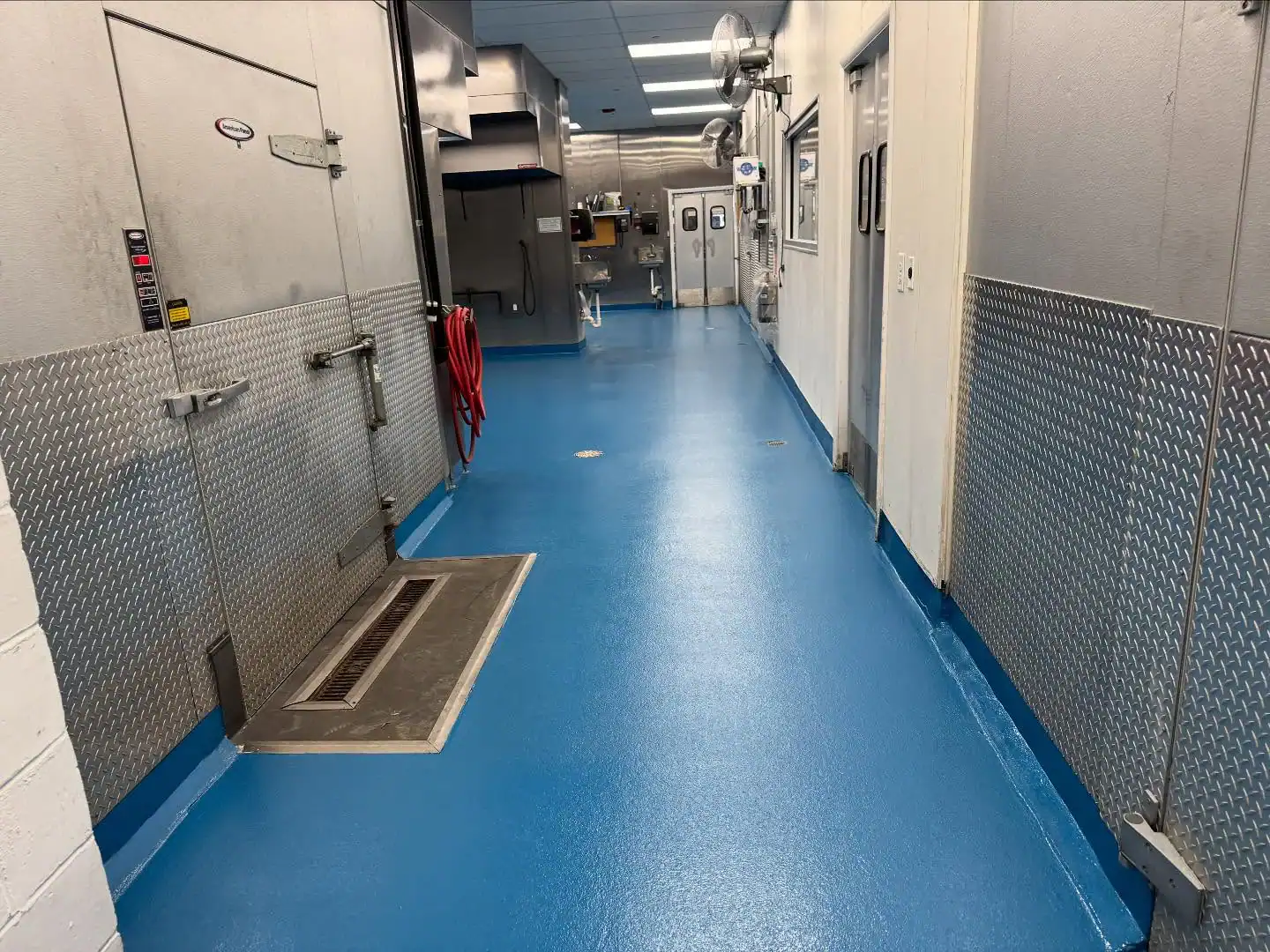
The first step is moisture testing and in Lindenhurst, this is where the entire project either gets done right or starts going wrong. Concrete slabs in this village, particularly in canal-adjacent and flood-zone properties south of Montauk Highway, carry moisture vapor levels that will cause premature delamination if they’re not measured and addressed before any coating is applied. This step gets skipped constantly in the industry. We don’t skip it.
Once the slab passes moisture assessment, the prep work begins. That means grinding, crack filling, and leveling the concrete surface so the coating system has a clean, stable foundation to bond to. Skipping prep is the other most common reason floors fail early and it’s entirely avoidable. From there, we match the coating system to the specific demands of your kitchen. High-heat zones near cooking equipment get a thermal shock-resistant cementitious urethane mortar. Prep and dish areas get chemical-resistant build coats. The entire surface finishes with a slip-resistant topcoat that meets ANSI wet DCOF standards for commercial kitchen environments.
Coved base goes in at every floor-wall junction no gaps, no crevices, nothing for bacteria or moisture to find. The result is a seamless, inspectable surface from one wall to the other. We offer fast-cure topcoat options when your schedule is tight, with return to service in as little as 24 hours which matters when you’re running a restaurant in a downtown that doesn’t slow down.
Ready to get started?
Commercial kitchen flooring in Lindenhurst isn’t a one-product job. The conditions inside a working kitchen vary dramatically from one zone to the next, and the coating system has to match each one. Applying the same product across a fry station, a walk-in cooler, and a dish pit is how floors fail in specific spots within the first year and why a lot of operators end up calling a second contractor before the first one’s work has a chance to age.
Near cooking equipment, where temperatures spike and steam is constant, a standard epoxy will crack. Cementitious urethane mortar handles thermal shock, impact, and chemical exposure in ways that standard epoxy simply can’t. In food prep areas, the priority shifts to antimicrobial surface properties and chemical resistance against the cleaners your staff uses every day. Throughout the kitchen, the topcoat needs to deliver a wet DCOF of 0.50 or higher the threshold for grease-exposed commercial kitchen surfaces so your floor is genuinely slip-resistant, not just textured.
For Lindenhurst operators running full-service restaurants along South Wellwood Avenue or in the mixed-use buildings coming online through the NY Forward revitalization, getting the floor right the first time matters. New construction and renovation projects have one window to install a compliant, durable system before the kitchen opens. Our food-grade seamless systems with integral cove base and zone-matched coatings are built to meet that standard from day one.
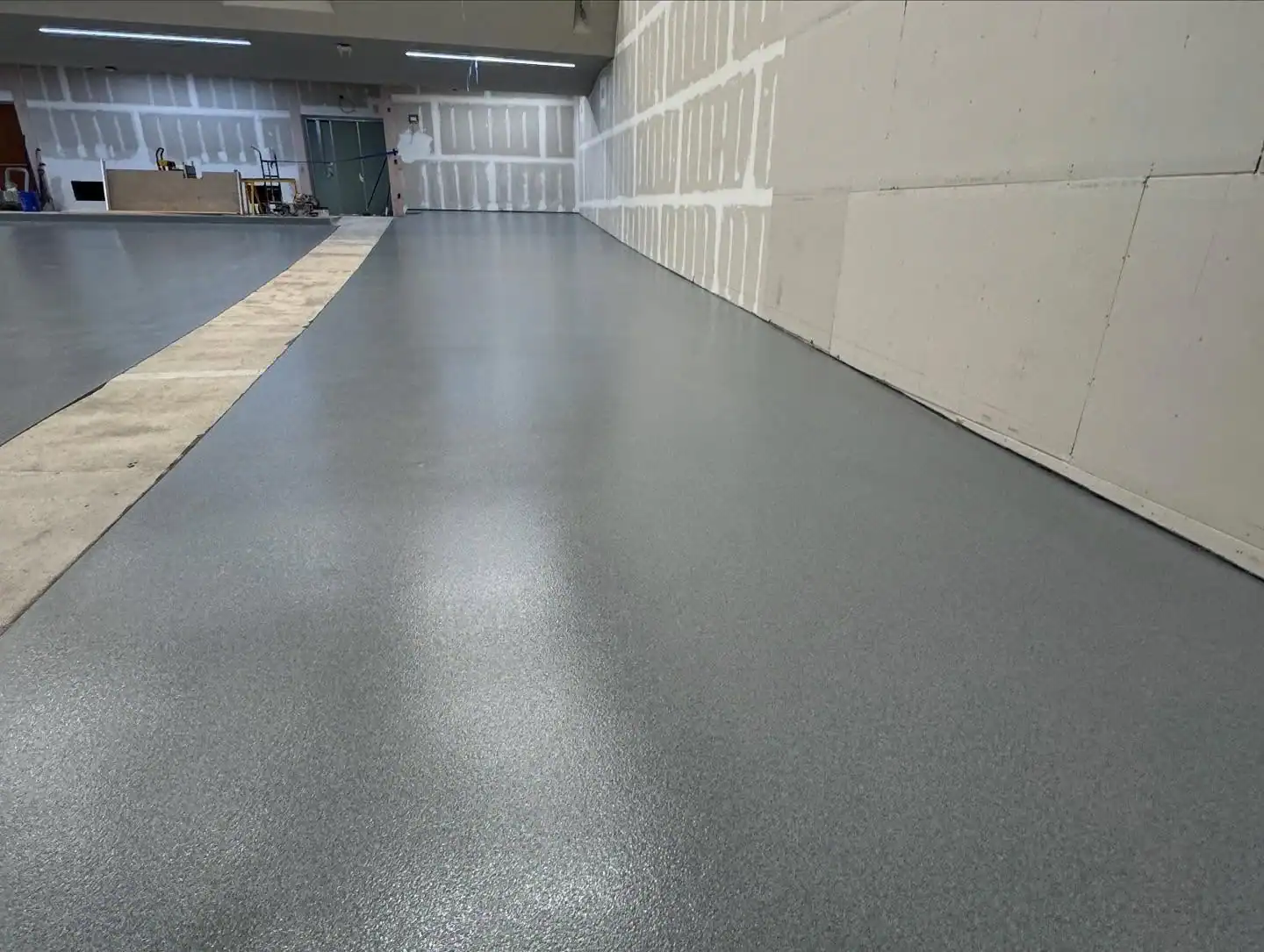
The Suffolk County Department of Health Services enforces food service establishment regulations that align with the FDA Food Code. Under those requirements, commercial kitchen floors must be smooth, non-porous, non-absorbent, and easily cleanable. They can’t have cracks, chips, or open gaps and they must have a coved base at every floor-wall junction, meaning the flooring material extends four to six inches up the wall to eliminate bacteria-trapping crevices at the base.
A seamless epoxy or urethane system with integral cove base is the standard of care that meets all of these requirements. What’s important to understand is that a compliant material in poor condition cracked, peeling, or with failing grout lines is still a code violation. SCDHS inspectors look at the condition of the floor, not just the material. If your Lindenhurst kitchen currently has quarry tile with deteriorating grout, that’s a citation waiting to happen regardless of how often you clean it.
The most common reason epoxy floors delaminate especially on Long Island’s South Shore is moisture vapor transmission from the concrete slab. When moisture trapped in the slab tries to escape upward, it creates pressure beneath the coating that eventually breaks the bond. The floor lifts, bubbles, and peels. It doesn’t matter how good the product is if the slab wasn’t tested before installation.
In Lindenhurst specifically, this risk is higher than average. The village sits on Great South Bay, is threaded with canals, and was heavily flooded during Hurricane Sandy in 2012. Many commercial buildings particularly those south of Montauk Highway in the waterfront neighborhoods have slabs that absorbed significant water and may still carry elevated moisture levels. Testing the slab before any coating is applied isn’t optional in this environment. It’s the step that determines whether the floor lasts two years or twenty. Every installation we perform starts with moisture assessment for exactly this reason.
The timeline depends on the size of the kitchen, the condition of the existing slab, and the coating system being installed. For most restaurant kitchens, the installation process including surface prep, base coat, build coats, and topcoat takes one to three days. If the slab needs significant crack repair or leveling work, that adds time to the front end.
The good news for Lindenhurst operators is that fast-cure polyaspartic topcoat systems allow return to light service within hours and full commercial use within 24 to 36 hours of final coat application. We can schedule work overnight or on weekends to minimize disruption to your regular service hours. For the independent restaurants and gastropubs that define Lindenhurst’s dining scene the kind of places doing consistent business from Tuesday through Sunday that scheduling flexibility is often the deciding factor. The goal is to get your kitchen back online as fast as the process responsibly allows, without cutting corners on cure time that would compromise the floor’s longevity.
Standard smooth epoxy is not appropriate for a commercial kitchen floor and any contractor recommending it for a grease-exposed environment either doesn’t know better or isn’t being straight with you. The ANSI A326.3 standard sets a minimum wet dynamic coefficient of friction (DCOF) of 0.42 for commercial walking surfaces. For kitchens with regular grease exposure, the target is 0.50 or higher.
The way you hit that number is through the topcoat. A properly specified slip-resistant aggregate broadcast into the final coat creates a surface that maintains traction even when it’s wet, greasy, or freshly mopped. The texture is fine enough to keep the surface cleanable it won’t trap grease the way a heavily textured quarry tile does but aggressive enough to provide real grip underfoot. Every commercial kitchen floor we install includes a slip-resistant topcoat formulated for food service environments. It’s not an upgrade. It’s part of the base specification.
Yes and it requires a different level of preparation than a standard inland installation. Many commercial properties in southern Lindenhurst are in FEMA-designated flood zones, particularly in the waterfront neighborhoods south of Montauk Highway that were most severely impacted by Hurricane Sandy. Buildings in these zones may be subject to additional construction requirements, and the concrete slabs in these structures need to be assessed carefully before any coating system is applied.
The key factors are moisture vapor transmission, slab condition, and the coating system’s ability to handle the environmental demands of a flood-prone building. Moisture-tolerant primer systems and epoxy formulations designed for high-humidity environments are part of the answer. So is thorough surface preparation grinding, crack repair, and leveling before the first coat goes down. A flood-zone slab that hasn’t been properly prepped and moisture-tested is one of the highest-risk substrates for early coating failure. If your Lindenhurst kitchen is in one of these areas, that context should be part of the conversation from the first call.
Both are used in commercial kitchens, but they perform differently and belong in different zones. Standard epoxy is durable, chemical-resistant, and works well in prep areas, walk-in coolers, and general kitchen traffic zones. It’s a strong system when it’s properly installed over a tested, prepped slab. Where it falls short is in high-heat environments areas directly adjacent to fryers, ovens, and steam equipment. Rapid temperature swings cause standard epoxy to expand and contract at a rate the material can’t sustain, which leads to cracking over time.
Cementitious urethane mortar sometimes called urethane cement is the correct system for those high-heat zones. It handles thermal shock, absorbs impact from dropped equipment, and resists the harsh cleaning chemicals used in commercial kitchens at a level that standard epoxy can’t match. It also bonds well to damp concrete, which makes it a practical choice in Lindenhurst’s coastal environment where slab moisture is a recurring variable. In most full-service restaurant kitchens, the right answer isn’t one system or the other it’s both, applied in the zones where each one performs best.