
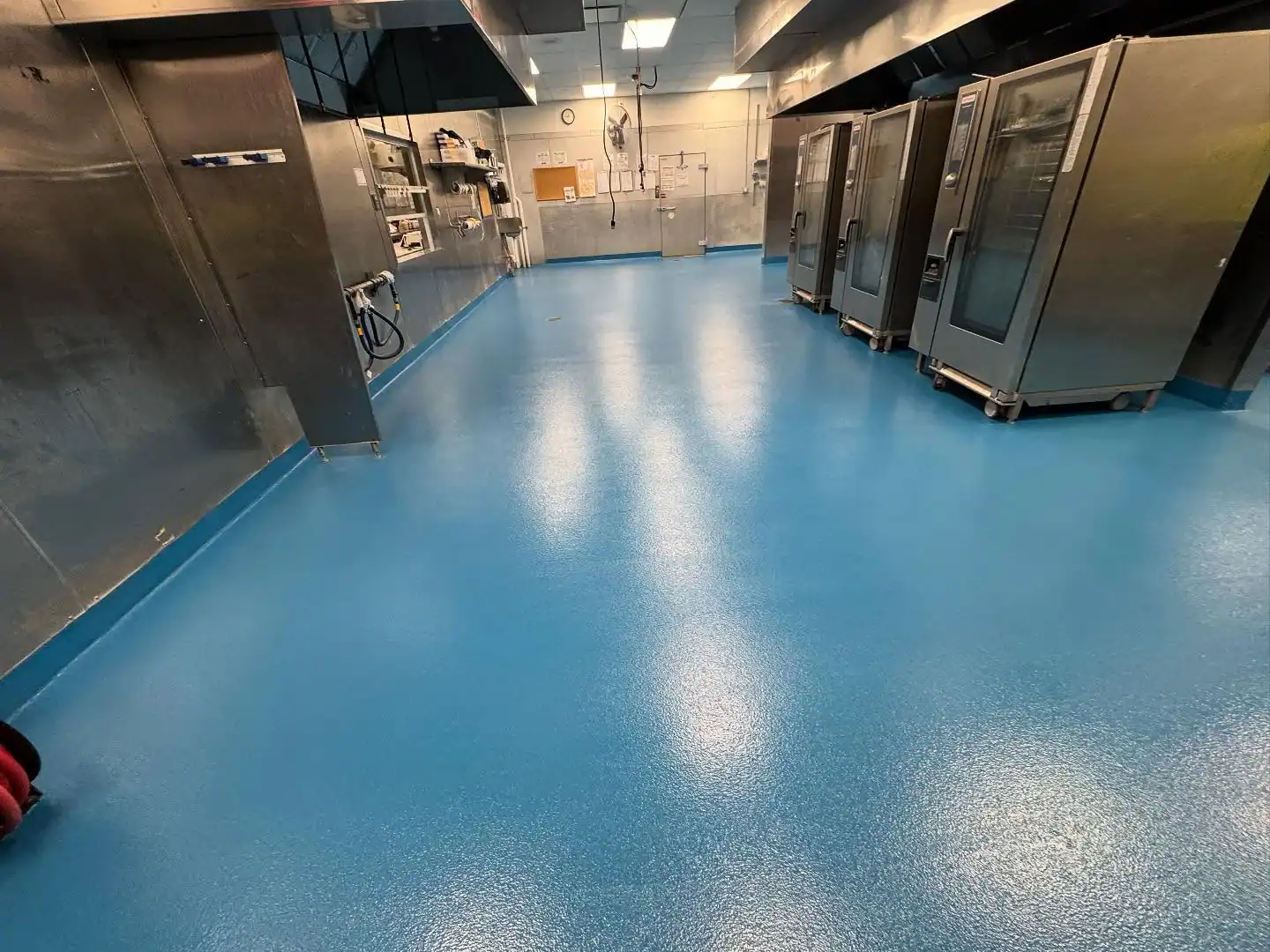
A properly installed kitchen floor doesn’t just look better it removes a category of risk from your operation entirely. No grout lines trapping grease between cleanings. No cracks that catch a health inspector’s attention. No surface that degrades under your commercial sanitizers or starts peeling at the edges after a year of steam and foot traffic.
For food service operators along the Route 25 corridor in Coram, that matters more than most places. These are busy kitchens in commercial buildings that, in many cases, have been through multiple tenants and multiple flooring attempts. The concrete slabs underneath are older, and central Suffolk County’s humidity regularly hitting 80% or higher during summer accelerates every failure mode a poorly installed floor has. Moisture gets into the slab. Coatings that weren’t properly bonded start to lift. What looked fine at installation looks like a problem six months later.
The right system, installed correctly from the start, changes all of that. You get a seamless, non-porous surface that can be fully sanitized, holds up under daily punishment, and gives your health inspector nothing to flag. That’s what a commercial kitchen floor in Coram should do.
We’ve been installing commercial and industrial floor systems for 35 years, operating out of Bohemia, NY roughly 10 to 12 miles from Coram via Route 112. That proximity means the crew that shows up to your Coram kitchen has been working in central Suffolk County buildings, in Long Island’s climate, on Long Island’s aging concrete slabs, for decades. We know what happens to floors in this market because we’ve been here through it.
We hold Sherwin-Williams High Performance Flooring ATP certification a factory-issued credential that covers moisture assessment, surface preparation, system selection, and full application method. We also hold Res Tech certification in specialized coating systems. Most flooring contractors in this market hold neither. These credentials aren’t decorative they represent documented, manufacturer-verified training in the exact process steps that determine whether a kitchen floor lasts or fails.
When you’re choosing someone to install a food-grade floor that a Suffolk County Department of Health Services inspector will evaluate, that difference is worth understanding.

Before anything goes on your floor, we test the concrete slab for moisture. This is the step most contractors skip and it’s the single most common reason epoxy floors delaminate ahead of schedule. In Coram’s central Suffolk County environment, with the water table and humidity levels typical of Long Island, skipping moisture testing isn’t a minor shortcut. It’s how a floor that looks fine on day one starts lifting by month six.
After moisture testing, we diamond grind the slab to the correct surface profile for long-term adhesion. Any cracks get filled. Uneven areas get leveled. The substrate has to be right before a single coat goes down and in older commercial buildings along Middle Country Road in Coram, that prep work often takes more time than the coating itself. That’s not a problem. It’s the job.
From there, the system gets built in layers: primer, base coat, build coats for thickness and impact resistance, and a slip-resistant topcoat. The specific system depends on the zone high-heat areas near fryers get urethane cement mortar that handles thermal shock, walk-in coolers get moisture-tolerant formulations, and high-traffic corridors get the build thickness they need. If downtime is tight, fast-cure polyaspartic topcoats can get you back in service within 24 hours. We build the schedule around your kitchen, not around a standard workday.

Ready to get started?
Every commercial kitchen floor we install is designed to meet the requirements the Suffolk County Department of Health Services actually enforces. That means seamless, non-porous surfaces with no grout lines or crevices where bacteria accumulate. It means integral coved base at every floor-to-wall junction the 4-to-6-inch upturned edge that New York State’s sanitary code requires in food preparation areas. It means surfaces that hold up under the commercial-grade sanitizing chemicals your kitchen uses daily without degrading or discoloring.
The system we select for your Coram kitchen depends on what that kitchen actually does. A diner on Route 25 that’s been running the same fryers for 20 years has different flooring needs than a catering prep facility or a food production space. Zones with heavy grease exposure and heat need different chemistry than dry storage corridors or walk-in cooler thresholds. We assess each area and match the system to the real conditions not a single product applied everywhere because it’s faster.
The result is a floor that satisfies your health inspector, holds up through Long Island’s humid summers and freeze-thaw winters, and doesn’t need to be revisited in two years. That’s the standard we hold the work to, and it’s what 35 years of commercial kitchen flooring experience in this market looks like in practice.

The Suffolk County Department of Health Services enforces the New York State Sanitary Code for food service establishments, which incorporates FDA Food Code standards. For commercial kitchen floors in Coram and throughout the county, that means smooth, non-porous, non-absorbent surfaces that are free of cracks, chips, and gaps and that can be fully cleaned and sanitized. Grout lines, surface pitting, and open cracks are all citable violations.
In practical terms, seamless epoxy and urethane cement systems are the standard of care for food preparation areas in Coram. These systems also need to include a coved base the upturned edge where the floor meets the wall to eliminate the crevice that tile and standard flooring leave behind. If your current floor has grout lines, visible cracking, or any surface that holds moisture or debris after cleaning, it’s worth addressing before your next inspection rather than after.
A properly installed epoxy or urethane cement floor system in a commercial kitchen should last 10 to 20 years under normal food service conditions. The range depends on traffic volume, chemical exposure, whether the system was correctly matched to the environment, and most importantly whether the substrate was properly prepared before installation.
In Coram and across central Suffolk County, the variable that shortens floor life more than anything else is moisture. The region’s humidity and Long Island’s shallow water table mean that concrete slabs in older commercial buildings can have significant moisture vapor transmission. If a contractor coats over a slab without testing for moisture first, that floor will delaminate regardless of how good the product is. The prep work moisture testing, diamond grinding, crack repair is what determines longevity. The coating is only as good as what it’s bonded to.
Yes, and for most food service operators on Middle Country Road in Coram, minimizing downtime is the primary scheduling concern. The honest answer is that some closure time is usually required active kitchen areas need to be clear and dry for proper installation but how much depends on the size of the space, the system being installed, and how the work is phased.
Fast-cure polyaspartic topcoat systems can allow return to light foot traffic within hours and full commercial use within 24 to 36 hours. For larger kitchens, work can often be phased by zone completing one section while others remain operational. We offer overnight and weekend scheduling for operations that run during standard business hours. The schedule gets built around your kitchen’s actual hours, and the plan gets discussed before any work starts so there are no surprises.
The clearest indicators are surface integrity and cleanability. If your floor has visible cracks, open grout lines, surface pitting, or areas where the coating has lifted or peeled, those are direct citation points under the New York State Sanitary Code. Inspectors from the Suffolk County Department of Health Services look for surfaces that are smooth, non-porous, and free of any feature that traps food particles, grease, or moisture.
Beyond the obvious visible issues, pay attention to how the floor responds to cleaning. If there are areas that stay discolored after sanitizing, or spots where moisture seems to sit rather than drain, those are signs of surface degradation that may not be immediately visible but will show up under inspection. If you’re unsure, the straightforward move is to have the floor assessed before your next scheduled inspection not after a citation forces the issue.
Epoxy is the right choice for most commercial kitchen zones it’s durable, seamless, chemical-resistant, and bonds well to properly prepared concrete. It handles foot traffic, rolling equipment, and commercial sanitizers without issue. For the majority of kitchen floor areas in a Coram restaurant, a food-grade epoxy system is the standard and appropriate solution.
Urethane cement is a different material designed specifically for environments with significant thermal shock areas where hot water hits the floor from steam equipment, where floor drains receive boiling water, or where temperatures fluctuate rapidly and repeatedly. Standard epoxy can crack under those conditions over time. Urethane cement handles the expansion and contraction without failing. In a busy diner kitchen or a high-volume food production facility, the cooking line and dishwashing area often warrant urethane cement while the rest of the floor uses epoxy. The right answer depends on what’s actually happening in each zone of your kitchen.
For a commercial kitchen floor installation in Coram, most restaurant and food service operators should expect to budget somewhere in the range of $8 to $18 per square foot, depending on the system selected, the condition of the existing slab, and how much surface preparation is required. A straightforward epoxy installation on a well-prepared slab lands toward the lower end. Urethane cement systems, significant crack repair, or extensive grinding and leveling work will move the number higher.
The variable that surprises most operators is surface prep. Older commercial buildings along Route 25 in Coram often have slabs that need more work than they appear to existing coating failures to remove, cracks to fill, moisture issues to address. That prep work adds cost, but it’s what determines whether the new floor lasts 15 years or fails in two. The cost of doing it right once is almost always less than the cost of replacing a failed floor, plus the lost revenue from an unplanned closure or a health inspection citation that forces the issue.