


You stop worrying about cracks spreading across your floor every time a forklift makes a turn. The constant back-and-forth with maintenance crews ends because your floor isn’t spalling at the joints anymore.
Your team moves faster when they’re not navigating around damaged sections or waiting for another patch job to cure. Forklifts last longer when they’re not rattling over uneven concrete all day, which means your maintenance budget stops bleeding from premature equipment wear.
The floor stays intact under the weight and vibration that comes with running a working warehouse. You’re not scheduling downtime to fix the same problem areas every few months. That’s what a proper forklift traffic resistant coating in Smithtown, NY does—it removes the floor from your list of problems so you can focus on actually running your operation.
We’ve been handling industrial floors for over 30 years at Advanced Epoxy Flooring, with our lead installers bringing more than 40 years of hands-on experience. We’ve worked in warehouses across the country, plus projects in the Bahamas, Moscow, and even the White House kitchen back in 1996.
In Smithtown, we understand what local warehouses deal with—constant forklift traffic, chemical exposure from operations, and the need to keep things moving without extended shutdowns. Our crews are OSHA 40 certified and most have been with us over a decade, so you’re getting people who know what they’re doing.
We’re not the cheapest option, and that’s intentional. You’re paying for a floor system that won’t need replacing in three years because we cut corners on prep work or materials.

First, we test your concrete for moisture because coatings fail when moisture is trapped underneath. If there’s an issue, we address it before anything goes down. Then comes surface prep—usually diamond grinding for warehouses in Smithtown to open up the concrete pores so the coating actually bonds instead of just sitting on top.
Any cracks, spalling, or joint damage gets repaired properly. We’re not just filling holes with quick-set compound and hoping it holds. The repair work is done to handle the same loads as the rest of your floor.
Once the surface is prepped and repairs are cured, we install the epoxy system that matches your operation. That might be a high-traffic concrete sealer for lighter use, or a heavy-duty 1/4″ trowel-down system if you’re running loaded forklifts constantly. We can add anti-slip additives where you need traction and install colored safety lines to mark traffic lanes.
The installation is planned around your schedule to minimize downtime. We’re not going to shut down your entire warehouse for two weeks if we can section it off and keep you operational.

Ready to get started?
You get a complete installation—not just coating over whatever’s there and calling it done. That includes moisture testing, surface preparation through diamond grinding, concrete repairs where needed, and the coating system itself.
The coating we install for warehouse floors in Smithtown, NY is engineered for forklift traffic. It’s 4-5 times more durable than standard epoxy because standard epoxy wasn’t designed for constant point loads and turning forces. We’re using industrial-grade materials that handle chemical spills, impact from dropped pallets, and the daily grind of a working facility.
Smithtown’s industrial sector includes distribution centers, manufacturing facilities, and logistics operations where downtime costs real money. The floor system we install is built to keep up with that pace. It creates a seamless, non-porous surface that doesn’t trap dirt or fluids in joints and seams, which matters for facilities that need to maintain clean operations or meet OSHA standards.
If you need custom safety striping, traffic lane markers, or designated zones marked out, that’s part of the installation. The goal is a floor that improves safety and efficiency, not just one that looks better for a few months.
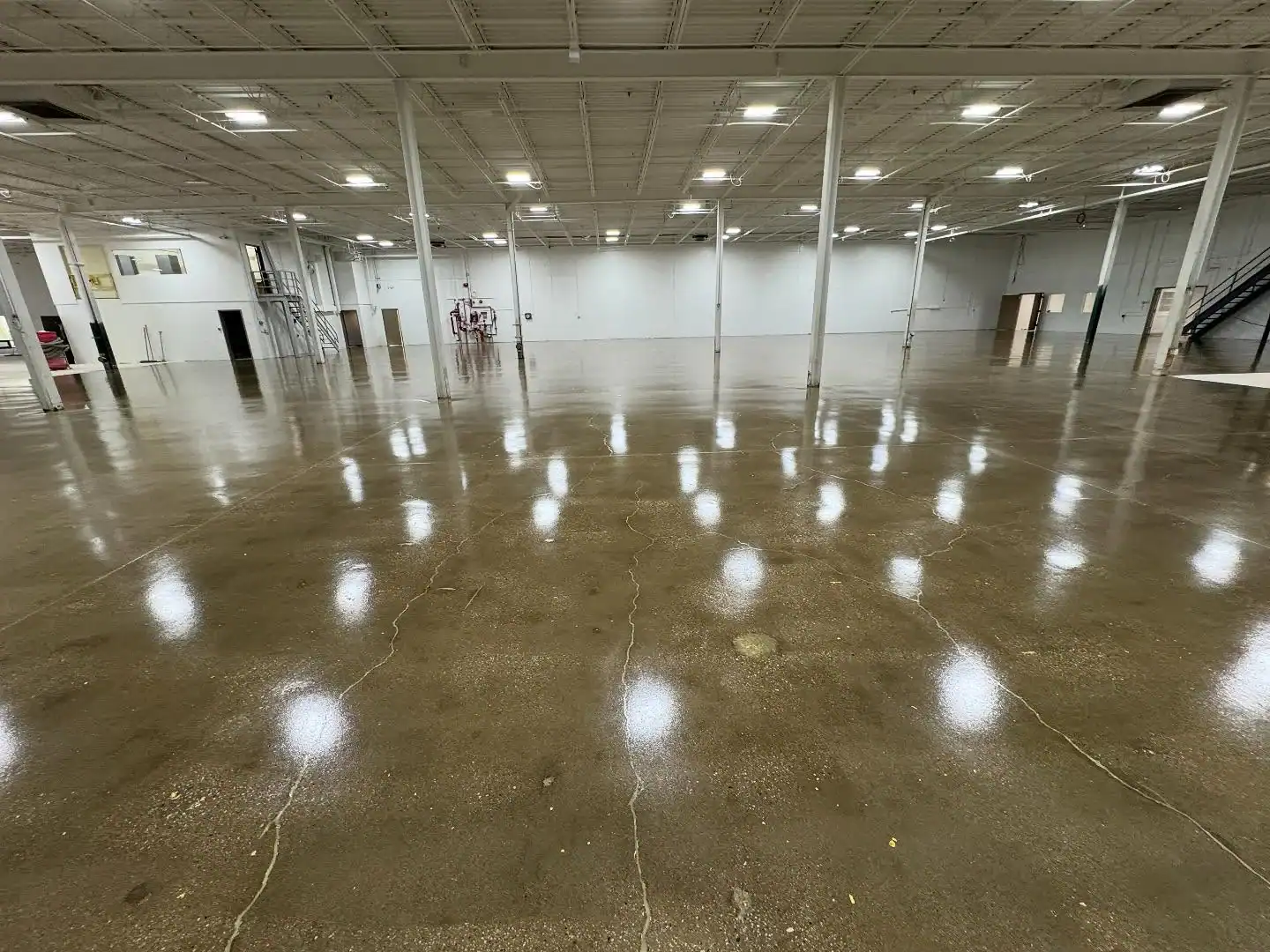
It depends entirely on what gets installed and how the prep work is done. A properly installed industrial epoxy system built for heavy traffic typically lasts 10-15 years in a working warehouse environment with forklifts running daily.
Standard epoxy—the kind you see advertised cheap—might last 2-3 years before it starts breaking down under point loads and turning forces. The difference is in the material thickness, the hardness rating, and whether the concrete was actually prepared to accept the coating.
If someone’s grinding the surface properly, repairing structural damage, and installing a system rated for your equipment weight, you’re looking at a long-term solution. If they’re just rolling on a thin coat over dirty concrete, you’ll be calling for repairs within a year. The installation matters as much as the product.
Yes, and that’s usually how we approach it. Most warehouses can’t afford to go completely dark for a week, so we section off areas and work in phases that keep your operation moving.
The timeline depends on your floor size and what condition it’s in. A straightforward coating on well-maintained concrete might only need 24-48 hours per section before it’s ready for light traffic, with full cure for heavy equipment in 3-5 days. If there’s significant repair work or moisture issues, that extends the timeline.
We plan the installation around your schedule—nights, weekends, or phased sections during slower periods. The goal is to minimize disruption while still doing the job right. Rushing the cure time or skipping prep steps to get you back online faster just means you’ll be dealing with a failed floor in six months, which costs you more downtime than doing it properly the first time.
Control joints are cut into concrete to manage cracking as it cures, but they become the weakest point once forklifts start running over them daily. The constant impact and vibration cause the edges to spall and crumble, especially when the joints aren’t filled or protected properly.
Once spalling starts, it accelerates. Moisture gets into the cracks, freeze-thaw cycles make it worse, and the forklift wheels chip away more material with every pass. Eventually you’ve got a joint that’s an inch wide and causing damage to your equipment.
We fix it by removing all the damaged concrete around the joint, cleaning it thoroughly, and filling it with a high-strength repair material that’s designed to flex slightly with the joint movement while still supporting heavy loads. Then the entire floor gets coated with a system that bridges over the joints and distributes the load across a wider area. It’s not a quick patch—it’s a structural repair that addresses why the joint failed in the first place.
It can, depending on what compliance issues you’re addressing. OSHA requires that walking and working surfaces be kept in safe condition, free from hazards that could cause slips, trips, or falls. A deteriorating floor with cracks, spalling, and uneven surfaces creates exactly those hazards.
Installing a proper floor system eliminates those defects and creates a smooth, level surface. If you add anti-slip additives in areas where spills are common or where foot traffic crosses forklift paths, you’re further reducing slip hazards. Custom safety striping helps with traffic management and clearly marks pedestrian zones, which addresses OSHA’s requirements for separating vehicle and foot traffic where feasible.
The floor itself won’t make you OSHA compliant if you’ve got other safety issues, but it removes several common citation areas related to walking surfaces and facility maintenance. Plus, a floor that’s easier to clean helps you maintain the sanitary standards OSHA expects in facilities handling food, pharmaceuticals, or other regulated products. It’s one less thing to worry about during an inspection.
Thickness, hardness, and chemical composition. Cheap epoxy is usually a thin mil coating (3-5 mils) that’s designed for light residential or retail use. It’ll handle foot traffic fine, but put a loaded forklift on it and the point load will crack it or cause it to delaminate from the concrete.
Industrial warehouse floor epoxy in Smithtown, NY is typically 10-30 mils thick for standard applications, or up to 1/4 inch for heavy-duty trowel-down systems. The resin is formulated to handle impact, abrasion, and chemical exposure. It’s also engineered to flex slightly under load instead of cracking, which matters when you’ve got equipment creating constant vibration and point stress.
The other major difference is in surface prep requirements. Cheap coatings are often marketed as easy DIY applications that go over existing floors with minimal prep. Industrial systems require diamond grinding, moisture testing, and proper repairs because they’re designed to last 10-15 years, not 2-3. You’re paying more upfront, but you’re not recoating the floor every few years or dealing with constant maintenance issues. The math works out better long-term if you’re actually using the space as a working warehouse.
Light foot traffic is usually fine after 24 hours. Forklifts and heavy equipment need to wait longer—typically 3-5 days for normal operations, with full cure taking 7-10 days depending on temperature and humidity.
The coating needs time to cross-link and reach full hardness. If you put heavy loads on it too early, you risk damaging the surface or causing the coating to separate from the concrete. That’s especially true with turning forces from forklifts, which create more stress than straight-line traffic.
Temperature affects cure time significantly. In colder months, coatings take longer to cure. In summer heat, they cure faster but the application window is shorter before the material starts to set up. We account for Smithtown’s seasonal conditions when planning the installation timeline and give you realistic expectations for when each section will be ready for full use. Rushing it doesn’t help anyone—you end up with a compromised floor that fails early and costs more to fix than waiting a few extra days would have.