


You’re running a warehouse, not babysitting a floor. When your surface can’t handle forklift traffic, chemical spills, or the weight of your daily operations, everything slows down.
A proper industrial warehouse floor epoxy in Merrick, NY changes that. You get a seamless surface that doesn’t crack under pressure, doesn’t absorb spills, and doesn’t need constant patching. Your team moves faster because the floor isn’t fighting them.
The difference shows up in what doesn’t happen anymore. No more calling someone out to fix another crack. No more slowing down operations because a section needs repair. No more wondering if your floor can handle what you’re about to put on it. Just a surface that does its job so you can do yours.
We’ve been installing forklift traffic resistant coating in Merrick, NY and across Long Island for over 30 years. Our president has 40 years of hands-on experience, and most of our crew has been with us for over a decade.
We’ve installed floors everywhere from local Nassau County warehouses to the White House kitchen. That’s not name-dropping—it’s proof that when the job matters, the system has to be right the first time.
Merrick’s industrial sector is growing, with Long Island’s warehouse vacancy rates at historic lows and rental demand climbing. Your facility needs flooring that keeps pace with that pressure. We’ve been doing this since before e-commerce turned every warehouse into a 24/7 operation, and we know what holds up when the work never stops.

We start with moisture testing because concrete that looks fine can still trap moisture that’ll ruin any coating. If your slab has issues, we handle the repair work before anything else goes down.
Next comes surface prep—usually diamond grinding for warehouses in Merrick, NY. This isn’t optional. It opens the concrete’s pores so the epoxy bonds at a molecular level instead of just sitting on top. Shortcuts here mean peeling later.
Then we apply your high-traffic concrete sealer in Merrick, NY as a customized system. Not one coat. Not a standard mix. A layered approach based on your traffic patterns, load requirements, and what actually rolls across that floor every day. We’re OSHA 40 certified, so installation meets safety standards while minimizing downtime.
The floor cures on a schedule that fits your operation. You’re not shut down for weeks. You get a surface that’s ready to handle your heaviest equipment without babying it through some extended break-in period.

Ready to get started?
Large scale warehouse flooring in Merrick, NY means covering serious square footage with a system that performs uniformly across every inch. You get a USDA-approved coating designed specifically for forklift traffic, not a general-purpose product stretched beyond its limits.
The system includes full concrete preparation, moisture mitigation if needed, crack and joint repair, and a multi-layer epoxy application engineered for your load requirements. It’s chemical resistant, so spills from oils, solvents, and industrial cleaners don’t eat through the surface.
Long Island’s industrial real estate market is tighter than it’s ever been. Facilities here are working harder, and floors are taking more abuse. Your coating needs to handle constant pallet jack traffic, temperature swings, and the reality that operations don’t stop for maintenance windows. This system is built for environments where downtime isn’t an option and the floor has to perform under pressure, day after day.
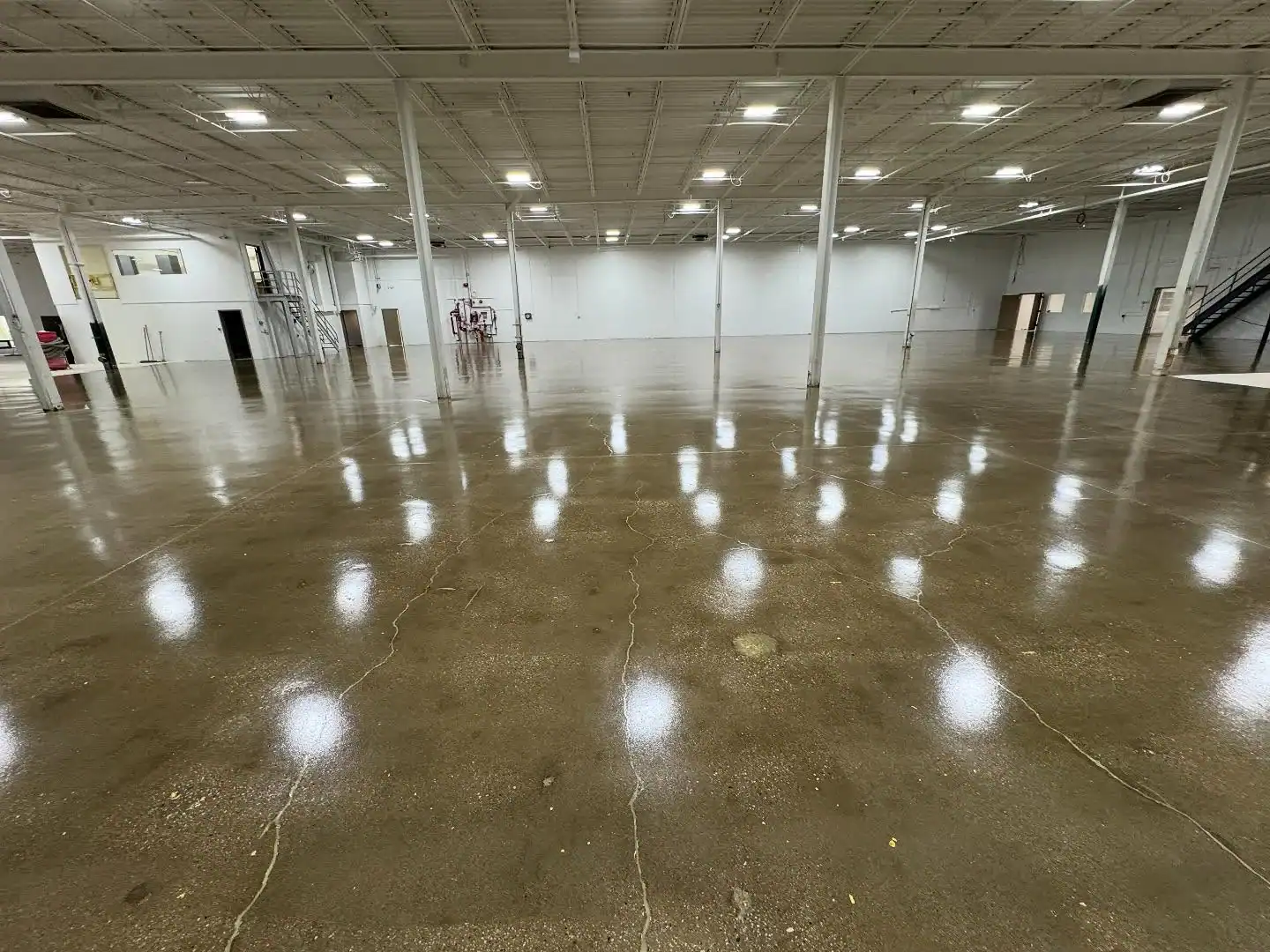
It depends entirely on your traffic and how the floor was installed. A properly applied system with the right prep work can last 10 to 20 years in high-traffic environments. Cut corners on surface prep or use an undersized coating, and you’re looking at failure in under five.
The key is matching the system to your operation. A warehouse running forklifts 16 hours a day needs a different build than one with light foot traffic. We spec systems based on load capacity, chemical exposure, and realistic wear patterns—not what sounds good in a sales pitch.
Most failures happen because the concrete wasn’t prepped correctly or moisture wasn’t addressed before coating. We test for both. If your slab has issues, we fix them first. That’s how you get decades of performance instead of a redo in three years.
Yes, if it’s engineered for your specific loads. Epoxy systems can be built to handle tens of thousands of pounds per square inch, but only if the concrete underneath is sound and the coating is applied in the right thickness and layers.
Forklift traffic is one of the hardest tests for any floor. The weight is concentrated on small wheels, and the constant turning creates shear forces that’ll tear up weak coatings. We design systems with impact resistance and compressive strength that match your equipment specs—not generic ratings.
The concrete itself matters just as much. If your slab has cracks, uneven sections, or poor flatness tolerance, the coating can’t fix that. We assess the substrate first, make repairs where needed, and then apply a system that distributes loads properly. That’s how you avoid the cracking and delamination that happens when someone just slaps coating over a bad slab.
Diamond grinding mechanically removes the top layer of concrete to expose a clean, porous surface. It gets rid of old coatings, contaminants, oils, and the weak surface layer that prevents proper adhesion. Without it, your coating is bonding to dust and grime instead of solid concrete.
The process uses industrial grinders with diamond-embedded discs that cut into the slab at a controlled depth. It’s loud, it creates dust (which we contain), and it’s not optional if you want a floor that lasts. This step opens the concrete’s pores so the epoxy penetrates and locks in at a molecular level.
Some contractors skip this and use acid etching instead because it’s faster and cheaper. Acid etching doesn’t work on dense concrete, doesn’t remove existing coatings well, and leaves a weaker bond. We use diamond grinding because it’s the only prep method that consistently delivers long-term performance in high-traffic warehouse environments.
Typically 3 to 7 days depending on square footage, concrete condition, and the system you need. That includes prep, application, and full cure time. We can work in phases to keep parts of your facility operational, but the coated areas need to stay clear until curing is complete.
Surface prep usually takes a day or two. Application depends on how many layers your system requires—most industrial jobs need multiple coats with cure time between each. The final cure before you can run full operations is usually 24 to 72 hours, but we can get light foot traffic on sooner if needed.
Rushing the process is where problems start. Coatings that aren’t fully cured will fail under heavy loads. We give you realistic timelines upfront and stick to them. Most Merrick warehouse operations can schedule around a week-long installation without major disruption, especially if we’re working nights or weekends.
Yes, but the level of resistance depends on the specific epoxy formulation. Standard epoxy handles most oils, cleaners, and light solvents without issue. If you’re dealing with aggressive acids, alkalis, or concentrated chemicals, you need a specialized system designed for chemical exposure.
Warehouses deal with everything from hydraulic fluid to battery acid to industrial degreasers. A proper high-traffic concrete sealer creates a non-porous barrier that prevents these substances from penetrating the concrete. Spills sit on the surface where you can clean them up instead of soaking in and causing damage.
The key is knowing what you’re up against before we spec the system. We ask about your operations, what gets stored, what gets spilled, and how often. Then we match the coating chemistry to your exposure risks. Generic “chemical resistant” claims don’t mean much—you need a system tested against the actual substances in your facility.
Because epoxy only performs as well as the concrete underneath it. You can use the best coating in the world, but if it’s applied over weak concrete, moisture issues, or contaminated surfaces, it’s going to fail. Preparation determines whether your floor lasts two years or twenty.
Concrete preparation includes testing for moisture, repairing cracks and spalls, leveling uneven areas, and creating the right surface profile for adhesion. Each step addresses a specific failure point. Skip moisture testing, and trapped water vapor will push your coating off from below. Skip crack repair, and those cracks telegraph through the epoxy and spread.
Most coating failures aren’t coating failures—they’re prep failures. We’ve seen plenty of warehouses where someone applied a decent product over bad concrete and blamed the coating when it failed. We spend more time on prep than most contractors because that’s where durability actually comes from. It’s not the exciting part, but it’s the part that determines whether you’re calling us back in three years or thirty.