
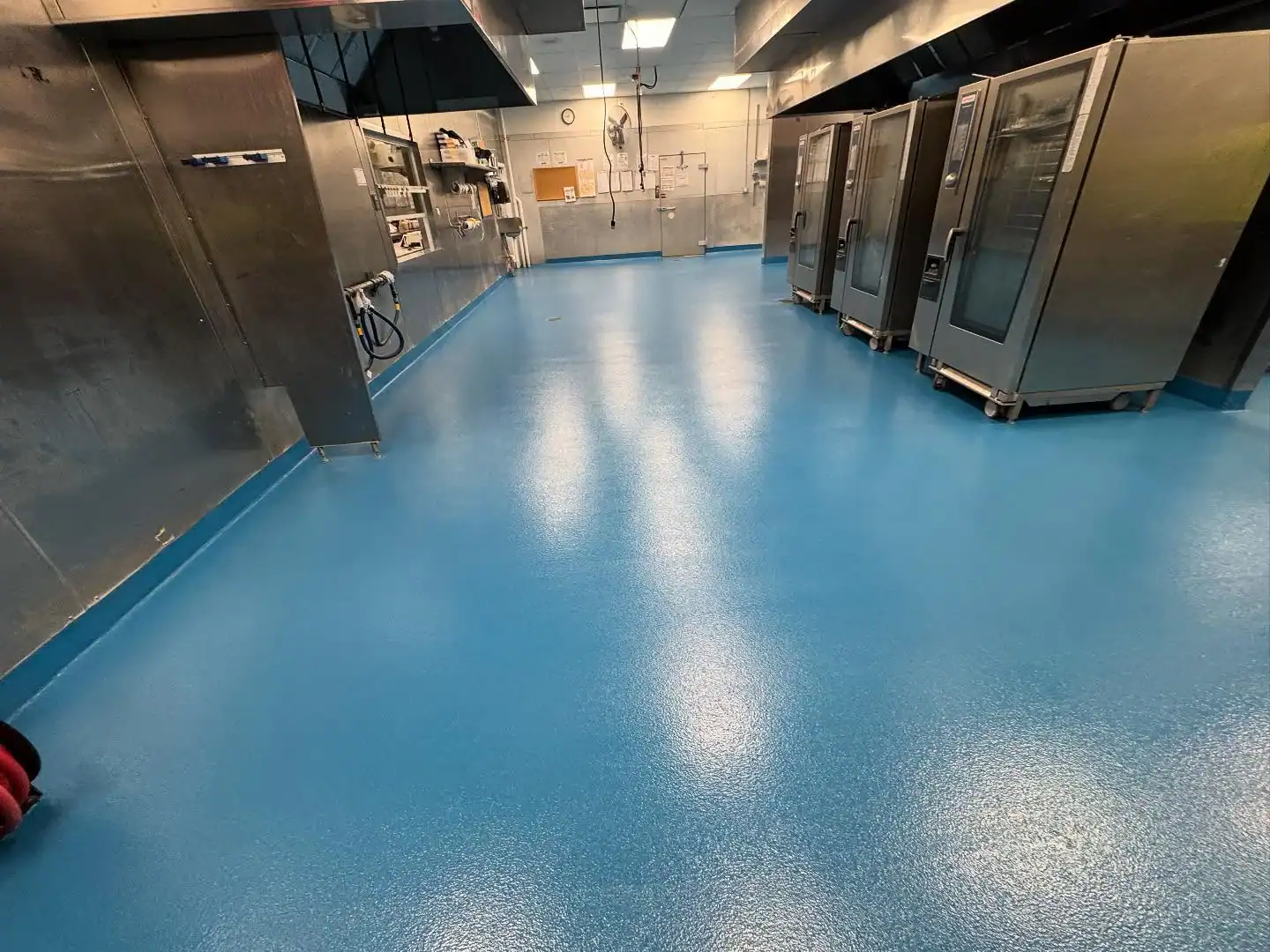
Most commercial kitchen floors in Commack fail for one of two reasons: the wrong system was installed, or the surface prep was skipped. Either way, you’re looking at a floor that peels, cracks, or gets flagged on your next Suffolk County health inspection and those violations are public record, listed by name.
The buildings along Jericho Turnpike have been running kitchens for decades. A lot of those slabs were poured in the 1950s and 1960s, which means they’ve absorbed years of grease, cleaning chemicals, and moisture. Long Island’s humidity regularly sitting above 65% in summer puts constant pressure on concrete from the inside out. If moisture vapor isn’t tested and accounted for before a coating goes down, delamination isn’t a risk, it’s a timeline.
The right system changes that completely. A properly installed, seamless epoxy floor gives you a surface that’s non-porous, chemical-resistant, and built to handle the thermal shock of steam cleaning and hot equipment. No grout lines for bacteria to hide in. No cracks for a health inspector to flag. Just a floor that keeps working as hard as your kitchen does.
We’ve been installing commercial kitchen floors across Commack and the surrounding Suffolk County area for 35 years. We’re based in Bohemia, NY just south of Commack on Route 454 and we built our entire operation around the idea that most floor failures aren’t bad luck. They’re the result of contractors who skipped moisture testing, rushed the cure, or applied the wrong system for the environment.
We hold Sherwin-Williams High Performance Flooring ATP certification and Res Tech certification two manufacturer-backed credentials that most contractors in this market simply don’t have. Sherwin-Williams has been a recognized name in high-performance seamless floor systems for over 60 years, and their ATP program isn’t a certificate you print after watching a video. It covers concrete assessment, surface preparation, moisture management, and full multi-coat application from the ground up.
That background matters when you’re running a kitchen on Jericho Turnpike in Commack and you need a floor that holds up to real conditions not just looks good on install day.
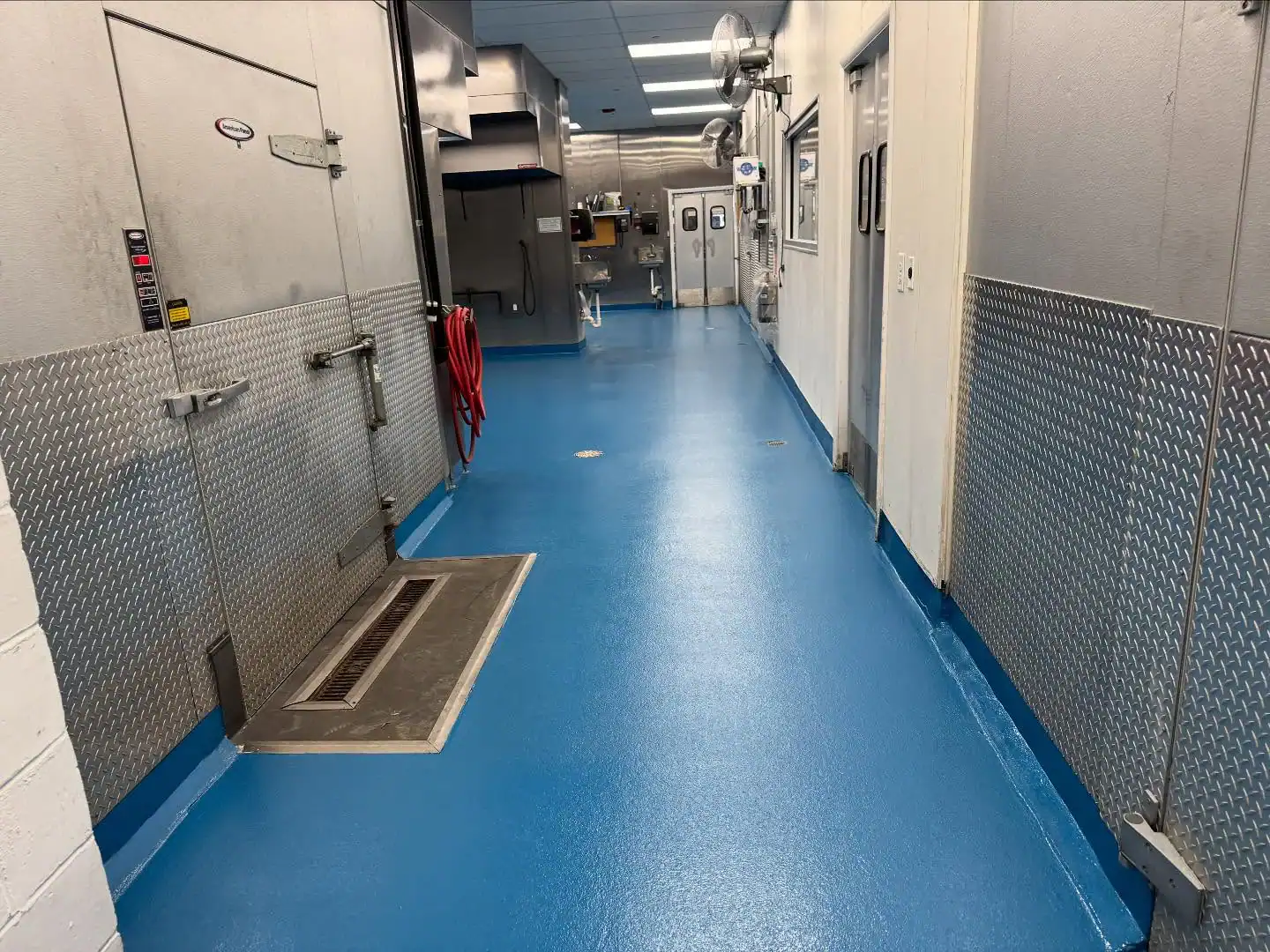
The first thing that happens on every commercial kitchen project isn’t mixing product it’s testing the concrete for moisture. Moisture vapor transmission is the leading cause of epoxy delamination, and in Commack’s humid Long Island climate, it’s not a theoretical concern. It’s something that has to be measured before anything else happens. Most contractors skip this step. That’s why most floors fail.
Once moisture levels are confirmed and documented, the concrete gets diamond ground to the correct surface profile. That means removing old coatings, contaminants, and any weak surface layer so the new system bonds directly to solid concrete. Cracks get filled. Uneven areas get leveled. The substrate has to be right before the coating system starts not patched over after.
From there, the system goes down in layers: a primer coat, build coats sized for the specific demands of your kitchen, and a slip-resistant topcoat. In high-heat zones near cooking equipment or steam cleaning areas, we use urethane cement mortar instead of standard epoxy it’s engineered for thermal shock and won’t crack under the temperature swings a working kitchen creates. Because Commack properties can fall under either Town of Huntington or Town of Smithtown jurisdiction depending on where your address sits, permit requirements vary. That’s a detail worth knowing before work starts, and something we can help you navigate.
Ready to get started?
Commercial kitchen flooring in Commack isn’t one-size-fits-all. A restaurant on Jericho Turnpike running a full dinner service has different floor demands than a commissary kitchen near the Long Island Innovation Park at Hauppauge but both need a system that’s seamless, non-porous, and built to handle chemical exposure, heavy foot traffic, and daily cleaning cycles without breaking down.
Every installation we do includes moisture testing, diamond grinding to the correct surface profile, crack repair, and a multi-coat system matched to the specific demands of your space. Coved base installation at floor-to-wall junctions is included where required that’s the detail health inspectors look for, and it’s the detail that eliminates the crevices where bacteria accumulate. Slip resistance is built into the topcoat, targeting a wet dynamic COF that meets or exceeds OSHA and ANSI A326.3 requirements for commercial kitchen environments with grease exposure.
We offer fast-cure polyaspartic topcoat options for kitchens that can’t afford extended downtime. That means return to light service in hours and full commercial use within 24 to 36 hours which matters when you’re running a kitchen seven days a week on one of the busiest commercial corridors in western Suffolk County. We don’t rush the system between coats, because that’s one of the most common reasons floors fail within the first year.
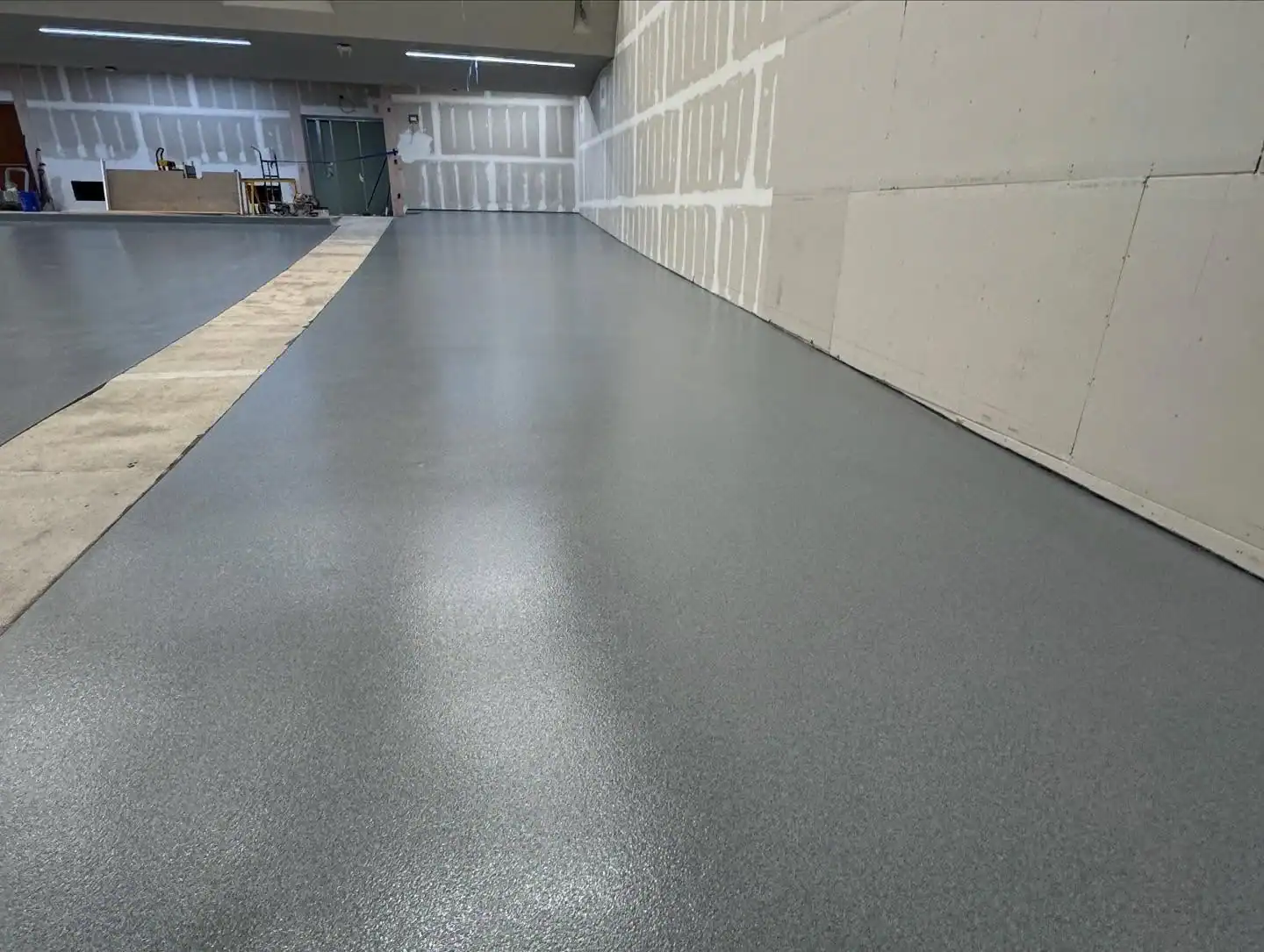
Suffolk County’s Food Protection bureau enforces the New York State Sanitary Code, which incorporates FDA Food Code requirements for commercial food service facilities. Under FDA Food Code Sections 6-201.11 and 6-501.11, kitchen floors must be smooth, non-porous, non-absorbent, and easily cleanable and they must stay that way. A compliant material that has cracked, pitted, or deteriorated is still a code violation, even if it was installed correctly years ago.
Health inspectors in Suffolk County also look at floor-to-wall junctions. Coved base is required to eliminate the gap where the floor meets the wall that gap is where grease and bacteria accumulate, and inspectors know it. Grout lines in tile floors are a frequent citation point for the same reason. A seamless epoxy system with integral coved base eliminates both issues. Restaurant inspection violations in Suffolk County are publicly listed by establishment name, so a floor citation in Commack isn’t a private matter it shows up in the public record.
A properly installed commercial epoxy floor in a Long Island kitchen should last 15 to 20 years with normal maintenance. The key phrase there is “properly installed” which means moisture was tested before application, the concrete was ground to the correct surface profile, and the right system was matched to the actual demands of the space. Kitchens that skip those steps often see delamination within one to three years, especially in Commack and across Long Island where moisture vapor pressure in older slabs is a constant factor.
High-heat zones near cooking equipment and steam cleaning areas have additional demands. Standard epoxy can crack under the thermal shock of rapid temperature changes the kind that happen every service in a working kitchen. Urethane cement mortar is the appropriate system for those zones. It’s more expensive than standard epoxy, but it handles thermal stress without breaking down. The cost difference between doing it right once and replacing a failed floor in two years is significant and that math is usually what moves Commack restaurant owners off the fence.
In most cases, yes with the right scheduling. We typically do commercial kitchen floor installations overnight or over a weekend to avoid disrupting service. Fast-cure polyaspartic topcoat systems allow return to light foot traffic in a matter of hours, and most kitchens are back to full commercial use within 24 to 36 hours of the final coat. That timeline matters when you’re running a kitchen on Jericho Turnpike where closing for two or three days isn’t a realistic option.
The honest answer is that the schedule depends on the size of the kitchen, the condition of the existing substrate, and how much prep work is required. A kitchen with significant crack damage, an old coating that needs to be fully removed, or high moisture readings in the slab may need more time before the coating system can go down. The moisture testing and substrate assessment that happen at the start of the project give you a clear picture of what the timeline looks like before any work begins so there are no surprises mid-installation.
Peeling almost always comes down to one of three things: moisture vapor wasn’t tested before installation, the concrete wasn’t properly prepared, or the wrong system was used for the environment. In Long Island kitchens, moisture is the most common culprit. Concrete slabs especially in older commercial buildings along Jericho Turnpike where foundations were poured 50 to 70 years ago hold significant moisture. When a coating is applied over a slab with elevated moisture vapor transmission, the pressure from below eventually breaks the bond between the coating and the concrete. It doesn’t matter how good the product is.
The fix isn’t complicated, but it requires doing the work upfront. We test moisture before any coating is applied, which tells us what we’re working with. If moisture levels are elevated, a moisture-mitigating primer is used before the system goes down. Diamond grinding the concrete to the correct surface profile ensures the coating has something solid to bond to, not just a contaminated surface layer. These aren’t optional steps they’re the difference between a floor that lasts and one that starts peeling within the first year.
Urethane cement mortar is a flooring system specifically engineered for commercial kitchen environments that experience thermal shock the rapid temperature changes caused by steam cleaning, boiling liquid spills, and the temperature differential between hot cooking areas and adjacent walk-in coolers. Standard epoxy is not designed for those conditions. Over time, the repeated expansion and contraction from thermal stress causes standard epoxy to crack, especially in kitchens that run heavy equipment and hot washdowns every service.
Whether your Commack kitchen needs urethane cement depends on how your space is used. High-heat zones near cooking lines, dishwashing areas, and anywhere steam cleaning is a regular part of the cleaning process are candidates for urethane cement. Lower-traffic areas like dry storage or dining prep spaces may be fine with a standard epoxy system. We assess this at the start of the project the goal is to match the right system to the right zone, not apply the most expensive option everywhere or cut corners where the conditions actually demand more.
It depends on where your property sits. Commack is one of the few communities on Long Island that straddles two separate town jurisdictions the Town of Huntington and the Town of Smithtown. Depending on which side of that boundary your commercial address falls on, permit requirements for renovation work may differ. Both towns have their own building departments, and what triggers a permit requirement in one may not in the other.
For most commercial kitchen flooring projects surface preparation, coating installation, and coved base work a permit is typically not required. But if the scope of work involves structural changes, drainage modifications, or anything that touches the building’s systems, that changes the conversation. The safest approach is to confirm which town jurisdiction your Commack address falls under before the project starts. We’ve worked in Suffolk County for 35 years and are familiar with the local municipal landscape if there’s a question about what applies to your specific address, we can help you sort that out before work begins.